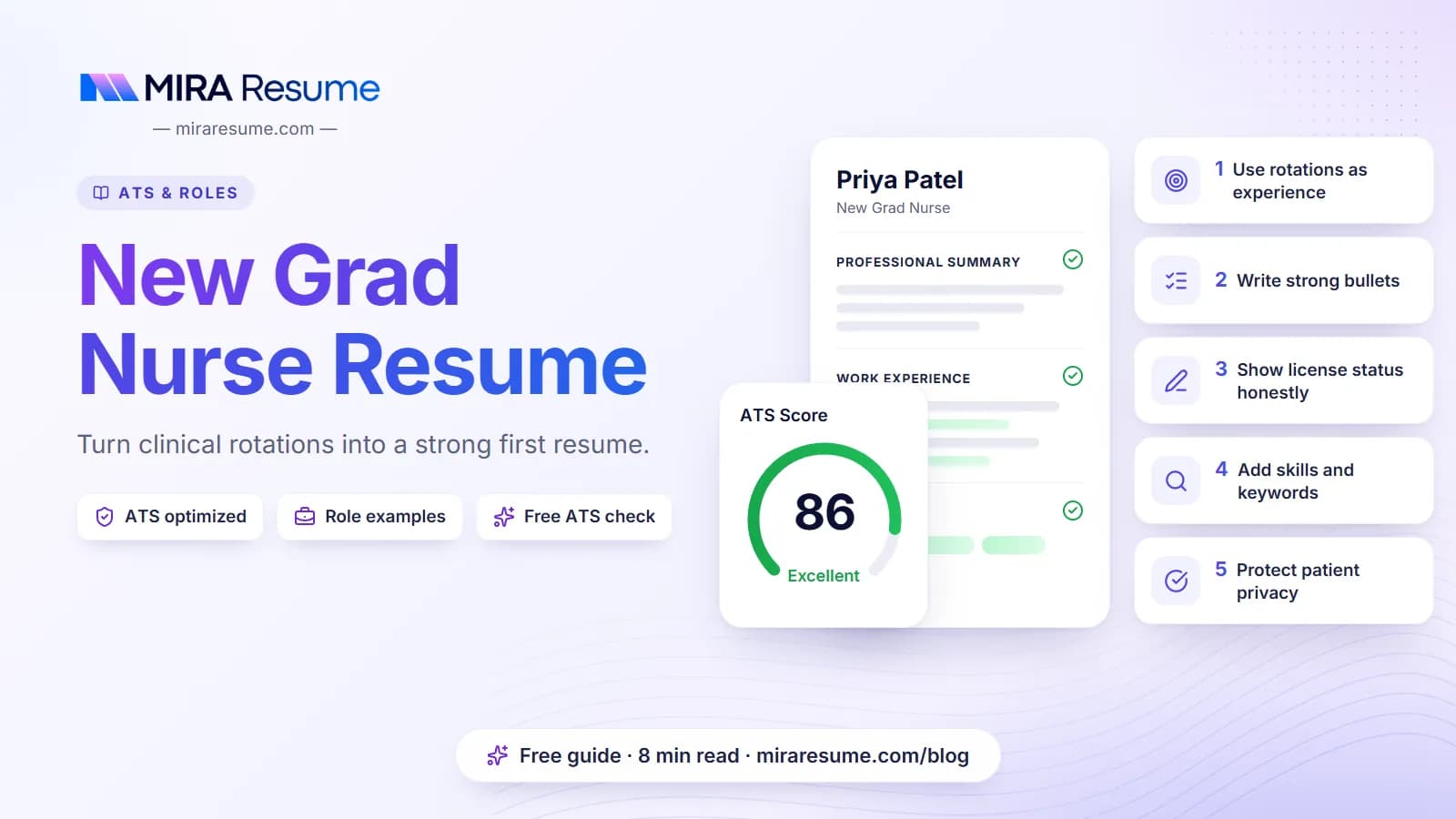

If you just finished nursing school, your new grad nurse resume has a different job than a seasoned nurse's. It cannot rely on past hospital jobs. Instead, it should show that your clinical rotations taught you real bedside skills, that you work well on a team, and that you are ready to learn.
Here you will learn how to turn rotations into bullets, how to show license status when you are still waiting on results, and how to lay out each section. A nurse who already has years of hospital time should read our registered nurse resume page instead.
Your clinical rotations are your work experience
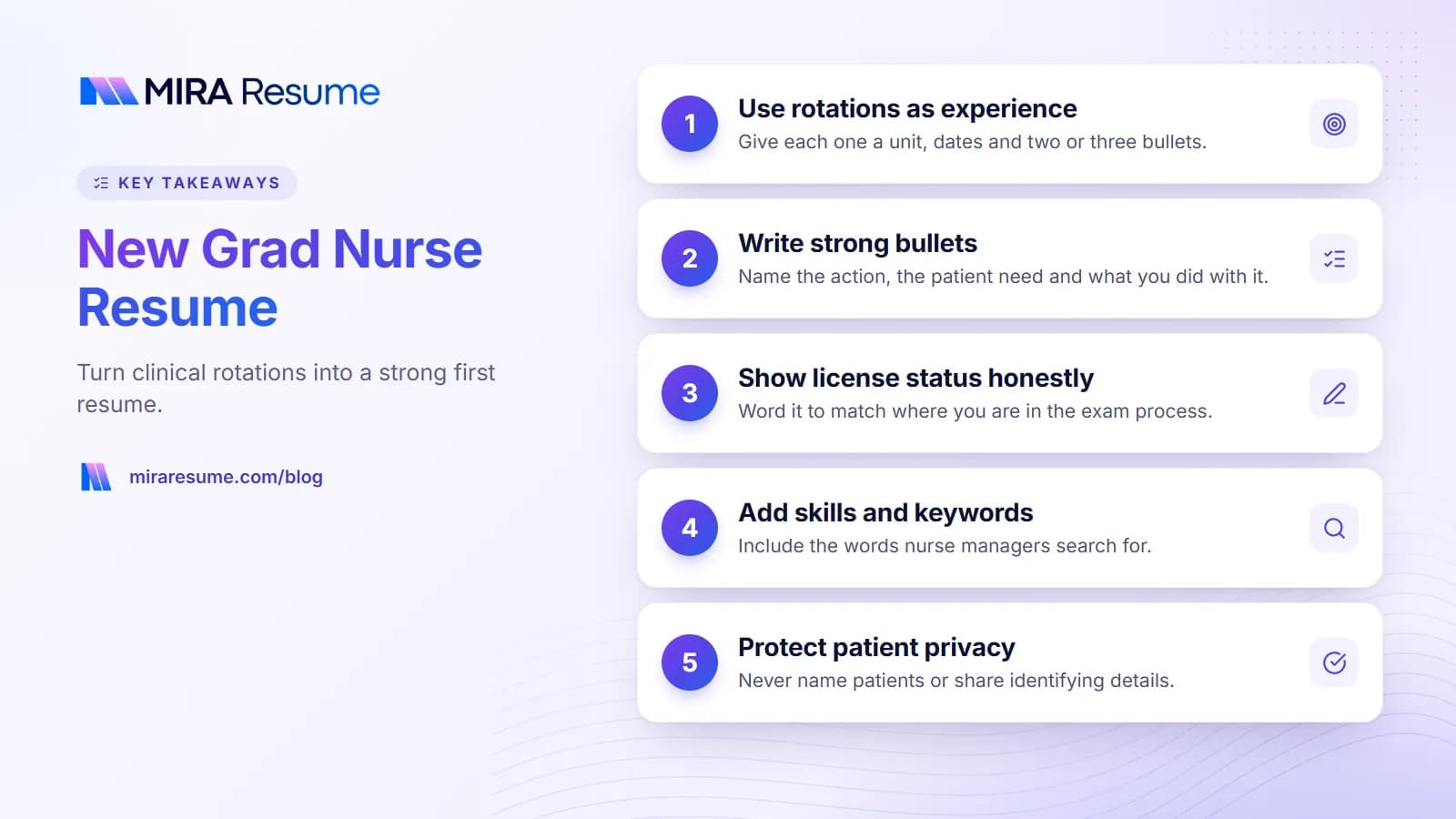
Hiring managers know new graduates have not held a nursing job yet. They also know you spent hundreds of hours with real patients. The goal is to show what you learned there in clear, short language.
Treat each rotation like a small job. Give it a title, a place type, dates, and two or three bullets. Do not name real patients or share any private details. You can name the facility type (for example, "medical-surgical unit at a community hospital") or the actual hospital if your school allows it and the job post makes it useful.
What a rotation entry needs
- Unit and setting: medical-surgical, pediatrics, maternity, mental health, emergency, community health, and so on.
- Dates and hours: total clinical hours if your school tracks them.
- What you did: care tasks, tools, and teamwork, written as actions.
- Who you worked with: nurses, providers, therapists, families.
Your hospital will likely hire from a short list, so give them the reasons you should be on it. If you want a general look at how a hiring tool scans a page, see how an applicant tracking system works.
A table to translate clinicals into resume lines
Use this table as a starting point. Match each rotation to the tasks you truly did and the words nurse managers search for.
| Rotation | What you may have practiced | Resume wording idea |
|---|---|---|
| Medical-surgical | Vital signs, head-to-toe assessment, medication passes with an instructor, wound care, charting | Provided care for [number] patients under a preceptor, documenting assessments and care in the electronic record |
| Pediatrics | Age-based assessment, family teaching, growth and safety checks | Explained care steps to children and parents in simple words and recorded responses |
| Maternity and newborn | Postpartum checks, newborn care support, breastfeeding education | Supported postpartum patients and newborn checks, teaching families about safe care at home |
| Mental health | Therapeutic communication, safety checks, group sessions | Used calm, respectful communication with patients in crisis and joined group sessions led by staff |
| Emergency or critical care | Observation, monitoring, triage support, teamwork in fast settings | Observed and assisted with monitoring in a fast-paced unit, escalating concerns to the nurse right away |
| Community or public health | Screenings, health teaching, home or clinic visits | Led a short health talk on [topic] and helped with screenings at [site type] |
| Leadership or capstone | Care planning, delegation practice, a quality project | Completed a capstone on [topic], presenting findings to unit staff |
Always say "under supervision" or "with a preceptor" when that is true. It is honest, and managers expect it. Do not list a task you only watched as something you performed.
Before and after: writing strong clinical bullets
New grads often write bullets that sound like a school syllabus. The fix is to name the action, the patient need, and what you did with the information. Square brackets mark facts for you to replace.
| Weak bullet | Stronger bullet |
|---|---|
| Completed clinical hours | Completed [number] clinical hours on a medical-surgical unit, caring for adults with heart, lung, and post-surgery needs |
| Took vital signs | Recorded vital signs and reported changes to the nurse in charge, so concerns were handled early |
| Gave medications | Prepared and gave medications with an instructor, checking the five rights before every dose |
| Learned charting | Documented assessments and care in the electronic health record using [system name, if known] |
| Taught patients | Taught patients and families about medicines, diet, and warning signs, using plain language and teach-back |
| Worked on a team | Joined shift handoff and care team huddles, sharing updates on assigned patients clearly and briefly |
For more verb ideas beyond "assisted" and "helped," check our list of action verbs for resume bullets. Quick drafts can come from the AI bullet enhancer, but always review for accuracy, since patient safety words matter in nursing.
How to show your license and exam status honestly
This is the part new grads worry about most. The right wording depends on where you are in the process. Licensing rules differ by state or country, so check with your board of nursing and your school for the exact steps.
| Where you are | Safe way to write it |
|---|---|
| Still in school, graduating soon | "Bachelor of Science in Nursing, Example University, expected May 2027" |
| Graduated, exam not yet taken | "RN license: NCLEX-RN scheduled for [month, year]" |
| Graduated, waiting for results | "NCLEX-RN taken [month, year]; results pending" |
| Passed and licensed | "Registered Nurse (RN), State of [state], License #[number if you are comfortable sharing], issued [year]" |
| Applying in another state | "RN license in [state]; applying for license by endorsement in [state]" (only if it is true) |
Never write that you are an RN before you hold the license. Boards and employers treat that very seriously. Many hospitals hire new grads with a start date tied to licensure, and they ask for proof.
Other credentials to list
- Basic Life Support (BLS) from a recognized provider, with the expiration date.
- Advanced cardiac or pediatric life support, if you hold it.
- Any state-level nursing assistant certificate you earned before nursing school.
For ways to lay out credentials, read how to list certifications on a resume. If you were a nursing assistant first, our CNA resume examples show how to describe that work.
Skills and keywords for a new grad RN resume
A new grad RN resume should include a skills list that mirrors the job post. Look for the unit name and the common phrases in the description, then use the same words where they honestly fit.
| Skill group | Examples |
|---|---|
| Assessment | Head-to-toe assessment, vital signs, pain assessment, patient monitoring |
| Procedures practiced | Medication administration (with supervision), wound care, IV care basics, catheter care, specimen collection, as taught in your program |
| Documentation | Electronic health records (name the system), care plans, shift reports, SBAR handoff |
| Safety | Infection prevention, fall prevention, patient identification, HIPAA, medication safety |
| Communication | Patient and family teaching, therapeutic communication, interprofessional teamwork, interpreter use |
| Personal strengths (shown, not claimed) | Time management across several patients, calm in busy settings, quick to ask questions |
List skills in a compact block, then show them again in your rotation bullets. This gives the software a chance to find the words twice and gives a human reader proof. Our overview of skills to put on a resume goes deeper on picking and ordering.
New grad nurse resume sample layout
Below is the section order that works well for most new graduates. The person and school are made up, so only copy the structure.
1. Header
Casey Rivera, BSN
City, State | 555-555-0188 | [email protected]
2. Short summary
Recent nursing graduate with [number] clinical hours across medical-surgical, pediatric, and community settings. Calm, careful, and eager to grow on an acute care team. NCLEX-RN scheduled for [month, year].
See more phrasing in our resume summary examples, or try an objective if you prefer, using the resume objective examples.
3. Licensure and certifications
NCLEX-RN: scheduled for [month, year]
BLS for Healthcare Providers, [issuer], valid through [year]
4. Education
Bachelor of Science in Nursing, Example University, City, State, May 2027
GPA: add only if it is strong; honors or Dean's List if earned
5. Clinical experience
Medical-Surgical Clinical Rotation, Example Community Hospital, 2026
- Cared for [number] adult patients per shift under a preceptor, recording vitals and assessments in the electronic record
- Taught patients about medicines and warning signs using plain words
Pediatric Clinical Rotation, Example Children's Clinic, 2026
- Completed age-based assessments and explained care steps to children and families
6. Work history and leadership
Add part-time jobs, even if they are not in healthcare. Waiting tables, retail, or caregiving all show people skills and stamina. Also add nursing club roles, volunteer hours, and any research or capstone work.
Make it distinct: prior jobs, school roles, and externships
Many new graduates had jobs before or during school. Do not hide them. They show you can show up, handle pressure, and talk to the public. Here is how to rank what you have.
- Healthcare jobs first: nursing assistant, patient care tech, medical scribe, EMT, or similar roles go right under your clinical rotations.
- Nurse extern or intern roles: list these as real work, with the employer name and dates.
- Customer-facing jobs: retail, restaurant, or hospitality bullets that show service, speed, and teamwork.
- School leadership: student nurse association, peer tutor, lab assistant.
- Volunteer work: health fairs, blood drives, community clinics.
Nurse residency programs
If you are applying to a nurse residency or new-graduate program, read the posting for its stated goals, and use the same themes in your summary where they honestly fit. Many programs mention learning, teamwork, and patient safety. Show those themes with real examples from clinicals.
Keep it to one page
A single clean page is the norm for new graduates. If it spills over, shorten older jobs and keep only the most relevant clinical entries. Our page on how many pages a resume should be explains why short and focused wins.
Common new grad nurse resume mistakes
- Calling yourself an RN too early. Use "expected" or "pending" until the license is issued.
- Sharing patient details. Never include names, ages that could identify someone, or specific case stories.
- Listing only school courses. A list of class names says little. Show what you did in clinical settings.
- Overstating what you did alone. "Performed surgery assist" is not right if you observed. Use accurate verbs like observed, assisted, or performed under supervision.
- Using a fancy design. Hospitals often run resumes through software, and columns, icons, and images can break the reading order. Try a plain format from our resume templates.
- Leaving out soft evidence. Precepting feedback, attendance, or teamwork examples help a lot when you lack job titles.
- One resume for every unit. Adjust your summary for the unit type, such as emergency, oncology, or labor and delivery.
Final checks and next steps
Before you apply, run through this short routine.
- Copy the job post and highlight the unit, skills, and credentials it lists.
- Edit your summary and skills so that true matches show near the top.
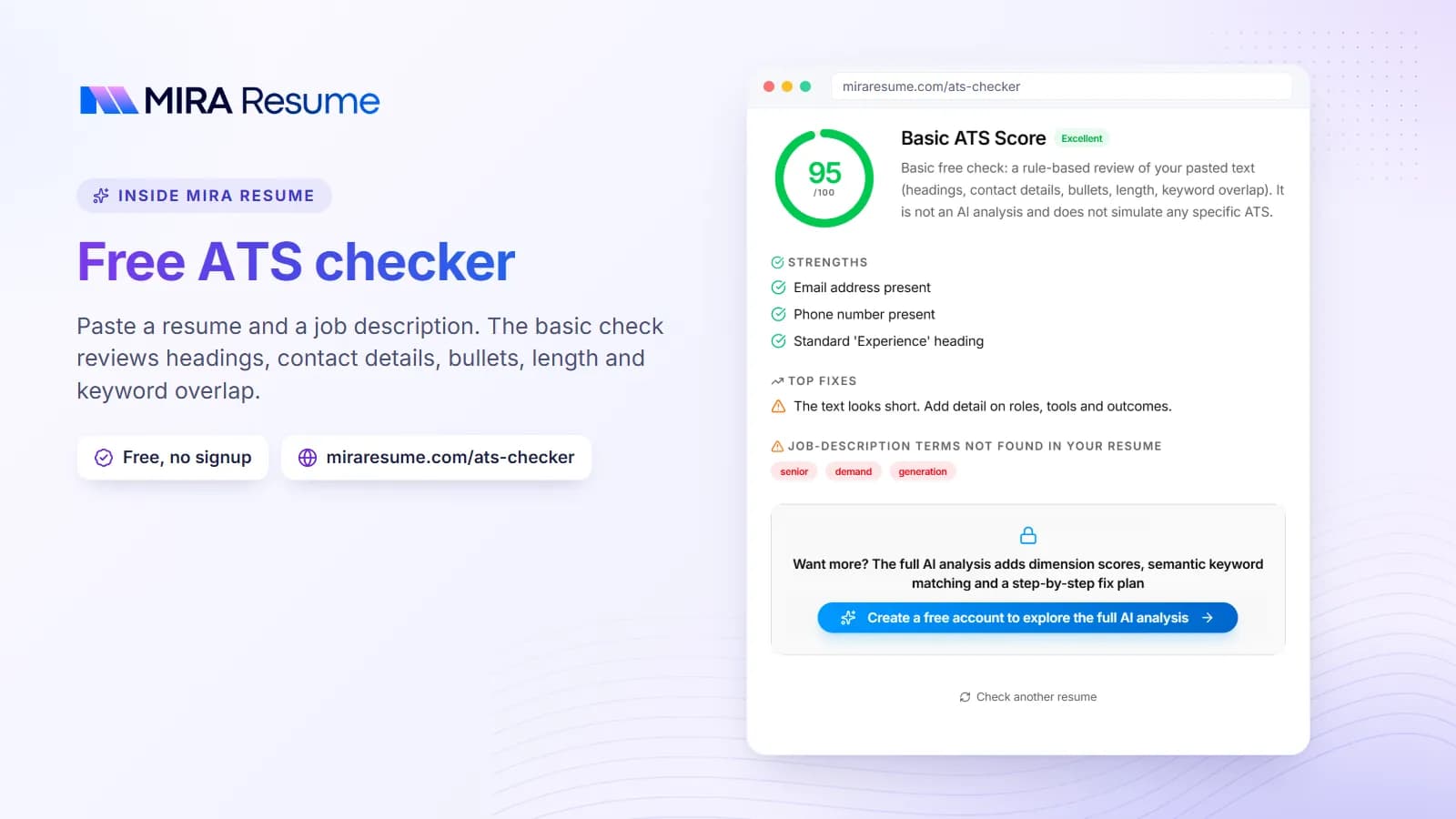
- Check your resume with the ATS checker to catch missing keywords and formatting issues.
- Ask a nursing instructor or preceptor to review for accuracy.
- Write a short cover letter. Our cover letter with no experience guide helps when you lack job titles.
If you want a starting layout, the AI resume builder can create sections for you to fill with your own facts. Keep a master document of every rotation and skill so you can tailor quickly for each hospital.