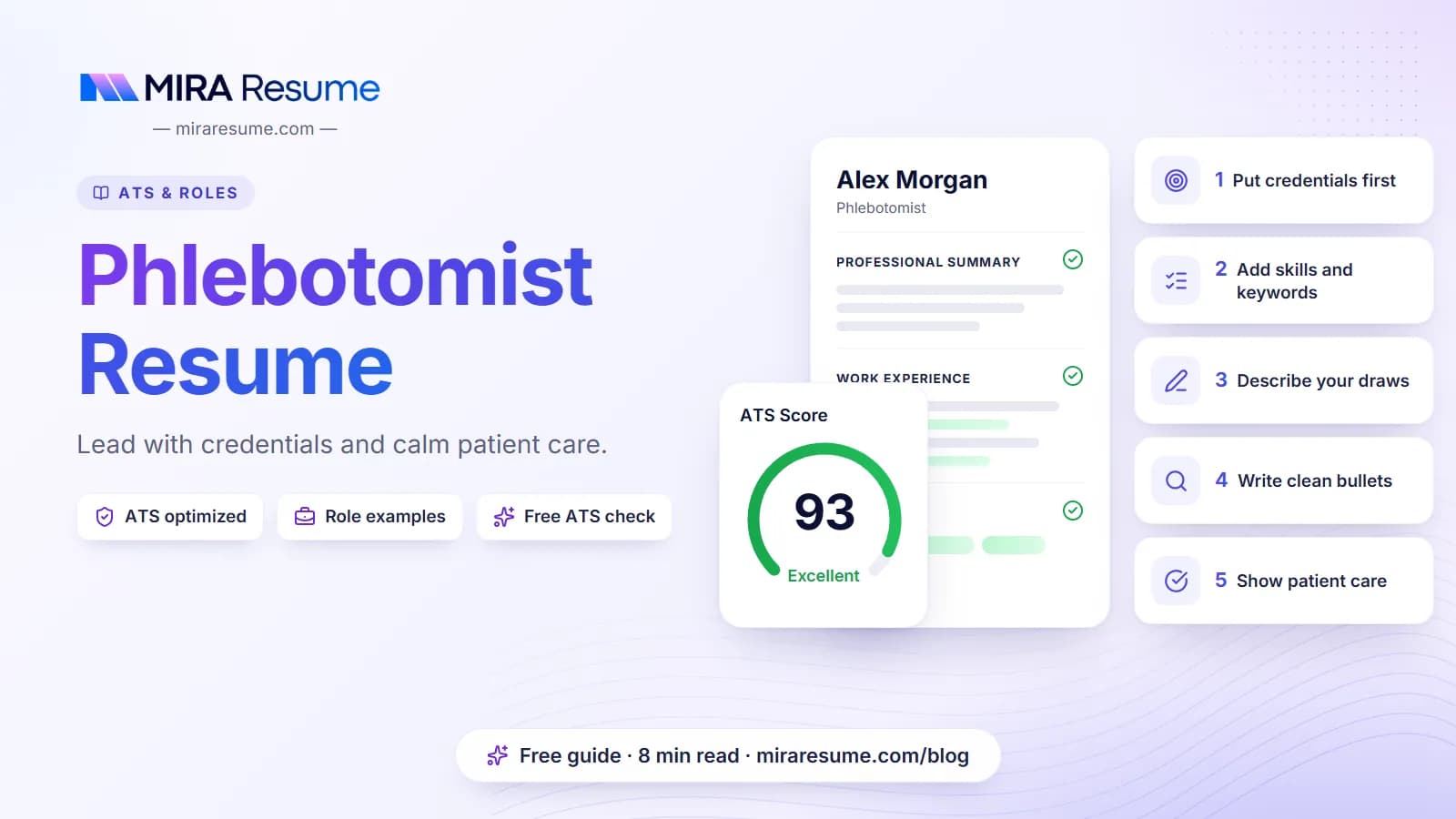

Labs, hospitals, and clinics read each phlebotomist resume for the same few things first: your training or certification, your hands-on draw experience, and your safety habits. After that, they look at how you handle patients who are scared, in pain, or in a hurry.
This guide is built around those priorities. You will see which credentials to place first, how to describe draws without exaggeration, a skills table, a sample layout, and tips for starting out. If you also have front-office duties, our medical assistant resume guide covers that mix.
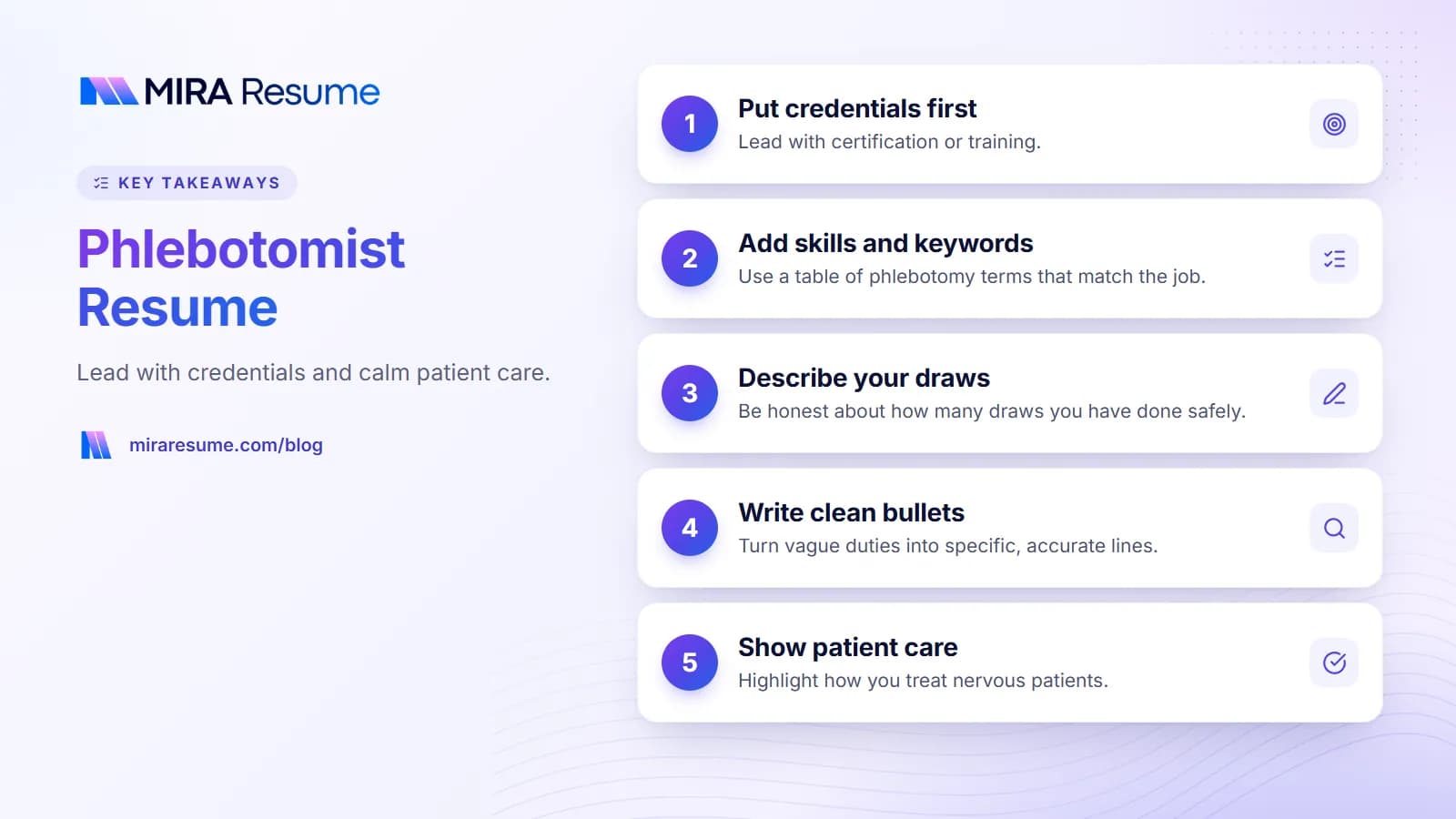
Put your credentials first
In this job, training and credentials matter a lot, so many strong resumes start with them right under the summary. Rules differ. Some states require a license or certification to draw blood, and others leave it to the employer. Check your state and the job post before you apply.
Credentials to name clearly
- Phlebotomy certification: the full credential name (such as "Certified Phlebotomy Technician"), the issuing group, and the year. Several national groups offer these exams.
- State license or permit: in states that require one, add the state name and, if you are comfortable, the license number.
- Program completion: the school, the program name, and the date, plus your supervised clinical hours if you know them.
- Basic Life Support (BLS) or CPR: with the expiration year.
- Other training: bloodborne pathogens safety, infection control, or specimen handling courses.
If you are not yet certified
Be upfront. Write "Certification exam scheduled for [month, year]" or "Completed training program, certification in progress." Hiring teams respect honesty, and some employers hire trainees. Never list a credential you have not earned. See our short guide on how to list certifications on a resume for layout tips.
Phlebotomist skills and keywords table
Most postings use similar terms, so matching the exact words matters for software that sorts resumes. Use the table to find honest keywords for your work.
| Skill group | Keywords | Tip |
|---|---|---|
| Blood collection | Venipuncture, capillary (fingerstick) collection, heel stick, butterfly needle, vacuum tube system | Say which patient types: adults, children, older adults |
| Specimen handling | Labeling, order of draw, specimen transport, centrifuge use, chain of custody | Show how you prevented mix-ups |
| Safety | Infection control, sharps safety, standard precautions, PPE, OSHA, bloodborne pathogens | Link safety words to a daily habit |
| Patient care | Patient identification, patient comfort, calming anxious patients, pediatric draws, difficult veins | Give a short example |
| Records and systems | Laboratory information system (LIS), electronic health record (EHR), data entry, HIPAA | Name the system if you know it |
| Work settings | Hospital lab, outpatient clinic, blood donation center, mobile draws, mobile health events | Mention the settings you worked in |
| Soft skills | Steady hands, clear speech, patience, speed under pressure, teamwork | Show, do not just claim |
For a broader approach to choosing and arranging your list, read about skills to put on a resume.
How to describe your draw experience honestly
Managers love numbers in phlebotomy, but they also spot exaggeration. Stick with figures you know or can estimate fairly, and use the word "about" for estimates.
| What to measure | Example wording | Use it when |
|---|---|---|
| Draws per shift or day | Completed about [number] blood draws per shift | You did routine daily collections |
| Total supervised draws in training | Completed [number] supervised venipunctures and [number] capillary sticks during training | You are new and your program tracked counts |
| Patient groups | Drew blood from adults, children, and older patients, including those with hard-to-find veins | You truly drew from those groups |
| Settings | Worked in an outpatient lab and on hospital inpatient floors | You rotated across areas |
| Accuracy or quality | Followed labeling steps on every tube to prevent errors | You can describe the steps |
| Speed and flow | Kept waiting-room lines moving during morning rush | You handled busy periods |
Avoid claiming a perfect record, such as "never missed a vein," since nobody can honestly say that. Better to write about your method, your care, and your calm.
Safe ways to talk about difficult draws
You can say "skilled with difficult veins and anxious patients" if it fits. Back it up with a short detail, such as using warm packs, choosing the right needle size, or talking a nervous child through the process.
Before and after: phlebotomist bullet points
Placeholders in brackets are for your real numbers. If you do not know a number, remove it and keep the detail.
| Weak bullet | Stronger bullet |
|---|---|
| Drew blood | Performed about [number] venipunctures per shift on adult and pediatric patients in an outpatient lab |
| Labeled tubes | Verified two patient identifiers and labeled each tube at the bedside to prevent specimen mix-ups |
| Good with patients | Explained each step in simple words, helping nervous patients stay calm and still during the draw |
| Followed safety rules | Practiced standard precautions and safe sharps disposal on every draw and kept the collection area clean |
| Used the computer | Entered patient orders and specimen details in the laboratory information system with attention to accuracy |
| Worked fast | Handled morning lab rush, keeping waits short without rushing patient care |
| Helped at blood drives | Supported community blood drives by screening donors for forms, caring for donors after donation, and keeping supplies stocked |
Verbs to try: collected, verified, labeled, prepared, documented, educated, comforted, followed, maintained. Our list of action verbs for resume bullets goes further. You can also paste a rough bullet into the AI bullet enhancer for a cleaner draft, then verify that every statement is true.
Phlebotomist resume sample, section by section
The person and employers below are invented. Take the order and tone, not the details.
Header
Sam Okafor, CPT
City, State | 555-555-0119 | [email protected]
Only add letters after your name if you hold that credential.
Summary
Certified phlebotomy technician with 2 years of outpatient lab experience. Skilled in venipuncture and capillary collection for adults and children, with careful labeling and a calm, friendly manner. Comfortable with early shifts and busy walk-in hours.
See more openers in our resume summary examples.
Certifications
Certified Phlebotomy Technician (name the credential), [issuing group], [year]
BLS for Healthcare Providers, valid through [year]
Experience
Phlebotomist, Example Outpatient Laboratory, City, State, 2024 - Present
- Performed about [number] draws per shift on adult and pediatric patients
- Checked two patient identifiers and labeled each tube at the point of care
- Documented collections in the lab information system and passed specimens to the processing team
Education and training
Phlebotomy Technician Program, Example Career College, 2024
Clinical externship: [number] hours at Example Hospital Lab
Skills
Venipuncture | Capillary collection | Specimen handling | Patient identification | Infection control | LIS/EHR entry | Pediatric draws | Bilingual (name the language)
Keep it on one page. If you want a clean format, check our resume templates.
Phlebotomist resume with no experience
Every phlebotomist was once new. If you just finished a program, your training and externship are your experience, so list them like a job: place, dates, hours, and tasks.
What to include
- Your program name, school, and completion date.
- Clinical or externship hours, with the site type.
- The number of supervised draws you completed, if your program tracked it.
- Certification status: earned, scheduled, or in progress.
- Past jobs that show service, speed, and care: retail, food service, caregiving, or customer support.
Entry-level vs. experienced
| Part | New graduate | Experienced phlebotomist |
|---|---|---|
| Order | Summary, certification, training, skills, other work | Summary, experience, certification, skills |
| Bullet focus | Technique learned, safety habits, supervised draws | Daily volume, patient groups, settings, training others |
| Extra proof | Attendance, instructor feedback, volunteer work | Lead roles, quality work, special collections |
| Length | One page | One page; two only for long careers |
Link to a cover letter, too. If you have little work history, read our guide on cover letters with no experience. And if your hours were in a nursing assistant role first, our CNA resume examples may help you word that history.
Tailor your resume to the workplace
Phlebotomists work in several places, and each values different strengths.
| Setting | What matters most | What to highlight |
|---|---|---|
| Hospital | Inpatient draws, teamwork, timing | Bedside labeling, working with nurses, early morning rounds |
| Outpatient lab or clinic | Steady patient flow, customer care | Walk-in lines, routine panels, pediatric draws |
| Blood donation center | Donor screening and comfort | Donor care, forms, safety checks, reaction awareness |
| Mobile or home draws | Independence, travel, time management | Driving, safe transport of specimens, patient homes |
| Research or special collections | Following exact steps | Protocol use, careful records, timed draws |
Match your top bullets to the setting. If the post says "early morning inpatient rounds" and you did those, say so right in the first bullet. Keep a master copy of your tasks, then copy and trim for each application.
Show patient care, not only technique
Anyone can say they are gentle. The best phlebotomist resumes show how. Patients often arrive nervous, fasting, or in pain, and a calm draw can shape how they feel about the whole visit. Managers know this, so a few honest lines about your approach can set you apart.
Ideas for patient-care lines
- Explained each step before starting and checked comfort during the draw.
- Used distraction and clear speech to ease fear in children and first-time patients.
- Asked patients about past difficult draws and picked a site and needle that fit.
- Offered a seat or water after the draw and watched for dizziness before the patient left.
- Used an interpreter service or simple words when a patient spoke limited English.
Use only what you truly did. One or two lines like these in your top role are enough, and they pair well with your technical bullets.
Common phlebotomist resume mistakes
- Hiding the certification. Make it easy to find near the top.
- Claiming tasks outside your training. Only list what you were trained and allowed to do in your state.
- Giving no sense of volume. Without numbers or scope, a reader cannot judge your experience.
- Using only soft words. "Compassionate" and "caring" are better when shown with an example.
- Including patient information. Never include names or details that could identify someone.
- Fancy layouts. Graphics and columns may confuse hiring software. Read how applicant tracking systems read resumes before you design.
- Typos in labels. A job built on accuracy needs a clean resume.
Final checklist before you apply
- Copy the job post and mark the credentials, settings, and systems it names.
- Check that your certification, BLS, and dates are accurate and easy to see.
- Match your skills and top bullets to the post, keeping only true statements.
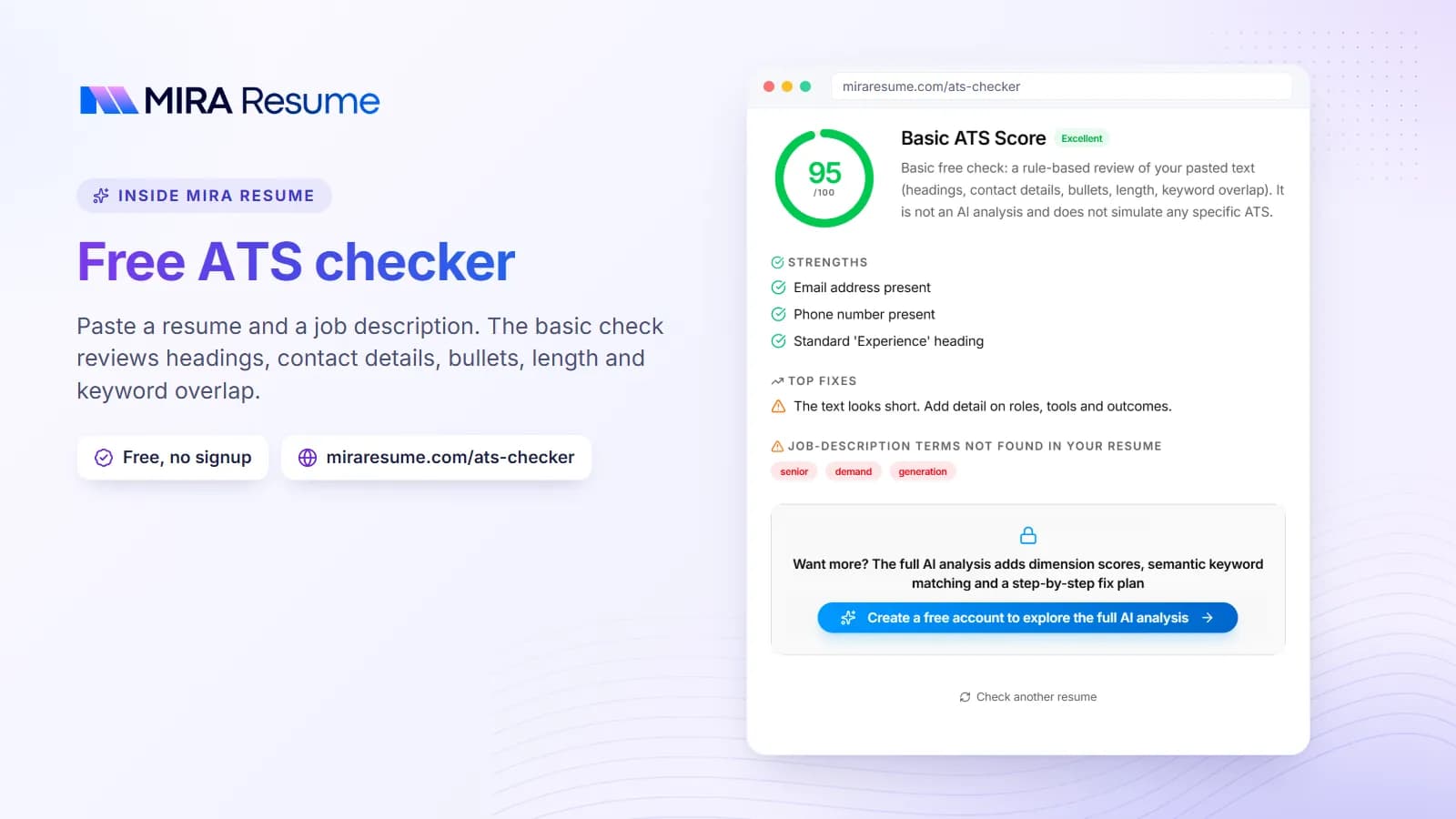
- Run your resume through the ATS checker to find missing keywords and layout issues.
- Save as a PDF with a clear name and add a short cover note if the employer allows it.
If you want to start from a clean structure, the AI resume builder sets up sections you can fill with your own facts.