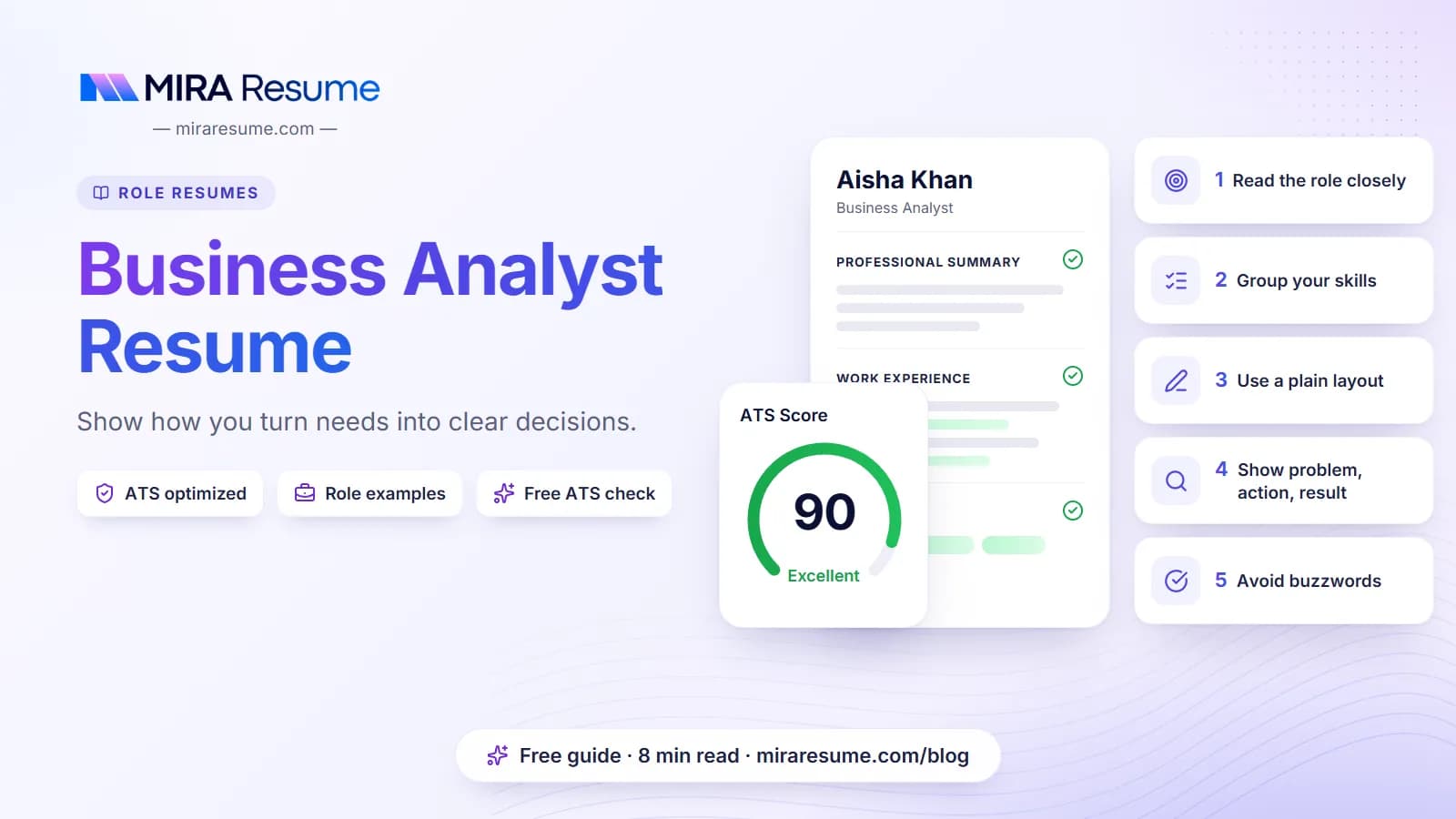

A business analyst resume proves one thing: you can take a fuzzy business problem, find the facts and help people agree on a fix. Hiring managers want to see the questions you asked, the data you used and what changed after your work. A list of meetings you attended does not show that.
Below you will find a simple layout, a skills table, before and after bullets, and notes for entry-level and experienced analysts. Every example uses placeholders in [brackets], so you can add your own true details.
What hiring managers look for in a business analyst
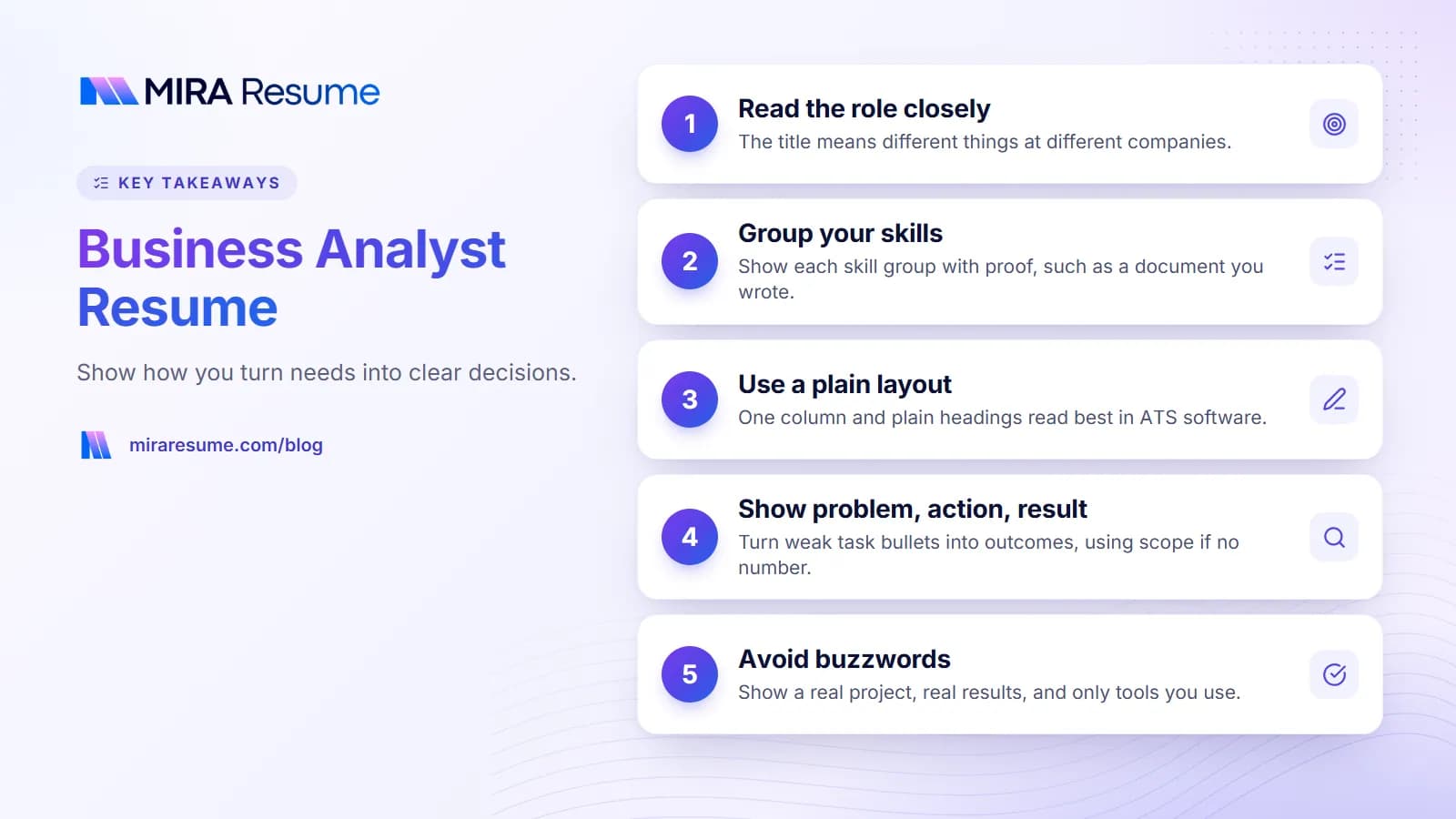
The title "business analyst" means different things in different companies. In one place it is mostly spreadsheets and reports. In another it is mostly talking to users and writing requirements. Read the job post and decide which side it leans toward, then lead with that side.
Most posts ask for four things: understanding the problem, working with data, writing things down clearly, and getting people on the same page. Your resume should give a small piece of proof for each.
Three questions to answer on your page
- What kind of problems have you worked on (cost, delays, customer complaints, a new system)?
- What did you do with data, documents or interviews to understand them?
- What happened afterward (a decision, a launch, time saved, errors reduced)?
If you can answer those three in each bullet, you are ahead of most applicants. If you are not sure how to build bullets from stories, try the STAR method for resumes.
Business analyst skills to put on your resume
Group your skills so a quick reader finds them. Use only what you can talk about in an interview.
| Skill group | Examples | Show it with |
|---|---|---|
| Requirements | Interviews, user stories, process maps, acceptance criteria | A bullet naming the document you wrote and who used it |
| Data and reporting | SQL, Excel, Power BI, Tableau, dashboards | A bullet with the question you answered and the tool |
| Process work | Process improvement, gap analysis, workflow mapping | Before and after of a process step |
| Delivery methods | Agile, Scrum, Kanban, Waterfall | The team size and how you took part |
| Tools | Jira, Confluence, Visio, Lucidchart | Skills line and project bullets |
| Soft skills | Facilitation, listening, writing, negotiation | Stories, not just the words |
For a broader set of ideas, see good skills to put on a resume, hard skills examples and transferable skills examples. If your career began in another job, the last one matters a lot.
How to place keywords naturally
Copy the exact skill names from the post into your skills section when they are true, such as "requirements gathering" or "stakeholder management". Then prove each one in a bullet. Our guide to resume keywords explains how to do this without stuffing.
Sample business analyst resume layout
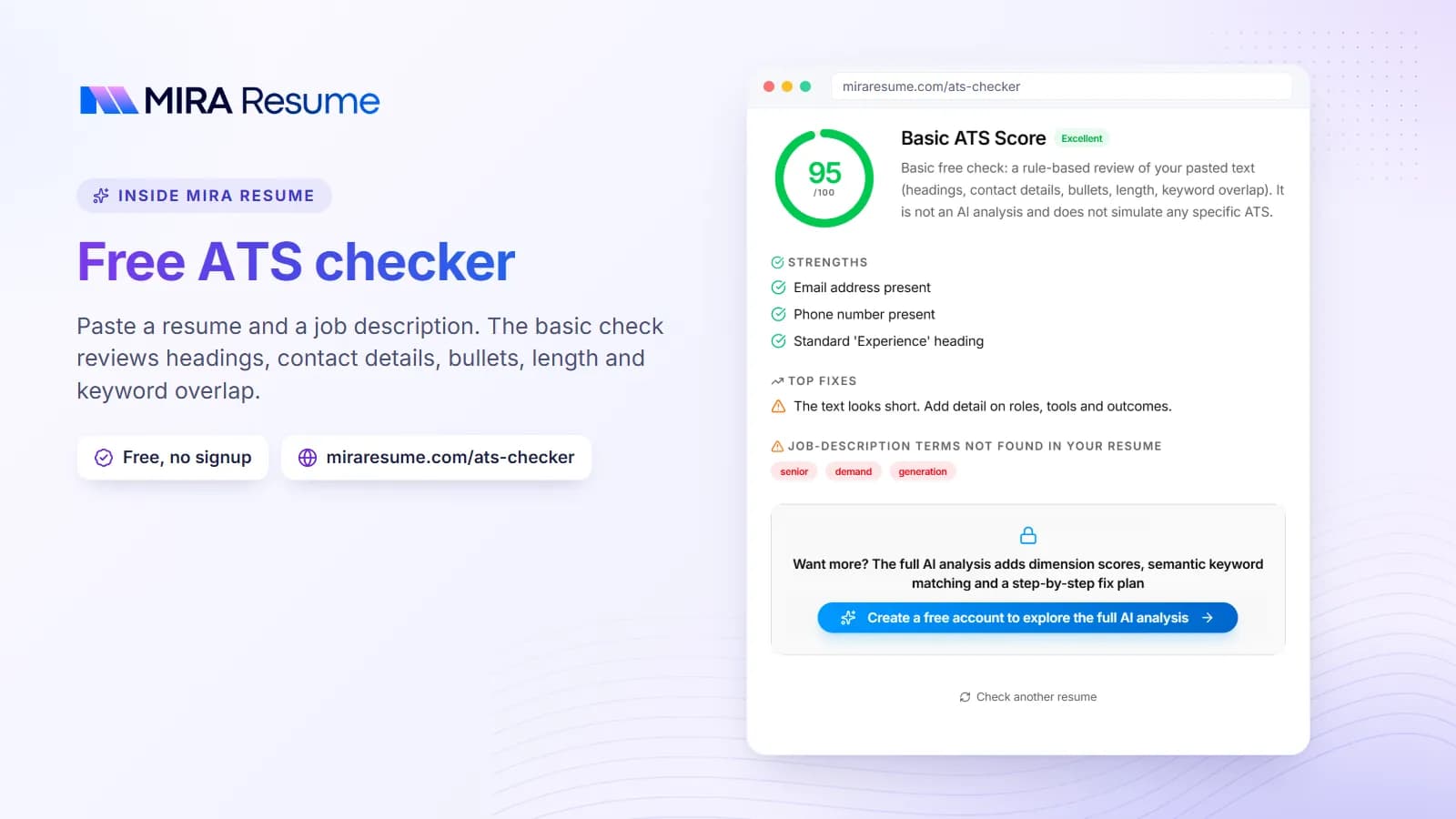
Use one column and plain headings. Applicant tracking systems read this best. If you want to test yours, run it through the ATS checker.
[Your Name]
[City, State] | [Phone] | [Email] | [LinkedIn URL]
Summary
Business analyst with [X] years in [industry]. Skilled at [requirements gathering] and [data analysis with tool]. Helped [team type] deliver [result].
Skills
Requirements gathering, process mapping, SQL, [BI tool], Jira, Agile, stakeholder communication
Experience
[Job Title], [Company] | [Dates]
- [Bullet with action, method and result]
- [Bullet with action, method and result]
Education
[Degree], [School], [Year]
Certifications
[Certification], [Year]
Summary examples
Business analyst with [X] years supporting [department] teams. Maps current processes, finds gaps and writes requirements developers can build from. Reduced [problem] by [number] at [company type].
Recent [degree] graduate with an internship in [area]. Comfortable with Excel, SQL basics and writing user stories. Looking for an entry-level business analyst role in [industry].
More wording ideas are in resume summary examples.
Business analyst bullet points: before and after
Weak bullets list tasks. Strong bullets show the problem, your action and the result. Replace each [bracket] with a real detail. If you do not have an exact number, describe the scope instead.
| Weak bullet | Stronger bullet |
|---|---|
| Attended stakeholder meetings | Interviewed [number] stakeholders across [departments] to define needs for [project], then wrote the requirements document used by [team] |
| Made reports in Excel | Built a [weekly or monthly] [tool] report on [metric] that helped [team] spot [issue] earlier |
| Helped improve processes | Mapped the [process name] workflow, found [number] delays, and proposed changes that cut [time or errors] by [number] |
| Worked with developers | Wrote [number] user stories with acceptance criteria and answered developer questions during [number] sprints |
| Tested new system | Planned and ran user acceptance testing with [number] users, logged [number] issues and confirmed fixes before launch |
Start bullets with active verbs such as analyzed, mapped, documented, led, clarified, and tracked. See action verbs for resume for more.
Add context when you cannot share numbers
Many analysts work with private data. You can still show scope: "for a team of [number] users", "across [number] regions", or "replacing a manual weekly process". Never invent numbers to sound better. A recruiter may ask you about each one.
Entry-level vs experienced business analyst resumes
Entry-level candidates have less work history, but many have project proof. Experienced analysts need to show growth. The comparison below can help you pick the right focus.
| Part | Entry-level | Experienced |
|---|---|---|
| Top of page | Short summary, then education and projects | Summary with domain focus, then work history |
| Proof | Internship tasks, class case studies, data projects | Delivered projects, process gains, team scope |
| Skills | Excel, SQL basics, documentation, one BI tool | Advanced SQL, BI, Agile delivery, stakeholder management |
| Length | One page | One to two pages |
No analyst title yet?
Many people become analysts from jobs in operations, support, finance or project coordination. Rename nothing, but describe your real duties in analyst terms: the data you pulled, the process you mapped, the requirements you helped write. A short note about the switch in your summary helps. For a move between fields, read about a skills-based resume, and for a first role, see entry-level resume examples.
Related roles
Analysts often work next to project managers and data teams. If your work leans that way, compare with our project manager resume and the data analyst resume guides.
Education, certifications and tools
Many analysts hold a degree in business, information systems, economics or a similar field, but it is not always required. Employers often care more about your proof of work. List your degree, school and year, then add any certificates you earned.
- Business analysis certificates from professional bodies, if you hold them
- Agile or Scrum training
- SQL, Excel or BI tool courses
Whether a certificate is needed depends on the employer, the industry and your country, so check each job post and verify requirements with the employer. Put the full name of each credential and the year. If one is still in progress, say "in progress" with an expected date. See how to list certifications on a resume for formatting.
A worked example: one project turned into three bullets
Seeing one project become resume lines makes the method clear. The story below is illustrative. Use it as a pattern, not as text to copy.
The story: A support team at a mid-sized company was getting many repeat questions. You were asked to find out why. You read a sample of tickets, interviewed a few agents, found the top causes, and wrote a proposal. The team changed a help page and a form, and repeat contacts dropped.
| Step you took | Resume bullet (fill in your facts) |
|---|---|
| Studied the data | Reviewed [number] support tickets in [tool] and grouped them into [number] root causes |
| Talked to people | Interviewed [number] agents and [number] team leads to confirm pain points and rank fixes |
| Proposed a fix | Wrote a [length] proposal for [change], approved by [role], that reduced repeat contacts by [number or range you can support] |
Notice that each line has a method (reviewed, interviewed, wrote), a scope (a number of tickets or people) and, in the last one, an outcome. If you cannot support an exact number, write "reduced repeat contacts" and be ready to explain how you know.
Prepare for interview follow-ups
Every bullet may become an interview question. For each one, prepare a thirty-second story: what the problem was, what you did, who you worked with and what happened next. This keeps you honest and calm. For more on that, see our follow-up email after an interview guide for the step after you talk to them.
Formatting details that help
- Use month and year for dates, and keep them in the same style throughout.
- Put your newest job first.
- Keep fonts to one family. See resume fonts for safe choices.
- Limit bullets to two lines each.
- Add a LinkedIn link if your profile is up to date. Read how to put LinkedIn on a resume for tips.
Common business analyst resume mistakes
- Buzzword soup. "Strategic thinker" and "synergy" prove nothing. Show a real project.
- No results. Say what changed after your report, not only that you wrote it.
- Too many tools. Keep the ones you really use and that the job post names.
- Hiding the data work. If you used SQL or a dashboard, say so in the bullet.
- Dense paragraphs. Use short bullets, three to five per job.
- Complex design. Skip tables inside the page, icons and charts. Plain text is easier for ATS to read.
- Not tailoring. A finance analyst post needs different keywords than a software one.
Before you send it, use our resume checker for a quick scan of format and keywords.
Build and tailor your resume faster
Start with a template that suits one-column reading, fill in the sections above, and save as a PDF. Our resume builder and resume templates give you a clean base. If you want help rewording bullets, the AI resume builder can suggest wording, and you decide what stays.
For each application, spend ten minutes on tailoring. Pick three skills from the post, make sure they appear in your skills line, and make sure at least one bullet proves each. Then reread the page for typos. You can also look at resume examples from other fields to see how bullets are shaped.
If you are applying through an online form, remember that some systems rank applicants by how closely the page matches the post. Read how ATS works to learn what that means in practice, without overthinking it.