
The best data analyst resume examples share one habit: they tie each tool to a business question and an outcome. "Used SQL and Excel" is a list of tools. "Wrote SQL queries that showed which product returns were rising, so the team could fix a packaging problem" is proof of work.
This guide shows a resume format for a data analyst, a table of skills and keywords, before-and-after bullets, and tips for people with no job experience yet. For software roles, see our software developer resume page.
What hiring managers look for in a data analyst resume
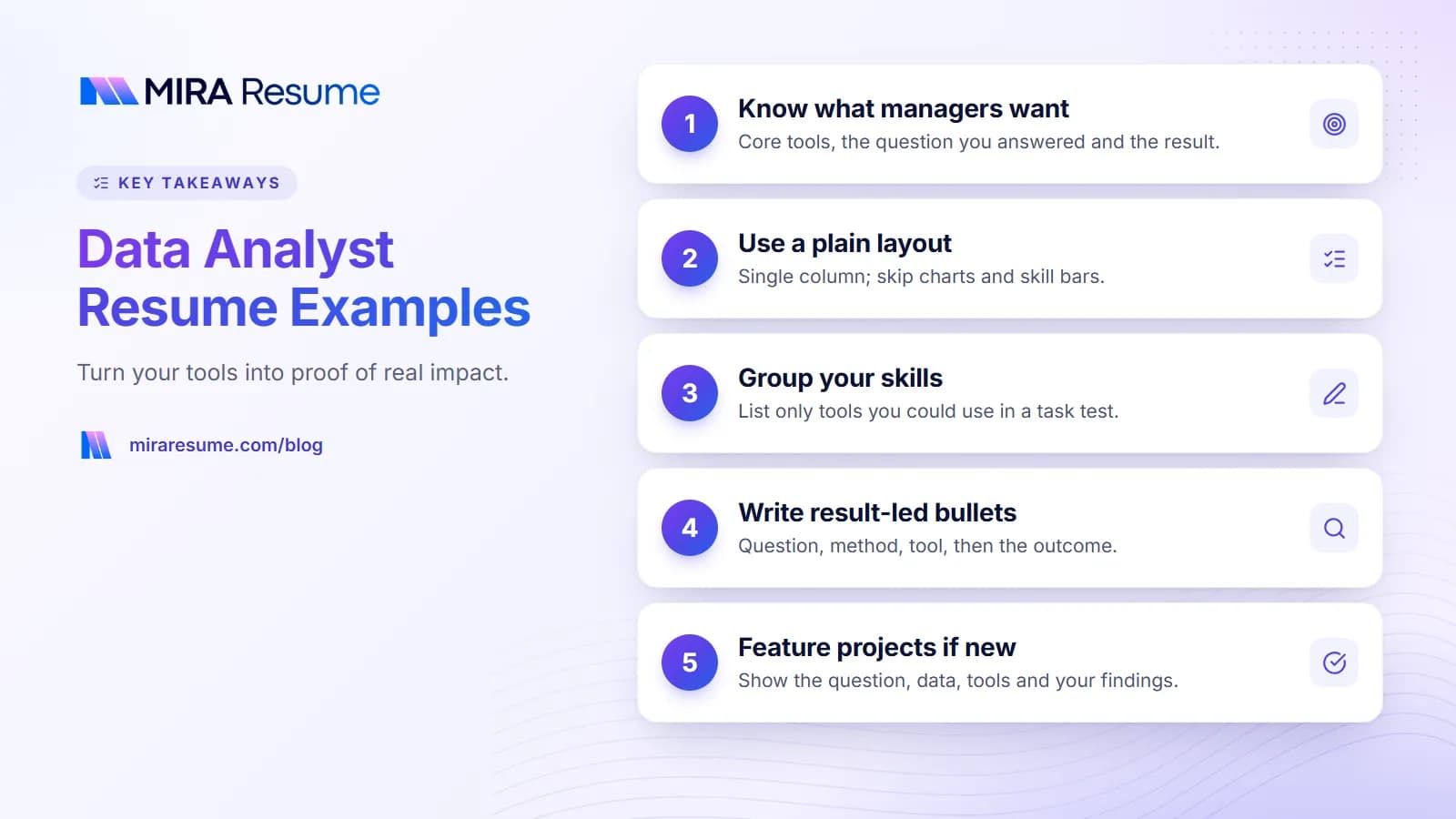
A data analyst job is a mix of technical work and communication. Managers read for both.
- Core tools. SQL, Excel or Google Sheets, and at least one reporting tool such as Tableau, Power BI, or Looker. Many roles also use Python or R.
- The question you answered. A short note on the problem: churn, sales trends, delays, costs, or customer behavior.
- The size of the data or audience. Rows, tables, dashboards, or the teams that used them.
- The outcome. A decision, a saved process, a changed policy, or a report people adopted.
- Clean communication. The ability to explain results to people who do not work with data.
Domain knowledge also helps. A marketing analyst, a finance analyst, and a healthcare analyst may use the same tools but ask different questions. Name your area.
Resume format for a data analyst
Use a single-column layout with standard headings. Dashboards, charts, and graphic skill bars look nice but can hide your text from applicant tracking systems. Put your numbers in words and bullets.
| Section | What goes in it | Tip |
|---|---|---|
| Header | Name, city, email, phone, LinkedIn, portfolio or GitHub link | Make sure links open |
| Summary | Role, years, tools, and a focus area | 2 to 3 lines |
| Skills | Grouped tools: Query, Analysis, Visualization, Other | Match the job post |
| Experience | Bullets with question, method, tool, and result | 3 to 5 bullets per job |
| Projects | Two or three that show full analysis work | Essential for beginners |
| Education and certificates | Degree, bootcamp, or course name and year | Add only relevant ones |
For basic layout rules, see how to format a resume. Most analysts fit well on one page.
Data analyst skills and keywords
Group your skills so a reader can scan them. Only list tools you could use in a task test.
| Group | Examples to consider | Best placement |
|---|---|---|
| Query and data work | SQL, joins, window functions, data cleaning, ETL basics, spreadsheets, pivot tables | Skills and bullets |
| Analysis | Descriptive statistics, A/B testing, regression, forecasting, cohort analysis, hypothesis testing | Bullets |
| Programming | Python (pandas, NumPy), R, notebooks | Skills and projects |
| Visualization and reporting | Tableau, Power BI, Looker, Excel charts, dashboards, KPI reports | Skills and bullets |
| Data platforms | BigQuery, Snowflake, Redshift, Google Analytics, CRM data (list only those you used) | Skills |
| Communication | Presenting findings, stakeholder meetings, documentation, data storytelling | Show it in bullets |
See our resume keywords and skills to put on a resume guides for how to choose and place them.
Data analyst resume example: a layout to copy
This data analyst resume sample uses an invented person and placeholders. Replace everything with your own facts.
Sam Patel
City, State | 555-555-0100 | [email protected] | LinkedIn | Portfolio linkSummary
Data analyst with [number] years in e-commerce reporting. Skilled in SQL, Python, and Tableau. Turns messy sales and customer data into clear weekly reports for non-technical teams.Skills
Query: SQL (joins, window functions), Excel
Analysis: A/B testing, cohort analysis, forecasting
Programming: Python (pandas)
Visualization: Tableau, Excel dashboardsExperience
Data Analyst, Example Retail Co., City, State, 2023 - Present
- Built a weekly sales dashboard in Tableau used by [number] team leads
- Wrote SQL to find why returns rose on [product group], leading to a packaging change
- Cleaned order data from [number] sources, cutting manual report time by [amount]
- Presented monthly findings to the marketing teamProjects
Customer Churn Analysis, personal project: cleaned [number] rows in Python, found three factors linked to churn, and shared a short write-up on GitHubEducation
Bachelor of Science in Statistics, Example University, 2022
Google Data Analytics Certificate, 2023
See more layouts in our resume examples.
Data analyst resume bullets: before and after
The strongest bullets follow this chain: question, method, tool, result. Use real numbers only, or leave them out.
| Weak bullet | Stronger bullet |
|---|---|
| Analyzed data | Analyzed [number] months of customer orders in SQL to find which segments reordered most, helping the team focus its email plan |
| Made dashboards | Built a Power BI dashboard tracking [metrics] that replaced a manual weekly report for [team] |
| Cleaned data | Cleaned and merged data from [number] sources using Python and pandas, fixing duplicates and missing values before analysis |
| Ran A/B tests | Designed and read out an A/B test on [feature], explaining the result and its limits to product managers |
| Worked with stakeholders | Met weekly with sales and finance leads to turn their questions into queries and shared results in plain language |
| Used Excel | Built Excel models with pivot tables and lookups to track budget against actuals for [number] cost centers |
For more verbs, use action verbs for resume bullets.
Be honest about limits
If you do not know the business impact, describe what the work enabled, such as "gave managers a single view of weekly sales." Never invent a result.
Entry-level data analyst resume
If you have no analyst job yet, projects and coursework are your proof. Treat them like real work.
| Source of proof | How to show it |
|---|---|
| Course or bootcamp projects | Name the question, the data source, your tools, and what you found |
| Personal projects | Use public data, share a GitHub or portfolio link, write a short summary |
| Internships | Show reports built, data cleaned, or teams supported |
| Work with spreadsheets in other jobs | Describe tracking, reporting, or forecasting tasks you did in operations, retail, or admin |
| Volunteer analysis | Nonprofit reports or survey analysis count as real work |
Layout for beginners
Put education and projects near the top, after the skills. Add a one-line summary naming the tools you use and the area you want to work in. See our computer science resume and IT resume examples for similar structures.
Choose projects that look like the job
Pick two or three that use SQL, a visualization tool, and clear writing. Quality matters more than quantity. Make sure the links work and that your write-ups explain the question and the finding.
Experienced data analyst resumes
With several years of experience, your resume should show growth in scope, not only in tools.
- Scope: number of teams, dashboards, or data sources you supported.
- Ownership: projects you led from question to final report.
- Influence: decisions that used your analysis.
- Mentoring: training junior analysts or documenting methods.
- Next-step skills: data modeling, automation, or experiment design.
Our guide on how to show a promotion on a resume helps display growth inside one company. If you are moving into a leadership role, see the project manager resume page for team and delivery language.
Data analyst resume sample: a project entry done well
Projects often decide entry-level resumes, so here is how to write one well. A good project entry has a name, a one-line question, your tools, and a result. This is an illustrative example.
Bike Share Usage Analysis, personal project
- Question: how do weekday and weekend rides differ across seasons?
- Cleaned [number] rows of public trip data using Python and pandas
- Wrote SQL queries to group trips by hour, season, and rider type
- Built a Tableau dashboard and a one-page summary with three findings
- Portfolio link: [your link]
| Project element | Why it matters |
|---|---|
| A clear question | Shows you start with a problem, not just a dataset |
| Named tools | Matches the keywords in job posts |
| Cleaning steps | Shows you know real data is messy |
| A finding in plain words | Shows you can communicate |
| A working link | Lets a manager check your work |
Common ways to choose a project topic
- Pick public data from a field you want to work in, such as health, sales, transport, or education.
- Ask a question a manager might actually ask, such as "which customers are most likely to leave?"
- Keep the scope small enough to finish. A finished small project beats an unfinished large one.
Certificates and bootcamps
List them under Education or Certifications with the name, the provider, and the year. They show effort, but projects and clear bullets carry more weight. Check each job post for degree or certification requirements, since they differ by employer.
Writing for non-technical readers
The first person to read your resume may be a recruiter, not an analyst. Use plain words for the outcomes and keep the tool names in a skills line. Write "found why returns were rising" before "ran a regression."
Common data analyst resume mistakes
- A tool list with no context. Add the question and the result beside each tool.
- Skill bars and charts. Ratings such as "SQL 80%" mean little and can break text reading in applicant tracking systems.
- Vague impact. "Improved efficiency" needs a what, who, and how much.
- Invented numbers. Only use figures you can explain in an interview.
- Dead portfolio links. Check every link before you send.
- Listing every tool you ever touched. Keep to the tools you could use in a test.
- Ignoring the job post. If a posting names Looker and you used it, say so. See how ATS works.
Final check before you apply
- Copy the job post and mark the tools, methods, and business areas it names.
- Update your skills, summary, and top bullets with the true matches.
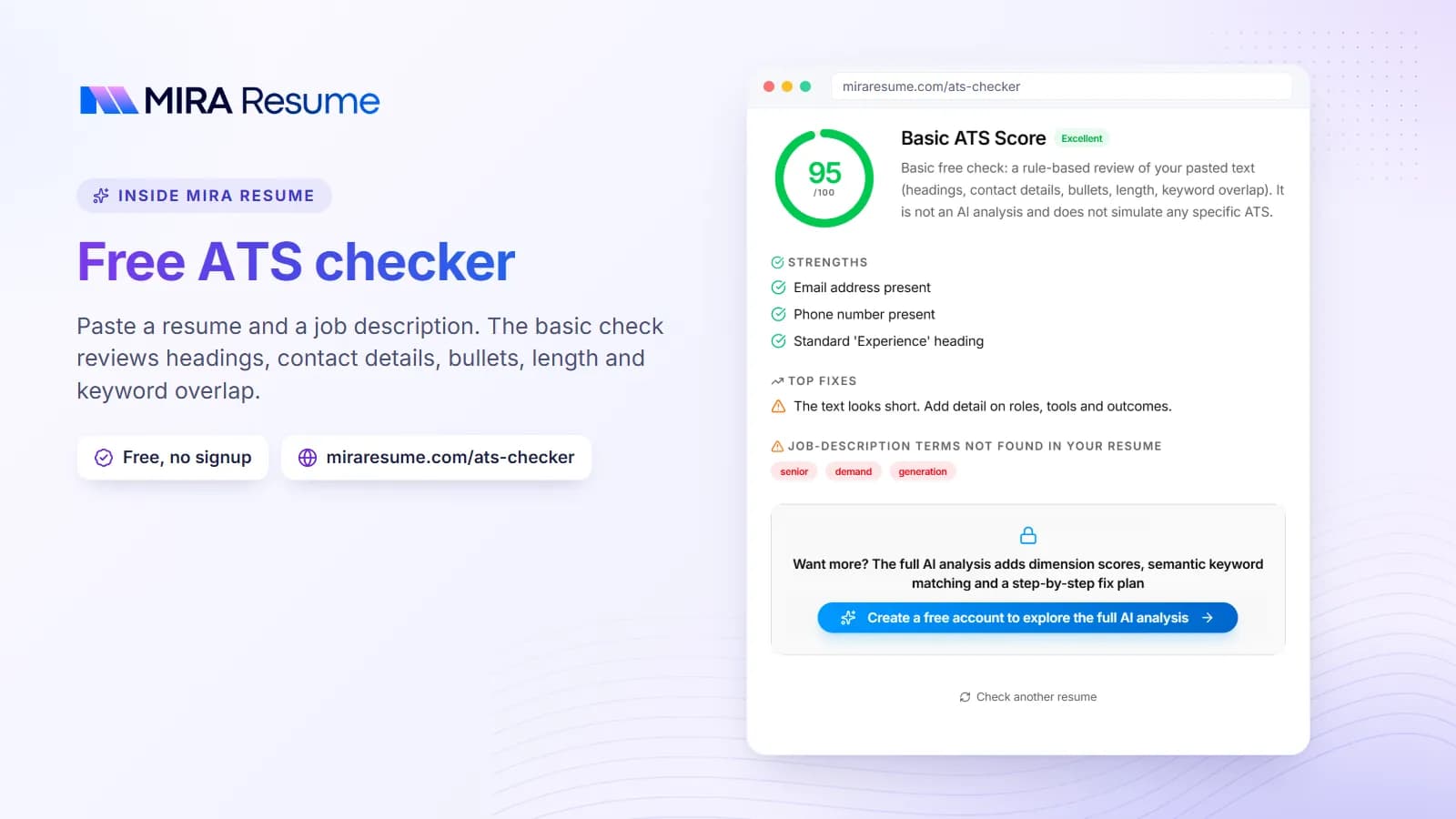
- Upload your resume to the ATS checker with the posting pasted in, and fix anything that reads badly.
- Save a PDF and open it on your phone to check that links and text look right.
If you want to start from a clean layout, the AI resume builder can set up the sections for you. Add your own projects and results.
Keep one master version
Analyst job posts vary a lot. One may stress dashboards and another may stress statistics or Python. Keep a master resume with every project, tool, and result. For each application, copy it and move the best matches to the top. Cut what does not fit. This keeps each version focused and saves time, and it lets you reuse strong bullets without rewriting them from scratch.
Be ready to talk through your work
Analyst interviews often include a case question or a task using real data. Practice explaining one project from start to finish: the question, the data, the steps, the finding, and what you would do next. Be honest about the limits of your data. Clear reasoning and plain language count for more than a long list of tools. Keep a short note on each project so you can describe it without hunting for details.