
Here is a quick example of summary in CV form: "Customer service professional with five years of experience in busy retail teams. Calm under pressure, clear in writing, and skilled at training new staff. Looking for a support team lead role." That is it. Three short sentences that tell a reader who you are, what you are good at, and what you want.
A CV summary (also called a profile, personal statement, or professional summary) sits right under your name. It is the first thing many people read, and sometimes the only thing they read before deciding to keep going. A weak one wastes that chance. A strong one makes your next lines easier to read.
This guide shows what to write in a CV summary, gives a simple formula, then offers 15 samples you can adapt. Everything is in plain language, and all examples are made up for teaching.
What a summary in a CV is, and what it is not
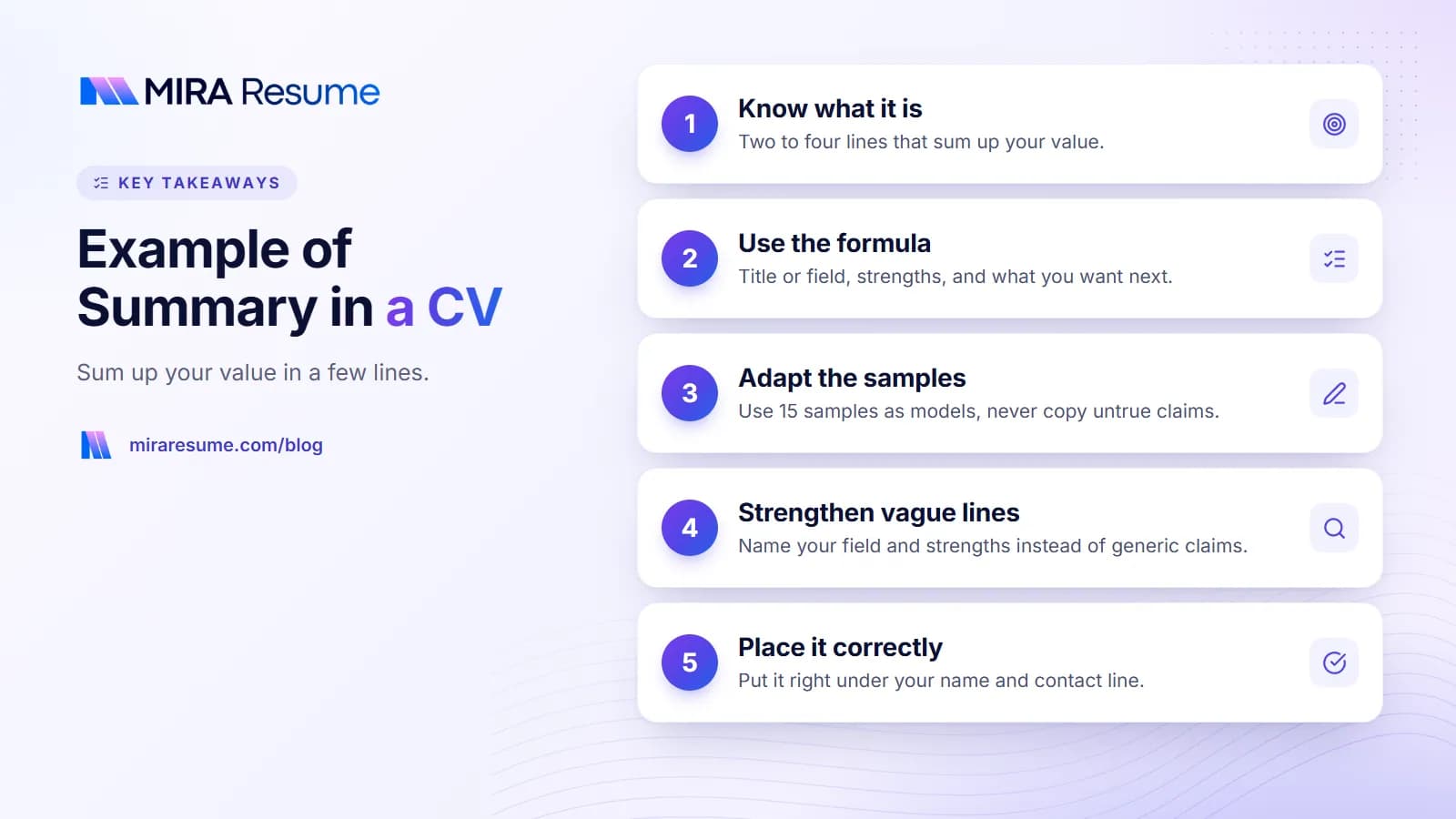
A CV summary is two to four lines that sum up your value. It answers three questions:
- Who are you, in work terms?
- What are you good at, and how can you show it?
- What do you want next?
Summary, profile, objective and personal statement
These words overlap, and people use them differently.
| Name | What it usually means | Where you see it |
|---|---|---|
| Professional summary | A short pitch based on your experience | US and international CVs |
| Profile or personal profile | The same idea, often a little more personal | UK and Ireland |
| Objective | A line about the job you want | Entry-level or career change |
| Personal statement | Can mean a short profile, or a long essay for university or graduate school | UK and academic settings |
| Research summary | Your field, methods and goal | Academic and science CVs |
If a form or a university asks for a personal statement, it may mean an essay of a page or more, not the short profile on your CV. Check the instructions.
For resume-style summaries, our resume summary examples and resume objective examples give extra ideas. If you are not sure which document you need, read about the difference between a CV and a resume.
What to write in a CV summary: a simple formula
Use this three-part pattern. Fill in the blanks with true facts.
[Job title or field] with [years or type of experience] in [setting or industry]. Skilled at [2 or 3 strengths]. Looking for [the role you want].
Step by step
- Start with your title or field. Use words from the job post, if they are true for you.
- Add proof of experience. Years, settings, or a type of work.
- Name two or three strengths. Make them specific. Replace "good communicator" with "explains complex steps clearly to new users."
- Finish with your goal. One short line about the role you want.
- Cut filler. Delete words like hard-working, passionate and dynamic unless you back them up.
How long should it be?
Two to four lines, or about 40 to 70 words. Longer than that and few people will finish it. If you need more room, put the detail in your bullets.
Write it last
Draft the rest of your CV first. Then your best points are fresh and your summary almost writes itself. Tailor it to each job by changing the job title and one or two strengths.
15 professional summary samples for a CV
These are samples, not scripts. Change them so they match your real history. Never copy claims that are not true for you.
Students and recent graduates
1. Business graduate. Recent business graduate with strong teamwork and presentation skills from group projects and a summer internship. Careful with detail and quick to learn new software. Seeking an entry-level marketing assistant role.
2. Science student. Biology student with hands-on lab experience in sample preparation and record keeping. Safety-minded and organized. Looking for a laboratory assistant position.
3. Personal statement for a graduate application. Psychology graduate interested in how habits form. Completed a research project on sleep and study habits and presented a poster. Seeking a place on a master's program to deepen research skills.
Teachers and education
4. Teacher CV summary. Primary school teacher with six years of experience in mixed-ability classrooms. Skilled at planning clear lessons, building positive routines, and working with parents. Seeking a Year 4 teaching role.
5. Teaching assistant. Teaching assistant with three years of support experience in a primary school. Patient and warm, with a record of helping children gain reading confidence. Applying for a learning support role.
Health care
6. Registered nurse. Registered nurse with seven years of experience on busy medical wards. Calm with patients and families, accurate with records and medication checks. Seeking a charge nurse position.
7. Medical receptionist. Front desk professional with four years in a family clinic. Friendly with patients, skilled with booking systems and privacy rules. Looking for a lead receptionist role.
Office and business
8. Administrator. Office administrator with five years of experience supporting small teams. Strong in scheduling, filing, and clear email writing. Looking for an executive assistant role.
9. Accountant. Accounts clerk with four years of experience in invoicing, payments, and month-end checks. Careful, honest, and comfortable with spreadsheets. Seeking a junior accountant position.
10. Sales. Sales associate with three years in retail, focused on helping customers find the right product. Good at listening and following up. Looking for an account coordinator role.
Technical and trades
11. Software developer. Developer with three years of experience building web apps with JavaScript. Writes clean code, tests it, and works well in small teams. Seeking a mid-level front-end role.
12. Electrician. Qualified electrician with six years of residential and small commercial work. Safety focused, reliable, and neat. Looking for a site electrician role.
Career change and special cases
13. Career changer. Retail supervisor moving into customer support. Six years of experience solving customer problems, training staff, and keeping accurate records. Completed a short course in help desk software.
14. Returning to work. Experienced administrator returning to work after a family break. Up to date with current office software through recent courses. Seeking a part-time office coordinator role.
15. Researcher. Environmental researcher with a master's degree and two years of field and lab experience. Skilled in water sampling and data analysis in R. Seeking a research assistant role.
Make your professional summary for a CV stronger
Here is how to turn a vague summary into a strong one.
| Weak version | Why it is weak | Stronger version |
|---|---|---|
| Hard-working person looking for a job in a good company. | No field, no proof, no goal | Warehouse team member with three years of experience in picking and packing orders accurately. Seeking a stock controller role. |
| Passionate marketing professional with excellent communication skills. | Buzzwords with no evidence | Marketing assistant with two years of experience writing email campaigns and social posts. Skilled at reading simple reports to see what works. |
| I am a recent graduate and want to learn and grow. | Talks about you, not the employer | Recent finance graduate with an internship in budget tracking. Careful with numbers. Looking for a junior analyst role. |
Add one true result if you have it
A number or outcome helps, as long as it is real. "Trained eight new staff members" is stronger than "trained staff." If you do not have a number, describe the task clearly instead.
Match the job post
Read the post and note the title and top three needs. Use the same terms in your summary if they are accurate. This also helps hiring software that searches for words. For more on this, see how an ATS works and skills to put on a resume.
Match the country
In the UK and Ireland, a short "personal profile" is standard. In the US, a "professional summary" is. Do not include your age, photo or marital status in the summary. If your role is academic, a research-focused version works better; see the science CV sample.
Where the summary goes and how to format it
Put the summary right under your name and contact line. Give it a clear heading such as Summary or Profile, or leave the heading out and let the paragraph stand alone.
- Use a normal paragraph, not a text box.
- Use the same font as the rest of your CV.
- Avoid bullet points in the summary. Keep it as a short paragraph.
- Use plain words. Short sentences are easier to read.
Layout at a glance
| Part of CV | Order |
|---|---|
| Name and contact details | First |
| Summary or profile | Second |
| Experience (or education if you are new) | Third |
| Skills | Fourth |
| Education, training, extras | Last |
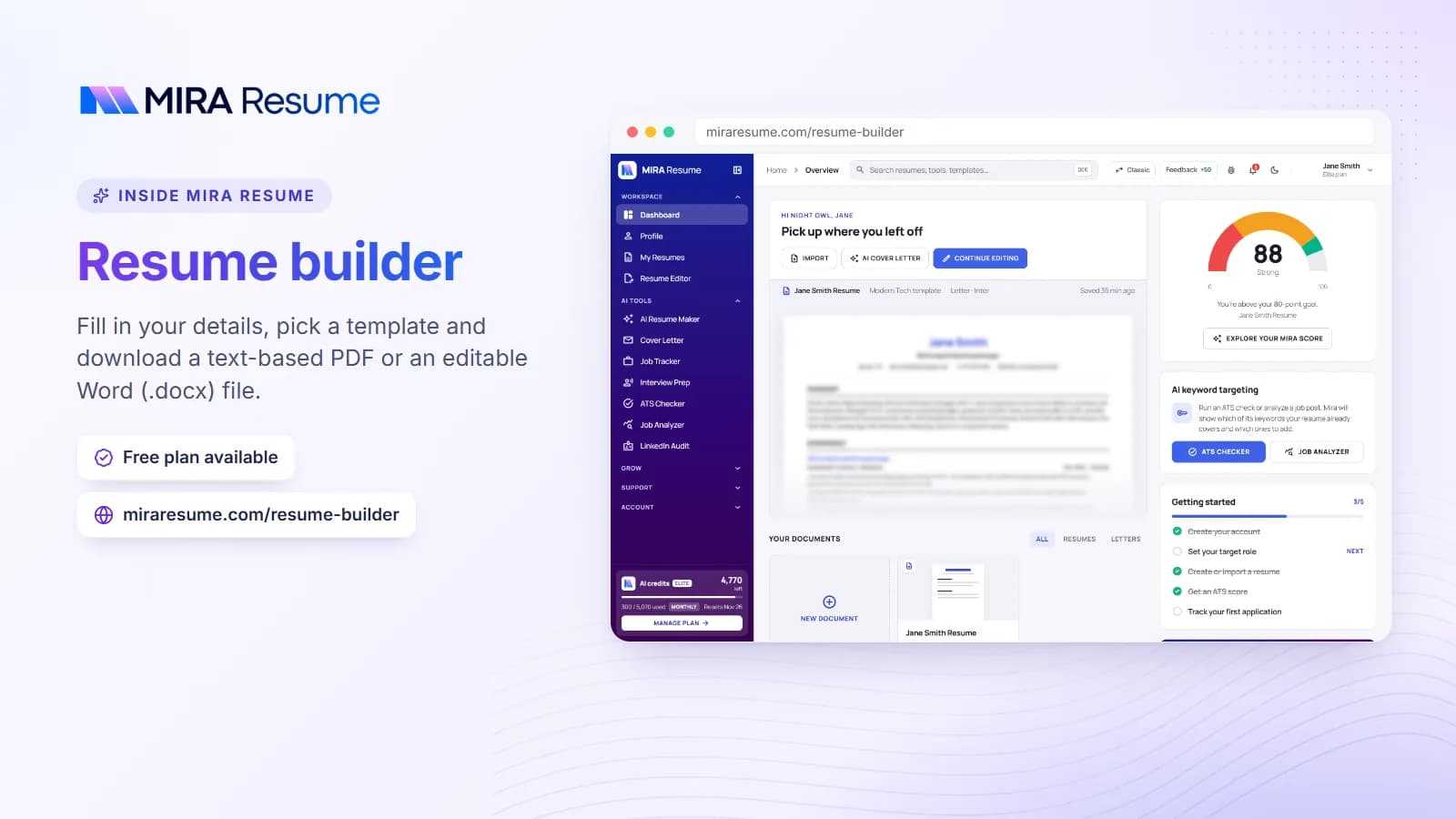
Use our ATS friendly CV template guide for the full order and a copyable sample. If you are building your CV in a word processor, see our tips for Word templates. Or use the Mira Resume AI resume builder to get a first draft of your summary, then edit it so it sounds like you and is true.
Common mistakes in a CV summary
- Too long. Five or more lines is too much. Trim to the key points.
- Too general. If it fits anyone, it helps no one. Name your field and strengths.
- Buzzwords. Words like dynamic, results-driven and go-getter are empty unless proved.
- Using "I" and long sentences. Most CV summaries drop the "I" and start with the title.
- Claims you cannot support. If you say expert, be ready to show it.
- Repeating your first job bullet word for word. Use the summary to sum up, not to copy.
- Using the same summary for every job. A quick tweak makes a big difference.
- Typos. Read it aloud. Ask a friend to check.
Quick final check
- Does it name your role or field?
- Does it give one or two specific strengths?
- Does it say what you want next?
- Is every word true?
- Is it under about 70 words?
When you are done, test the full file with the ATS checker. It cannot predict every employer, but it can catch layout problems that hide your words.