
Everyone wants low stress high paying jobs. The honest truth is that no list can promise you one. Stress depends on you, your manager, your team, your city and even the season. A job that feels calm to one person can feel hard to another.
So instead of giving you a fixed list with pay numbers that may be wrong, this guide teaches you how to judge a job for yourself. You will learn what causes stress at work, which kinds of roles often give people more control, how to check real pay, and how to present your skills on a resume to move toward them.
We do not quote salary figures here because they change by country, city, company and year. Use trusted local sources, such as official labor statistics or current job postings, to check pay before you decide.
What does low stress really mean?
Stress at work usually comes from a few causes. When you know which ones affect you, searching gets easier.
Common sources of work stress
- Workload: too much to do, with too little time.
- Time pressure: hard deadlines, shift changes, or being on call.
- Low control: little say in how or when you do the work.
- High stakes: mistakes that affect safety, health or large sums of money.
- People issues: difficult customers, conflict or poor management.
- Uncertainty: unclear goals, layoffs or unstable income.
Stress is personal
Some people find public speaking stressful and quiet data work calm. Others find the opposite. Some enjoy fast work and feel bored when it is slow. Start by listing what drains you and what energizes you. That list is more useful than any article.
Low stress does not mean no effort
Well-paid roles still ask for skill and responsibility. What changes is the type of pressure. A job may have steady hours and clear tasks, but need deep focus. That kind of "good stress" can feel satisfying instead of draining.
| Stress source | Question to ask | Warning sign |
|---|---|---|
| Workload | How many hours does the team really work? | Everyone is always rushing |
| Control | Can I decide how I do my tasks? | Every step is checked |
| Hours | Are hours predictable? | Constant emergencies |
| Stakes | What happens if I make a mistake? | Serious harm is possible |
| People | Who do I deal with most? | Angry customers all day |
How to judge a job before you apply
You can learn a lot before you send an application.
Read the job post closely
- Words like "fast-paced", "wear many hats" and "must be flexible" can mean heavy workload or uncertain hours.
- Clear lists of duties and set hours are often a sign of better structure.
- Look for on-call duty, weekend work or travel.
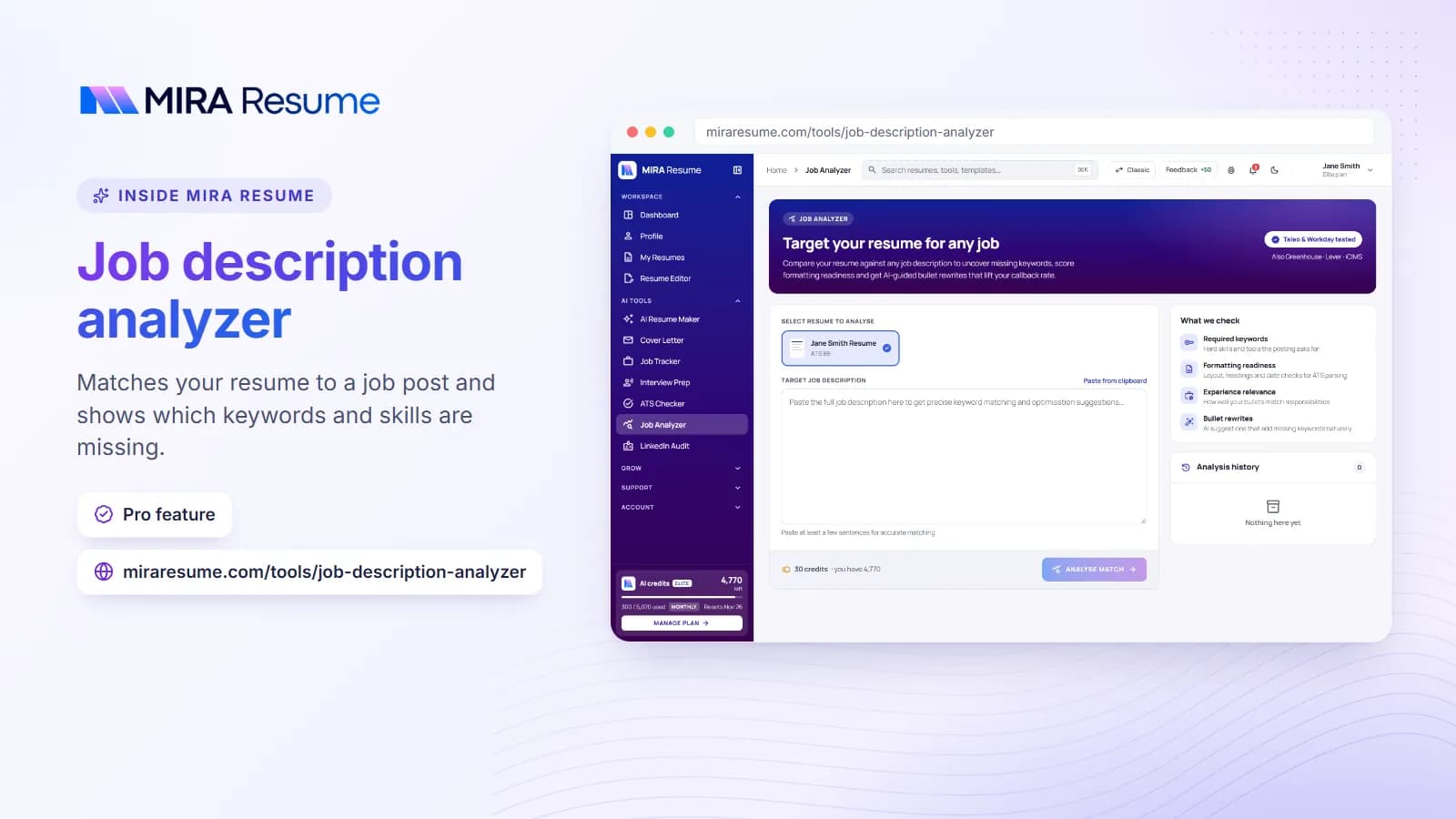
Our job analyzer can help you compare what a posting asks for with your own skills so you see the real shape of the role.
Ask smart questions in the interview
- "What does a normal week look like?"
- "How are priorities set when the team is busy?"
- "What are the usual hours, and how often do people work extra?"
- "How is success measured in the first six months?"
- "Why is this position open?"
Listen to how they answer, not just what they say. Pauses and vague replies can tell you something. Practice these with interview prep so you feel at ease.
Talk to people who do the job
Ask people in your network about the daily work. Look for current or former employees, and ask about the best and hardest parts of their week.
Check reviews with care
Employee reviews can be helpful, but a few angry or glowing posts do not tell the full story. Look for repeating themes instead of single comments.
Job categories that people often find calmer and well paid
Pay and stress vary a lot inside every field. The groups below are starting points, not promises. Always check the specific employer and your local pay. We do not list salary numbers because they differ by place and change over time.
Roles with steady routines and clear tasks
- Some technical or data roles, where the work is set by projects and clear specs.
- Some finance and accounting support roles outside of month-end or tax season.
- Some specialist technician or laboratory roles, where processes are structured.
Roles with more control over your time
- Independent professionals, such as consultants or freelancers, who choose clients and schedules (income can be uneven).
- Remote-friendly roles where you can plan your day.
- Research or analysis roles with long-term, focused projects.
Roles in stable organizations
- Some public sector or education-support jobs with predictable hours and benefits.
- Some in-house roles at large companies, where workload may be shared among bigger teams.
| Category | What may help | What can still be hard |
|---|---|---|
| Structured technical work | Clear tasks, quiet focus | Deadlines, learning new tools |
| Finance support | Defined processes | Busy seasons |
| Independent work | Control of schedule | Unstable income, finding clients |
| Public sector | Stable hours and benefits | Slower pay growth, bureaucracy |
| Research or analysis | Deep, steady work | Pressure to produce results |
If you want to see how specific roles are described in resumes, look at our guides for a computer science resume or a staff accountant resume.
How to check pay honestly
"High paying" means different things to different people. A salary that feels high in one city may be modest in another once you count rent and tax.
Use real sources
- Official labor or statistics websites in your country.
- Pay ranges in current job postings, where required or shared.
- Professional associations in your field.
- Honest conversations with people in similar roles.
Look past the base salary
- Bonuses and commissions, and how reliable they are.
- Health, retirement and paid time off.
- Flexible work, which can save time and travel costs.
- Costs of the job, such as commuting, licenses or equipment.
Think about pay per hour of stress
Divide your estimated yearly pay by the hours you would actually work, including late emails and travel. A job with an average salary and calm hours may feel better than one with a higher pay and endless overtime.
Be careful with "top ten" lists
Many lists on the web mix up pay and stress and use old or unclear data. Treat them as ideas, not facts. Check the source before you trust a number.
| What to compare | Why it matters |
|---|---|
| Base pay | Your steady income |
| Real weekly hours | Shows your true hourly value |
| Benefits | Can be worth a lot |
| Job security | Affects long-term stress |
| Growth path | Affects future pay |
Build a plan to move into a calmer, better-paid role
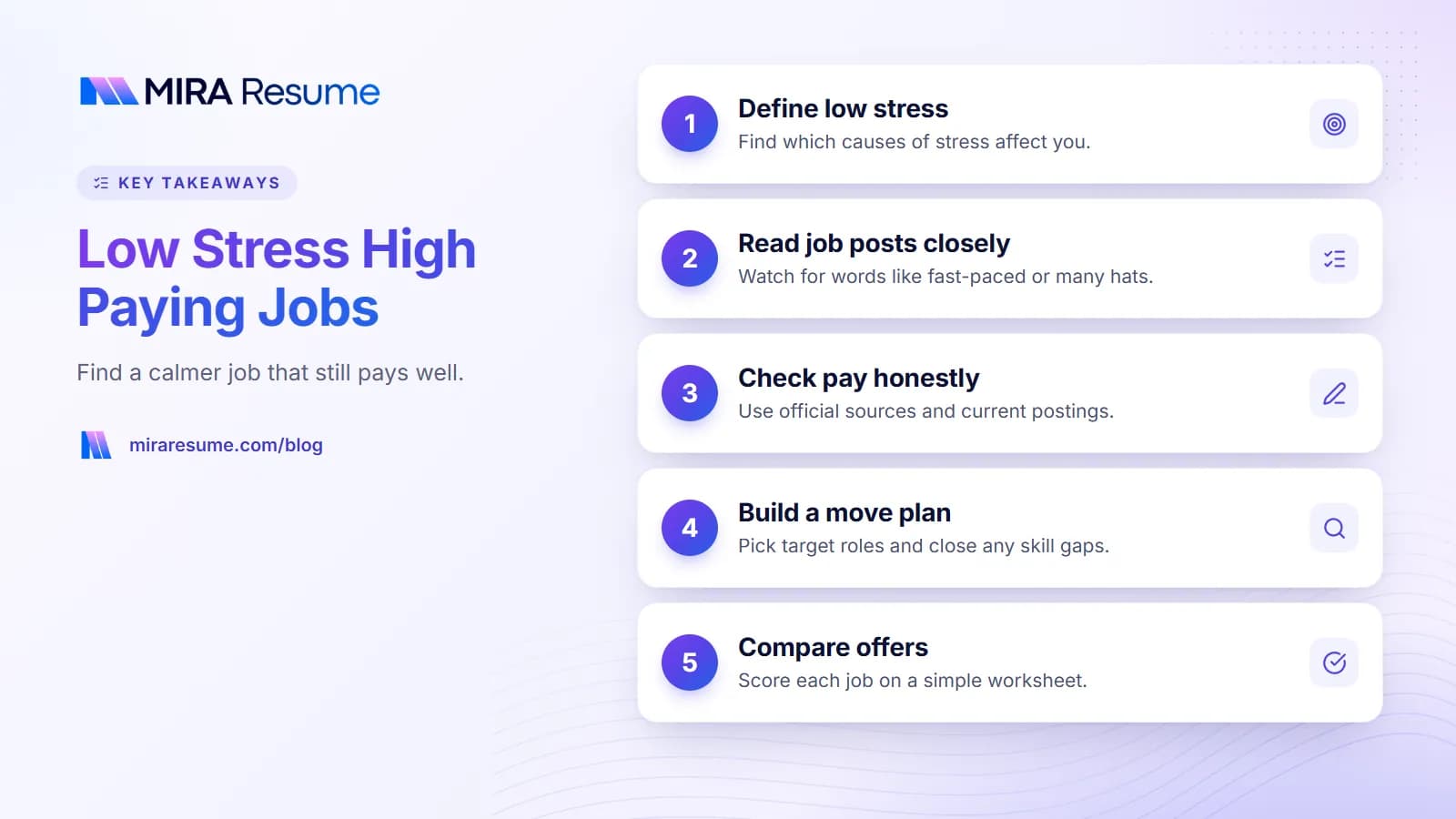
A move like this rarely happens overnight. Follow steps you can control.
- List your strengths. What do you do well and enjoy?
- List your stress triggers. Be specific.
- Pick two or three target roles. Read real job posts for each.
- Find skill gaps. Courses, certificates or small projects can fill them.
- Update your resume. Show results and tools that match the target job.
- Apply with intention. Fewer, better-matched applications often work better than many random ones.
- Track and review. Learn from interviews and adjust.
If you want to change careers
Think about which skills transfer. Communication, project work, customer care, data handling and training are valued in many fields. Show them with clear examples. A summary at the top helps readers see the connection. Our guide to resume summary examples and skills-based resumes show how.
If you are new to the workforce
Do not worry if you lack a long history. Focus on school projects, volunteering and learning. See cover letters with no experience and skills to put on a resume.
Keep your search organized
Use the job tracker to log each application, contact and date, so you can learn what works.
How to show your fit on your resume
Hiring teams for calmer, well-paid jobs often look for people who work reliably, communicate clearly and handle details. Your resume should show those traits with real evidence, without exaggeration.
Use clear, true results
- Say what you improved, saved or delivered, using your own numbers if you have them.
- Use action verbs. See action verbs for your resume.
- Show steady work: "Managed 40 weekly client requests with no missed deadlines" is only fine if it is true for you.
Match the job post
Use the same key skills as the posting, in your own words. The ATS checker can show you how well your resume matches. Our guide to how ATS works explains why this matters.
Keep the layout clean
Pick a simple, readable layout from the resume templates and stick to one or two pages. See how many pages a resume should be for guidance.
| Resume part | What to do |
|---|---|
| Summary | Two or three lines about your strengths and goals |
| Skills | Tools and methods that match the job post |
| Experience | Results, scope and tools, with action verbs |
| Education and training | Relevant courses and certificates |
You can build or update yours in the resume builder or with the AI resume builder.
Common mistakes when searching for a low stress job
- Trusting job titles alone. Two people with the same title can have very different workloads.
- Chasing a list. A "top ten" list may not fit your skills, location or goals.
- Ignoring your own limits. If you dislike a type of work, pay will not fix it for long.
- Skipping the interview questions. Ask about hours and priorities.
- Assuming remote means calm. Remote jobs can have blurry hours.
- Quitting before you have a plan. Set up your next step first. Read how to resign from a job when you are ready.
- Believing guarantees. Nobody can promise a job with high pay and no stress.
If you are comparing against high-pressure jobs
Some people trade stress for higher pay on purpose. That is a valid choice. See our guide to high-paying jobs with high stress to compare the two paths honestly.
A simple worksheet to compare two job offers
When you have two options, a plain worksheet beats a gut feeling. Score each item from 1 (poor) to 5 (great) for each job, then look at the pattern rather than the total alone.
| Factor | Job A | Job B | Why it matters to you |
|---|---|---|---|
| Pay compared with local living costs | Money that stays after bills | ||
| Predictable hours | Lets you plan your life | ||
| Control over how you work | Lower pressure for many people | ||
| Quality of the manager | Often the biggest factor | ||
| Chance to grow | Affects future pay |
Fill it in after each interview, while your memory is fresh. If one job scores high on pay but low on hours and manager quality, you now know what you would be trading. Nothing here needs outside data, and the answers are yours alone.
Trust your own limits
If a role scores well on paper but your stomach drops when you picture the first Monday, take that seriously. It does not mean the job is bad. It means it may not suit you. The reverse is also true: a plain-sounding job may fit you well.