Coming soon
CV Formats by Country

German CV Format: How to Write a Lebenslauf (With Example)

German CV format explained: the tabular Lebenslauf, photo and personal data rules, CEFR language levels, Anschreiben and Zeugnisse, plus an example in English.

Mira Resume Editorial Team · Career content team Published Updated 10 min read
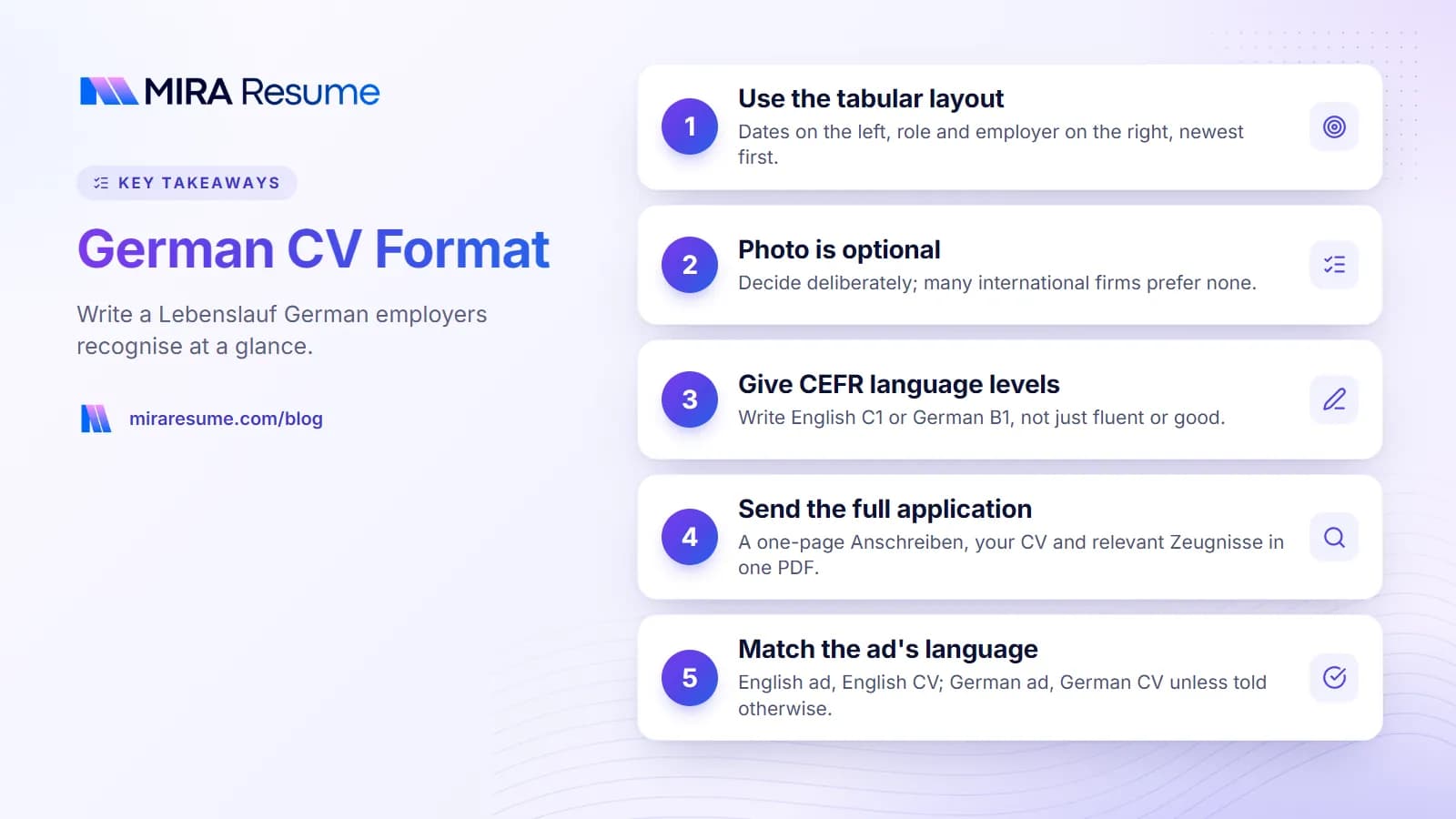
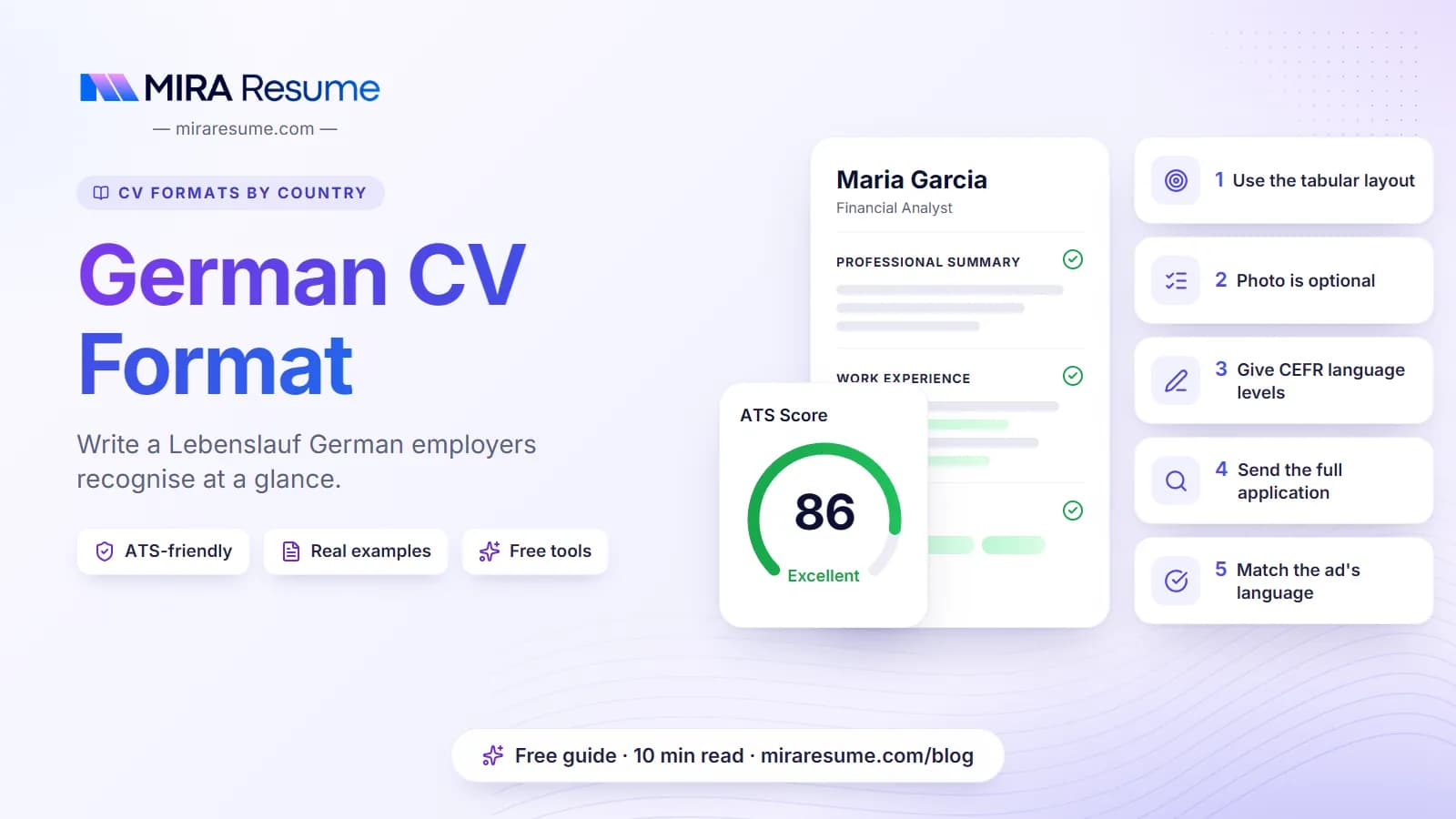
German CV Format: cover image for the Mira Resume guide, with an example resume and the 5 main points

The German CV format is called the Lebenslauf, and it has a few habits you will not find in a UK or US CV. Most German CVs use a tabular layout, with dates in a narrow left column and details on the right. Many include a little more personal information than you might expect, and the CV usually travels with a cover letter (Anschreiben) and copies of certificates (Zeugnisse).

This guide explains how to write a Lebenslauf that German employers recognise, which details are optional, how to show your language levels, and when a German CV in English is the better choice. You will find a section order, an example, a do and don't table and a final checklist.

Key takeaways: 1. Use the tabular layout; 2. Photo is optional; 3. Give CEFR language levels; 4. Send the full application; 5. Match the ad's language
Key takeaways from this guide.

What a German CV looks like at a glance

German employers usually expect a complete, well-organised application rather than a short pitch. The CV is the core of it, and its look is fairly standard.

FeatureCommon German practice
What it is calledLebenslauf (CV in English-language ads)
LayoutTabular: dates on the left, details on the right
OrderNewest entries first in most CVs today
Length1 to 2 pages; 2 is common with several years of experience
Paper sizeA4
DatesMonth and year, often written as 03/2022
PhotoOptional, not required
Signature and dateTraditional, now often left out in online applications
Sent withAnschreiben (cover letter) and Zeugnisse (certificates and references)

Accuracy matters a lot. German recruiters tend to read dates closely, so explain gaps honestly with a short line, such as "Career break: family care" or "Language course, Berlin". Our guide to CV date formats shows the cleanest ways to write them.

The tabellarischer Lebenslauf explained

The tabellarischer Lebenslauf (tabular CV) is the standard German layout. Each entry sits on a line with the time period on the left and the role, employer and details on the right. It makes a career easy to scan from top to bottom.

PeriodEntry
04/2023 to presentMarketing Manager, Nordlicht Media GmbH, Hamburg
Lead a team of four; plan campaigns for B2B clients
09/2020 to 03/2023Marketing Specialist, Elbtal Verlag GmbH, Hamburg
Ran email and social campaigns for a book publisher
10/2016 to 07/2020B.A. Media Management, a university in Hamburg

The employers above are made up. You may also hear of the ausführlicher Lebenslauf, a longer CV written as continuous text. It is rarely asked for today; unless an ad requests it, use the tabular style.

One practical warning: if you upload your CV to an online portal, real tables, text boxes and two-column designs can confuse applicant tracking software. You can keep the tabular feel by putting the dates at the start of each line in a single column. Our ATS-friendly CV template guide explains why.

Personal details (Persönliche Daten): what is optional

Traditionally, German CVs opened with a block of personal data. Some of it is still standard; much of it is now optional.

DetailInclude?Notes
Full nameYesAt the top, as the title of the page
City or full addressYesMany German CVs give a full postal address; city is often enough
Phone and emailYesAdd +49 for a German number, or your country code if abroad
LinkedIn or Xing profileOptionalUseful if it matches your CV
Date and place of birthOptionalTraditionally common; many applicants now leave it out
NationalityOptionalHelpful if it shows you can work in Germany, for example as an EU citizen
Marital status, childrenOptionalIncreasingly left out
PhotoOptionalSee the next section
Religion, health, tax IDNoNot relevant to the application

A good rule: include a detail only if you are comfortable with it and it helps the reader. If you need a visa, a short work authorisation line is more useful than your marital status.

Should you put a photo on a German CV?

For many years, a professional photo was a normal part of a German application. Today it is optional. Germany's General Equal Treatment Act (Allgemeines Gleichbehandlungsgesetz, AGG), in force since 2006, protects applicants against discrimination on grounds such as ethnic origin, sex, religion or belief, disability, age and sexual identity. A photo can reveal several of these, so it is widely understood that employers should not require one, and leaving it out should not count against you. The Federal Anti-Discrimination Agency has also promoted anonymised applications.

In practice, habits vary. Many traditional employers still receive photos, and some applicants include one by habit. International companies and startups often prefer applications without a photo. If you choose to include one:

  • Use a recent, professional headshot with a plain background.
  • Place it at the top right of the first page, at a modest size.
  • Never use a holiday photo, a selfie or a heavily filtered image.

If an ad says "please do not send a photo", follow it. This is general guidance, not legal advice.

Signature and date

A traditional Lebenslauf ends with the place, date and a handwritten signature, for example "Munich, 21 November 2026" followed by your name. For paper applications this is still common. For online applications, many people leave it out or add a scanned signature. Either is usually fine; if you sign, make sure the date is current.

German section headings are fairly fixed. Here is a common order, with the German heading and its English equivalent.

OrderGerman headingEnglish headingWhat to include
1Persönliche DatenPersonal detailsName, contact details, optional personal data
2KurzprofilProfile (optional)Three to four lines on your experience and goal
3BerufserfahrungWork experiencePeriod, job title, employer, city, three to five bullets
4AusbildungEducationDegree, vocational training (Berufsausbildung), school leaving certificate
5WeiterbildungFurther trainingCourses and certificates with dates
6KenntnisseSkillsLanguages with CEFR levels, IT skills, tools
7Ehrenamt / InteressenVolunteering / interestsOptional; keep it short and genuine
8Ort, Datum, UnterschriftPlace, date, signatureOptional, see above

Vocational training is valued in Germany, so list an apprenticeship or vocational qualification with the same care as a degree. Early-career applicants can put education before experience.

German CV example (in English)

Here is a short example of the header, profile and one experience entry, written in English for an international employer. The person and company are made up.

Priya Sharma
Munich, Germany | +49 151 0000 0000 | [email protected] | linkedin.com/in/priya-sharma-example
Nationality: Indian | Residence permit with permission to work

Profile
Backend developer with five years of experience building payment and booking systems in Java and Kotlin. Works well in mixed German and English teams. Looking for a senior backend role in Munich.

Work experience
03/2022 to present: Backend Developer, Isarblick Software GmbH, Munich
- Build and maintain booking services used by partner hotels
- Moved two legacy services to a cloud setup, reducing manual deployments
- Review code and mentor two junior developers

Languages
English: C1 | German: B1 (Goethe-Zertifikat B1) | Hindi: native

Notice the dates at the start of each entry, the CEFR language levels and the clear work authorisation line. To build a German CV template like this without fighting the layout, use the CV builder and pick a one-column design from our templates.

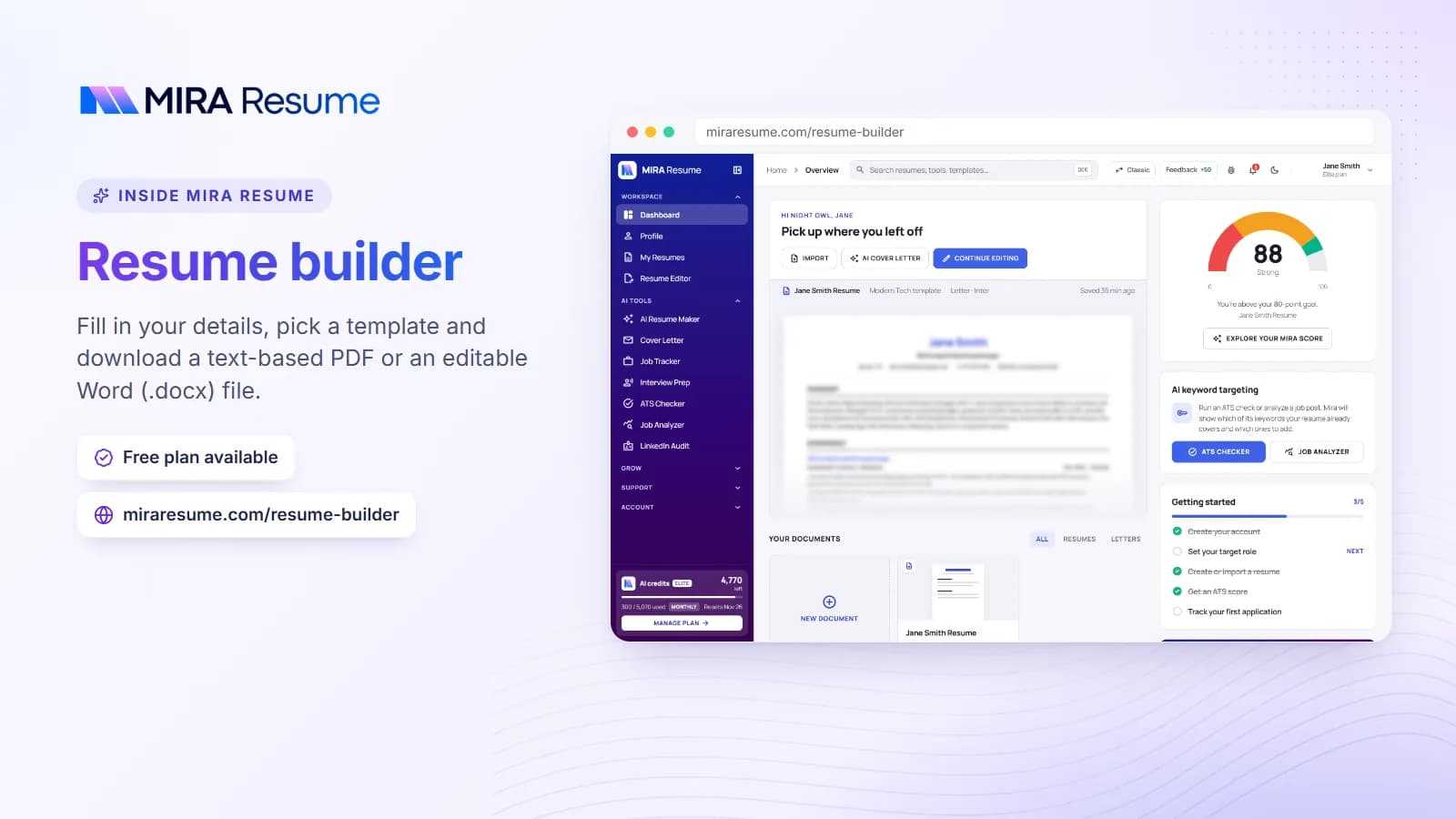
Screenshot of the Mira Resume resume builder (Fill in your details, pick a template and download a text-based PDF or an editable Word (.docx) file.)
Screenshot: Resume builder: Fill in your details, pick a template and download a text-based PDF or an editable Word (.docx) file.Try it

Language skills and CEFR levels

Languages matter in Germany, and employers usually expect you to give a level rather than a vague word like "fluent". The standard scale is the Common European Framework of Reference for Languages (CEFR).

LevelMeaningRoughly means you can
A1 / A2Basic userHandle simple everyday situations
B1 / B2Independent userWork and discuss familiar topics; B2 handles most work conversations
C1 / C2Proficient userUse the language easily for complex work and writing

Write your native language as "native" (Muttersprache). If you hold a certificate, such as a Goethe-Zertifikat, TestDaF or telc exam, name it and its level. How much German you need depends on the employer: many customer-facing and public roles expect strong German, while some international tech teams work mainly in English. Be honest, because interviews often switch languages to check.

The Anschreiben: your German cover letter

The Anschreiben is a one-page cover letter that explains why you want this role and why you fit it. Many German employers still expect one, though some now accept applications without it. If the ad or online form does not mention it, sending one is the safer choice.

  • Subject line (Betreff): the job title and any reference number from the ad.
  • Greeting: address a named person if you can find one.
  • Opening: say which role you are applying for and what draws you to it.
  • Middle: two or three examples that match the job requirements.
  • Close: if the ad asks, give your earliest start date (Eintrittstermin) and salary expectations (Gehaltsvorstellung).

Keep the tone polite and factual. Our cover letter templates give you a clean layout, and the AI cover letter generator can draft a first version for you to edit.

Zeugnisse: certificates and employer references

German applications often include copies of Zeugnisse: degree and school certificates, training certificates and, very importantly, the Arbeitszeugnis. This is a written reference from a former employer. Employees in Germany have a legal right to one when they leave a job, under section 109 of the Gewerbeordnung, and on request it can be a qualified reference that also comments on performance and conduct.

What to include:

  • Your highest degree or vocational qualification.
  • Arbeitszeugnisse from recent, relevant jobs, if you have them.
  • Certificates for training that the job asks for.
  • Translations of foreign documents if the employer requests them.

Many employers ask for all documents in a single PDF, so merge them in a logical order: cover letter, CV, then certificates, newest first. Because Zeugnisse do so much of the work, a separate list of referees is less central than in the UK or Australia. If you trained abroad, the official "Anerkennung in Deutschland" portal explains how foreign qualifications are recognised; some professions, such as medicine, nursing and teaching, need recognition before you can work in them. For layout ideas, see how to list certifications.

German CV in English: when to use one

A German CV in English is often the right choice. A simple rule works for most people:

  • Ad written in English, or an international company or startup that works in English: send an English CV.
  • Ad written in German: send a German CV and Anschreiben, unless the ad says English is fine.
  • Not sure: follow the language of the ad, and check the company's careers page.

An English version should still follow German habits: tabular dates, CEFR language levels, a clear work authorisation line and accurate degree names. Keep the original German or local degree title in brackets if the translation could be unclear. Do not write a German CV in a level of German you could not keep up in an interview.

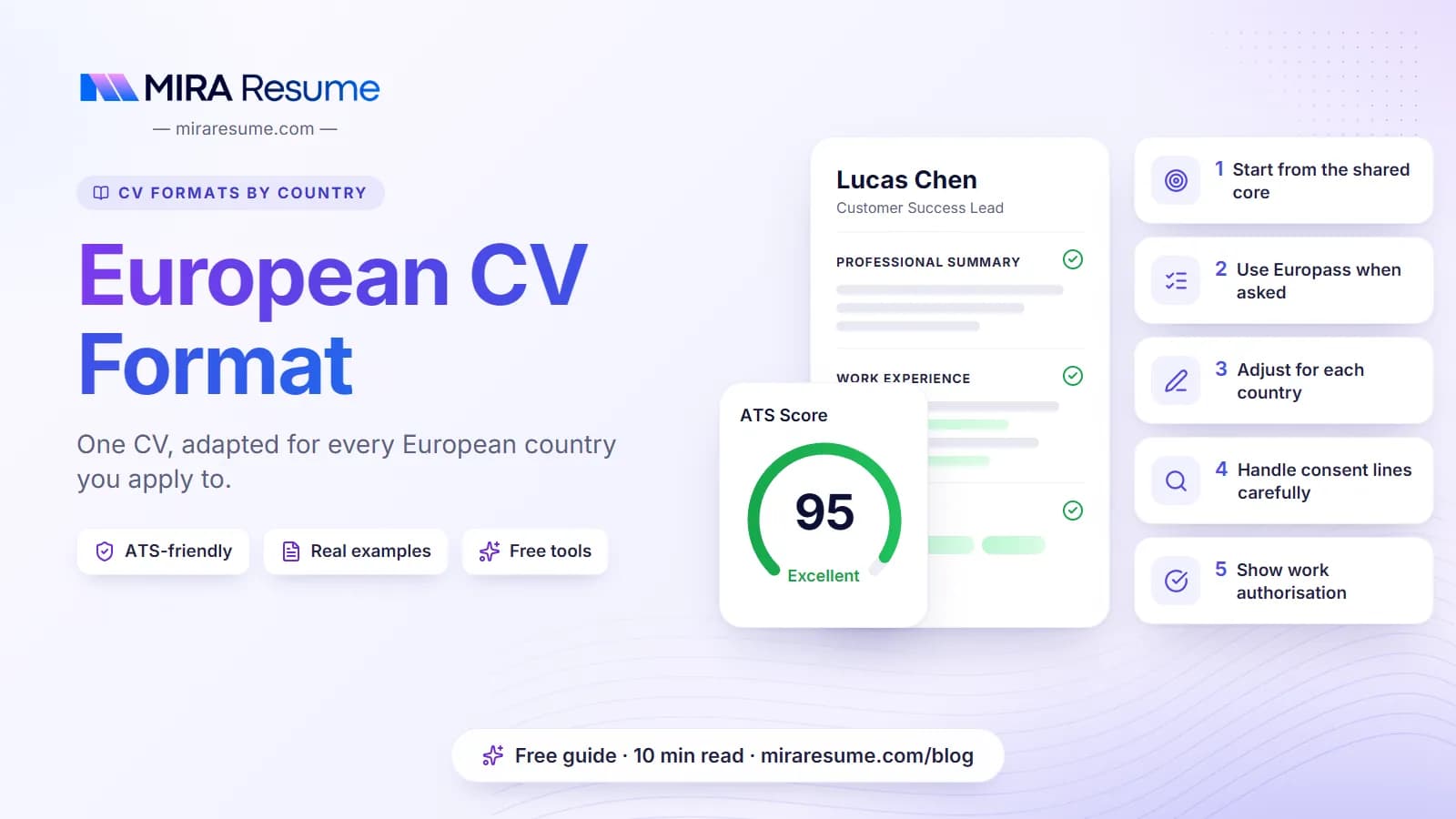
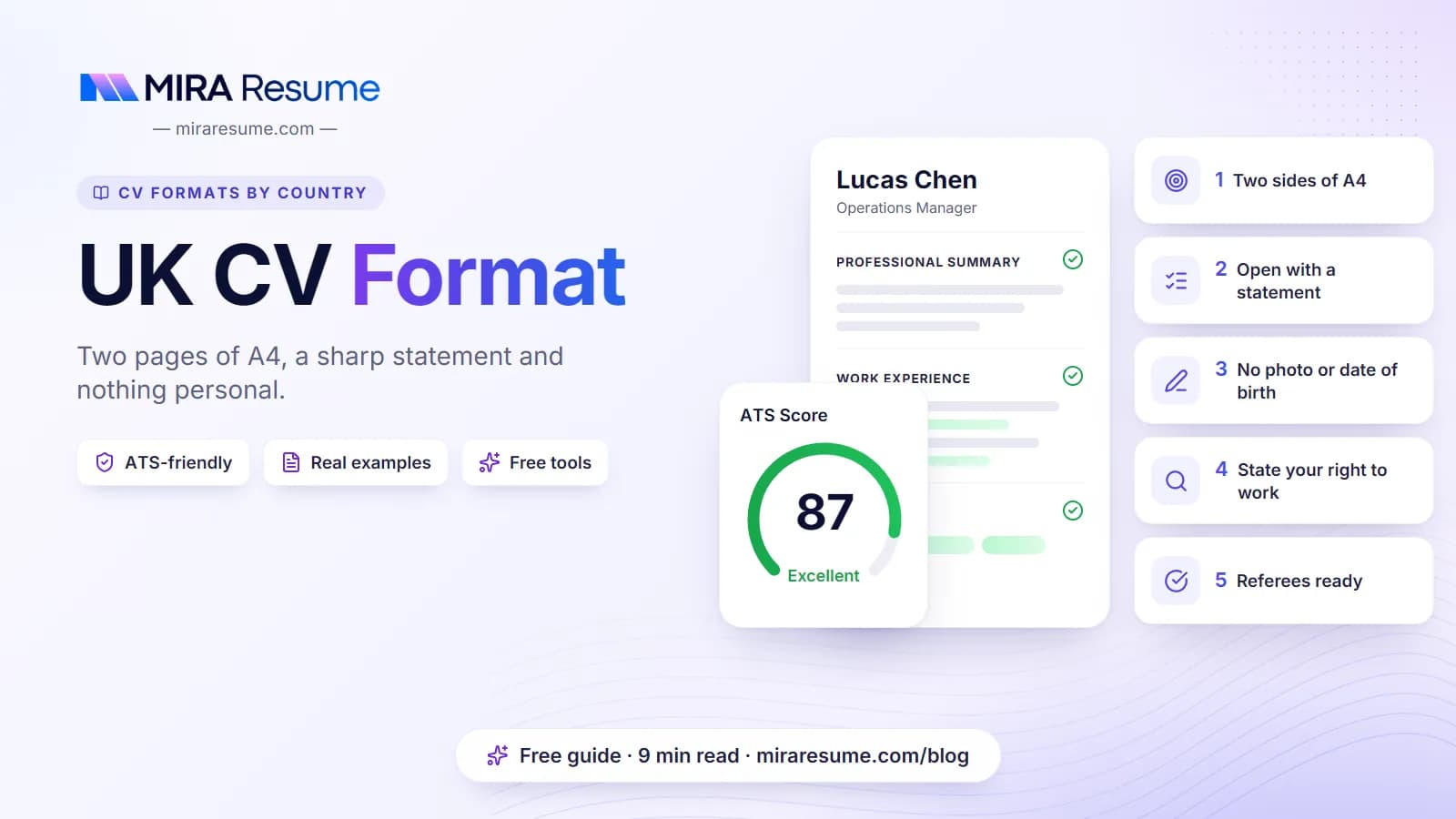
If you are applying in several countries, our European CV format guide compares local habits, and the UK CV format shows how much leaner a British CV is. For Europass, see our Europass CV guide.

Online applications, ATS and job boards

Most German job searches happen online: on job boards such as StepStone, on LinkedIn and Xing, on the Federal Employment Agency's job portal, and on employer careers portals. Many larger employers use applicant tracking systems that read your uploaded documents or ask you to fill in a form.

  • Use a text-based PDF unless the portal asks for something else.
  • Keep headings standard and avoid text boxes, icons and skill bars.
  • Respect file size limits; compress certificate scans if needed.
  • Name files clearly, for example "Priya-Sharma-Lebenslauf.pdf".
  • Copy key words from the ad where they truthfully match your experience.

Run your CV through the ATS checker before you upload it, to catch layout problems early.

Applying to German jobs from abroad

Citizens of EU and EEA countries and Switzerland can generally work in Germany without a separate work permit. Most other applicants need a visa or residence permit that allows work. Routes for skilled workers include the EU Blue Card for qualified professionals, but the rules change and depend on your situation. Check the German government's official "Make it in Germany" portal and the German mission in your country. This is not immigration advice.

DoDon't
Use the tabular layout with clear month and year datesLeave unexplained gaps in your timeline
Give CEFR levels for every languageWrite "fluent" or "good German" without a level
Decide on a photo deliberately; it is optionalAdd a casual or old photo
Add a clear work authorisation line if relevantLeave employers guessing about your visa
Send the Anschreiben and relevant ZeugnisseUpload a CV alone when the ad asks for full documents
Translate degree titles accuratelyUpgrade a qualification in translation

If you are also applying from India, compare the habits in our Indian resume format guide, since personal details that are common there are often optional in Germany.

Final checklist before you apply

  1. Is your Lebenslauf in the tabular layout, on A4, with newest entries first?
  2. Is it one to two pages, with no unexplained gaps?
  3. Have you chosen deliberately which optional personal details and photo to include?
  4. Are all languages listed with CEFR levels and any certificates?
  5. Have you written a one-page Anschreiben for this role?
  6. Are your Zeugnisse merged into one tidy PDF, if the employer asks for them?
  7. Does the CV match the language of the job ad?
  8. Have you added a work authorisation line if you need a visa?
  9. Is the file a text-based PDF that passes an ATS check?

Want to compare with other countries? Browse all our CV formats by country.

Frequently asked questions

Do I need a photo on my German CV?

No. A photo is optional in Germany. The General Equal Treatment Act protects applicants against discrimination on grounds such as age, sex and ethnic origin, which a photo can reveal, so employers should not require one. Many traditional employers still receive photos, while international firms often prefer none. If you add one, use a recent, professional headshot.

How long should a German CV be?

One to two pages is the norm. Two pages is common once you have several years of experience, while students and graduates usually need one. Certificates and references are sent as separate attachments, so they do not count towards the CV length. Keep entries short and use the tabular layout to save space.

Can I send a CV in English to German companies?

Yes, if the job ad is in English or the company works in English, which is common in tech, research and international firms. If the ad is written in German, a German CV and cover letter are usually expected unless the ad says otherwise. Whichever you choose, keep German habits such as tabular dates and CEFR language levels.

Do I need to sign my Lebenslauf?

Not always. A traditional Lebenslauf ends with the place, date and a handwritten signature, and this is still common for paper applications. For online applications, many people leave it out or add a scanned signature, and employers rarely mind either way. If you do sign, make sure the date is current.
What is a tabellarischer Lebenslauf?

It is the standard German CV layout. Each entry sits on one line with the time period on the left, such as 03/2022 to present, and the role, employer and details on the right. Entries usually run newest first. It is easy to scan and is what most German employers expect unless they ask for something else.

What are Zeugnisse in a German job application?

Zeugnisse are certificates and references attached to your application. They include degree and training certificates and the Arbeitszeugnis, a written reference that employees in Germany have a legal right to receive from an employer when they leave. Many employers ask for these documents in one PDF along with your CV and cover letter.

Found this useful? Share it

Send it to a friend who is job hunting, or save it for later.

Read this guide with AI

Get a plain-language summary and help applying it to your own resume. Pick an assistant; it opens with this article and a ready prompt.

Back to CV Formats by Country hub

All articles