
A grad school resume is a short document that supports your application to a master's, doctoral or professional program. Unlike a job resume, it is not built to land a job interview. It is built to show that you can handle research, writing and advanced classes, and that you have a clear reason for the program you chose.
This guide covers what to include in a resume for graduate studies, how it differs from a CV, how to order the sections, and a sample you can copy. Rules vary by school and field, so always follow the program's own instructions first. For a wider look at the two formats, read CV vs resume.
Resume or CV for graduate school?
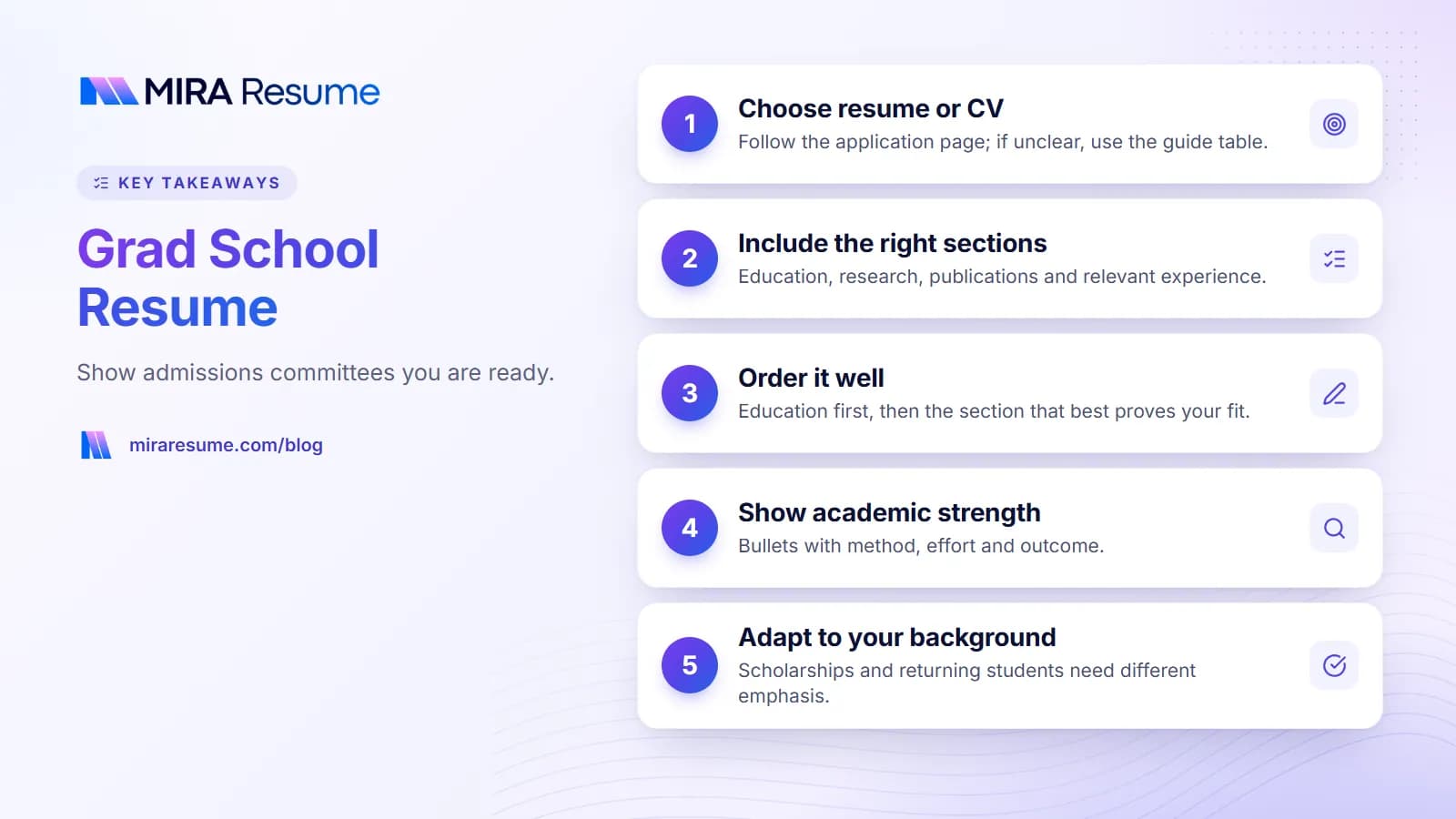
Check the application page first. Some programs ask for a "resume", some for a "CV", and some for a "statement of qualifications". Do what they say. If they do not specify, use this table.
| Program type | Usual choice | Typical length |
|---|---|---|
| Professional master's (MBA, public health, education, social work) | Resume | One to two pages |
| Research master's or PhD in science or humanities | CV or academic resume | Two pages or more |
| Law, medicine, dentistry | Resume or CV, per portal | One to two pages |
| Scholarship or fellowship | Whatever the call says | Often one page |
A resume is short and picks the best items. A CV is longer and lists everything in academic work. If you are applying for a research degree and have papers, posters or lab work, a CV or academic resume lets you list them. Our science CV sample shows a longer format, and what is a CV explains the basics.
If you are unsure
Email the admissions office and ask. It is a normal question, and the answer saves you from sending the wrong thing.
What to include in a resume for graduate studies
Committees read for evidence of academic readiness. They want to see where you studied, what you researched, what you produced and what drew you to the field. Use these sections, in this order, unless your work experience is very strong.
| Section | What to put there |
|---|---|
| Header | Name, email, phone, city and, if tidy, a link to a profile or portfolio |
| Education | Degrees, schools, dates, GPA, honors, thesis title, relevant courses |
| Research experience | Labs, projects, faculty you worked with, methods used, outputs |
| Professional experience | Jobs and internships related to the field, with short bullets |
| Publications and presentations | Papers, posters, talks, with full details |
| Teaching and tutoring | Teaching assistant roles, peer tutoring, workshops |
| Awards and funding | Scholarships, grants, honors, fellowships |
| Skills | Software, lab methods, languages |
| Service and leadership | Student organizations, volunteering linked to the field |
You do not need every section. A student with no publications can skip that one and lean on research projects and coursework. A professional applying for an MBA may put work experience first and keep academic items short.
Show fit with the program
Read the program page and note faculty interests, research centers and the courses they stress. If your experience matches, use the same terms in your bullets. This shows you know what they offer. Do not name a professor you have never read, and do not claim an interest you do not have.
How to order and format a graduate program resume
For most applicants, education goes at the top. After that, put the section that best proves your fit. For research degrees, that is research experience. For professional degrees, it is often work experience.
- Education first for students and recent graduates.
- Research or experience next, in reverse order, newest first.
- Publications and awards after that, using one consistent citation style.
- Skills and service last, kept short.
Format rules
- Use a plain font such as Times New Roman, Georgia, Arial or Calibri at 10.5 to 12 point.
- Use normal margins, at least 0.7 inch.
- Use the same style for dates, headings and bullets.
- Avoid photos, colors, icons and tables for layout.
- Save as a PDF so it looks the same in every upload portal.
For formatting basics, see how to format a resume and how many pages a resume should be. Applicant portals sometimes use software to store your file, so a one-column format is a safe choice.
Grad school resume example
This sample is made up. It is for a student applying to a master's program in public health. Replace everything with your own facts.
Amara Okafor
Philadelphia, Pennsylvania | 555-010-7712 | [email protected]Education
B.S. Health Sciences, [University Name], May 2026 | GPA 3.7
Honors thesis: [Title of your thesis]
Relevant courses: Epidemiology, Biostatistics, Health Policy, Community HealthResearch Experience
Undergraduate Research Assistant, [Name] Lab, [University], Sep 2024 to May 2026
- Cleaned and coded survey data from 400 respondents in R.
- Co-wrote the methods section of a poster on [topic].
- Presented the poster at the [event name], spring 2026.Professional Experience
Community Health Intern, [County Health Department], Summer 2025
- Helped run a vaccine information table and recorded questions for a staff report.
- Updated an outreach contact list of 150 community groups.Awards
Dean's List, six semesters | [Name of scholarship], 2024Skills
R | Excel | Survey design | Data cleaning | Spanish (conversational)Service
Volunteer, Free Health Clinic, 2023 to present
This page is dense but clear. Each bullet names a task, a tool and a context. Look at the numbers: they come from the writer's own work, which makes them safe to state.
Where to put your goal
Most grad school resumes skip an objective, because your statement of purpose does that job. If the form asks for a summary, keep it to two lines that name your field and strongest proof. For letters that explain your goals, see statement of qualifications.
Scholarship resume tips
A scholarship resume is a close cousin. It often has to fit on one page, and it should show need, merit or impact, depending on the award. Read the criteria and line up your strongest items to match.
- Lead with what they value. If the scholarship is for leadership, put leadership near the top. If it is for service, list service first.
- Show results. Say what changed because of you, such as "Organized a book drive that collected supplies for three classrooms."
- Include work and family duties. Paid work, family care and other duties show time management and drive.
- Keep it to one page. Select the strongest items only.
- Proofread. Ask a teacher or advisor to read it.
Most scholarship committees want facts they can check, so keep every date and title accurate. Our student resume examples have shorter layouts that suit scholarship forms.
Write bullets that show academic strength
In a graduate program resume, bullets should show method, effort and outcome. Name what you did, what tool or method you used, and what it produced.
| Weak bullet | Stronger bullet |
|---|---|
| Assisted in lab | Prepared samples and recorded results for weekly experiments under a faculty supervisor |
| Did a thesis | Wrote a 60-page honors thesis on [topic] using interviews with 12 participants |
| Was a teaching assistant | Led two weekly review sessions for 25 first-year students and graded short quizzes |
| Worked on a group project | Wrote the literature review and built the data table for a five-person policy report |
Use strong verbs such as analyzed, designed, tested, wrote, presented, coded and coordinated. Do not turn your page into a list of buzzwords. Use real nouns: methods, tools, topics and counts.
Keep each bullet to one or two lines. Committees read many files, and short, exact lines are easier to remember than long paragraphs. If a project has a title, a date or a public link, include it, so a reader can look it up.
If you are changing fields
Applying to a program that differs from your degree is common. Show a clear link: relevant courses, a project, work or volunteering. Add a line about training you did on your own. Do not hide the change. Explain it in your statement and let the resume support it.
Returning to study after years of work
Many graduate applicants have worked for several years. If that is you, the committee wants to see how your work led to this choice. Keep your page to two pages at most, and put professional experience first if it relates closely to the program. Education can follow right after.
| Your background | Lead with | What to stress |
|---|---|---|
| Five years in a related job | Professional experience | Projects, leadership, results that connect to the program |
| Work in a different field | Education, then relevant experience | Transferable skills, recent courses, a bridge project |
| Recent graduate with research | Education, then research | Methods, outputs, faculty mentors |
| Recent graduate with no research | Education, then coursework and projects | Class projects, writing, any related work |
Older jobs can be shortened to one line each. You do not need to list every task from ten years ago. If you have a gap, write the years plainly, and add a short note if it helps. See resume with gaps in employment for wording.
References and recommenders
Most programs ask for letters from professors or supervisors, separate from your resume. Do not put "references available on request" on the page. Ask your recommenders early, give them your resume and your goals, and send a polite reminder before the deadline. See references on a resume for more.
Common mistakes on a grad school resume
- Sending a job-style resume to a research program. Show research, not just work tasks.
- Listing every job since high school. Include only what supports your application.
- Using a long skills list. Pick tools and methods you can truly use.
- Using mixed citation styles. Format every paper and poster the same way.
- Going over the page limit. If the program says one page, do not use two.
- Not tailoring. Change the order and the wording for each program.
- Using fancy design. A plain, readable page signals care.
- Claiming credit for team work. Say what you did yourself.
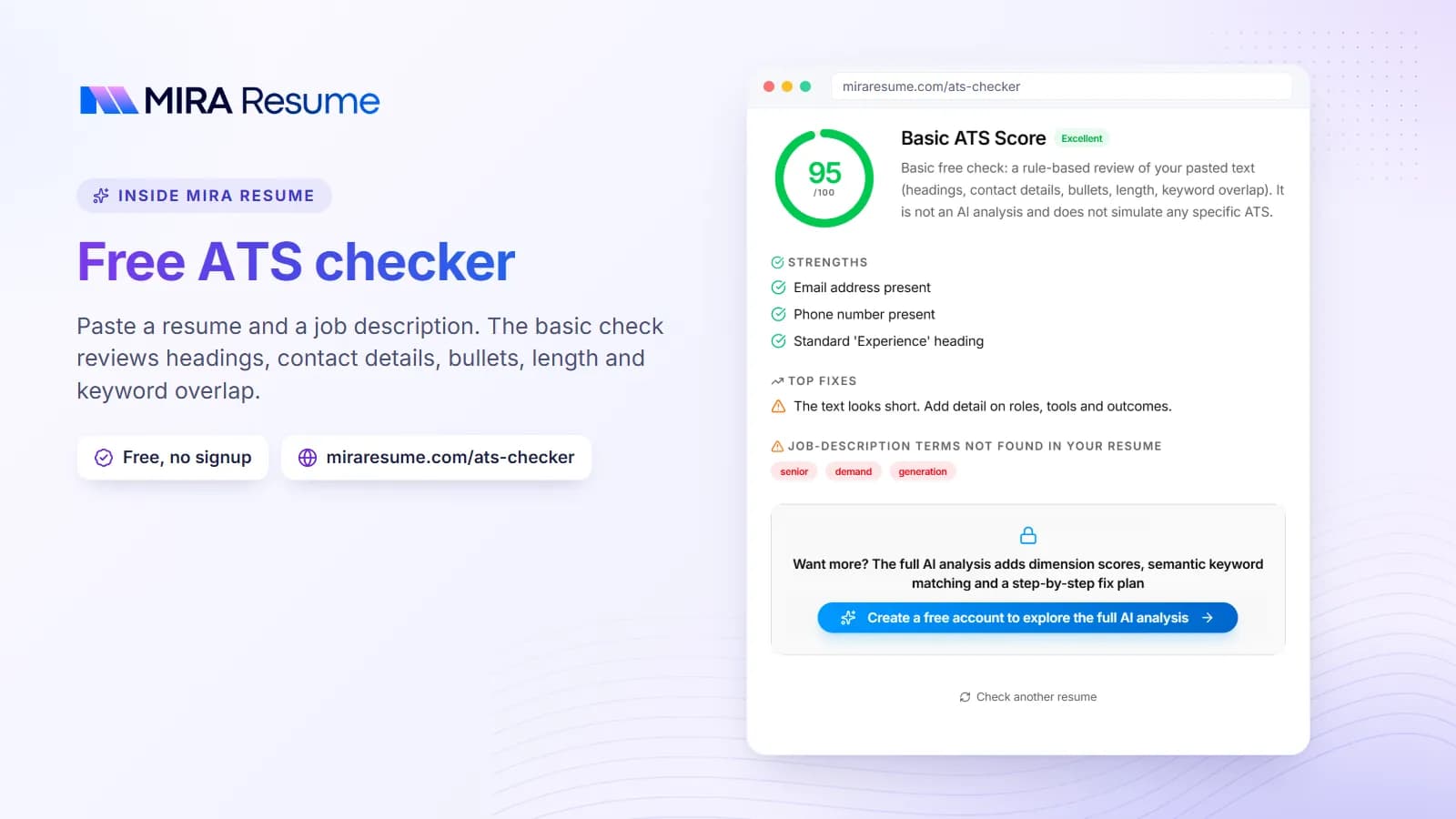
When your draft is ready, give it to a professor or advisor. Most welcome a request to review one page. You can also check the layout with our resume checker. If you are also thinking about jobs after your degree, entry level resume examples shows a different style.
Build it with a template
If you want a clean one-column starting point, choose a plain design from our resume templates and download the result as a PDF or an editable Word (.docx) file. For academic CVs with long publication lists, a word processor may give you more control.