Coming soon
CV Formats by Country

European CV Format: What Changes From Country to Country

European CV format guide: what Europe shares, how Germany, France, Spain, Italy, Poland and others differ, CEFR levels, GDPR lines and when to use Europass.

Mira Resume Editorial Team · Career content team Published Updated 10 min read
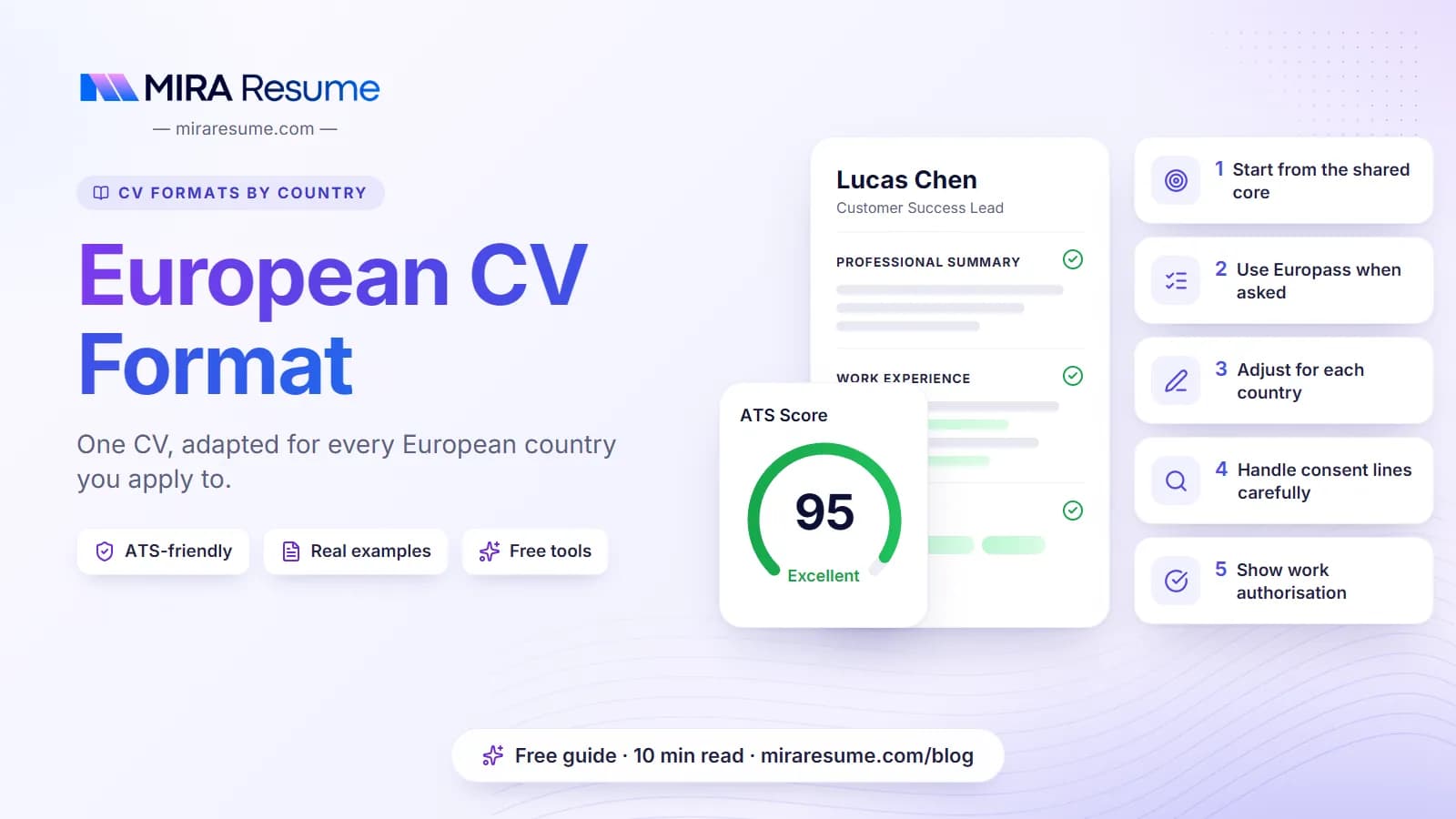
European CV Format: cover image for the Mira Resume guide, with an example resume and the 5 main points

There is no single European CV format that every employer uses. Europe has dozens of countries, languages and hiring cultures, and a CV that works well in Berlin may look slightly out of place in Amsterdam or Madrid. Still, there is plenty of common ground: newest jobs first, A4 paper, one to two pages for most roles, and language skills shown as CEFR levels.

This guide covers that common ground, when the Europass CV makes sense, how habits differ in Germany, France, the Netherlands, Spain, Italy, the Nordic countries and Poland, and what to know about data-consent lines and personal details. Use it as your starting point, then check the job ad and any country guide that applies.
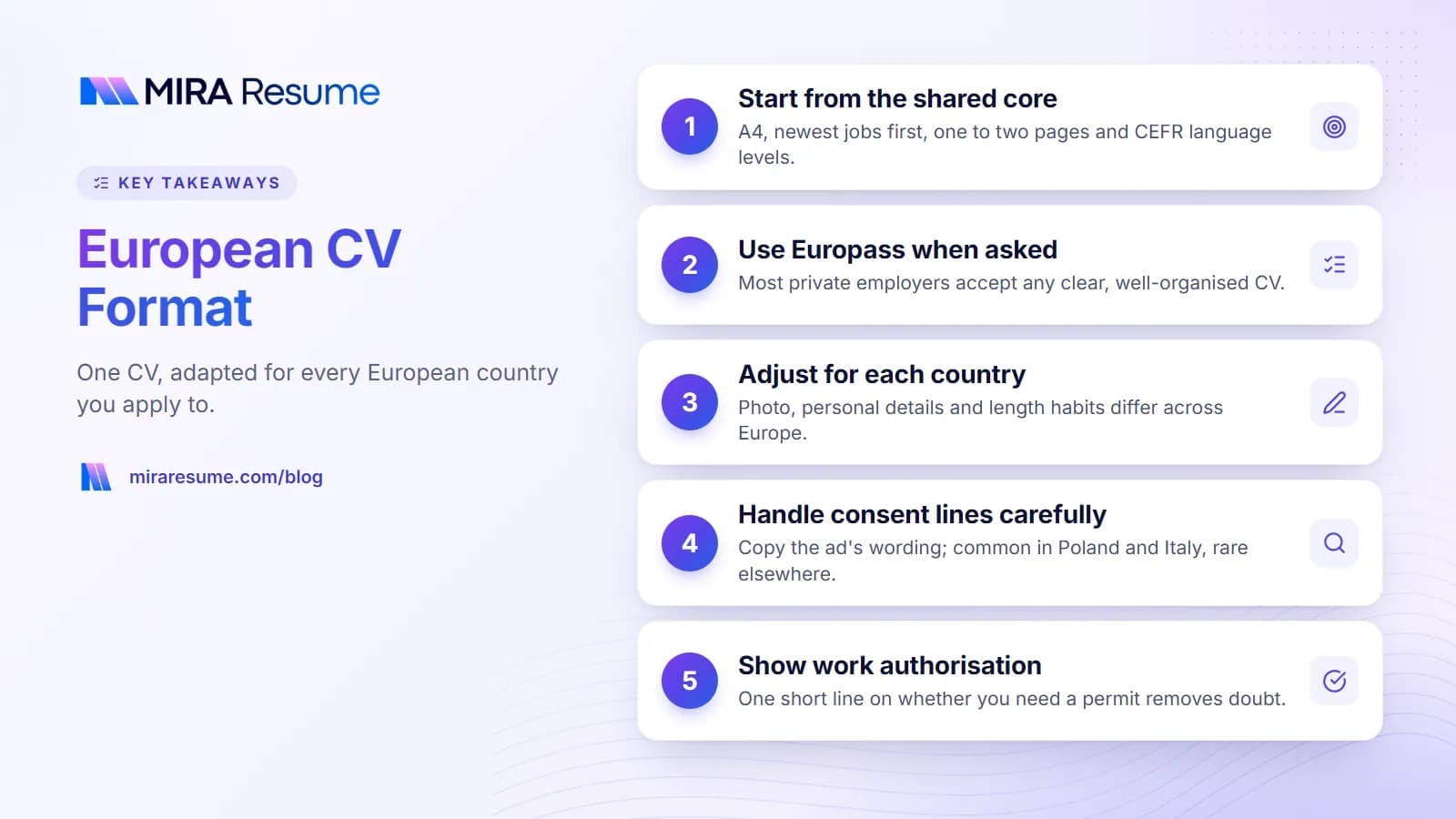
Key takeaways: 1. Start from the shared core; 2. Use Europass when asked; 3. Adjust for each country; 4. Handle consent lines carefully; 5. Show work authorisation
Key takeaways from this guide.

Is there one European CV format?

Not really. The European Union sets shared rules on things like data protection and equal treatment, but it does not set a CV format that employers must accept. Each country has its own habits, and each employer has its own preferences. What you can rely on is a shared core that works in most places. So if you are looking for one Europe CV format, the honest answer is that shared core plus a few local adjustments.

FeatureCommon across EuropeVaries by country
Name of the documentCV or curriculum vitaeLocal names, such as Lebenslauf in Germany
OrderReverse chronological, newest firstGermany often uses a tabular layout
Length1 to 2 pages for most jobsShorter is favoured in some countries for early-career roles
Paper sizeA4Rarely varies
LanguagesCEFR levels (A1 to C2)How much the local language matters
PhotoUsually optionalMore traditional in some countries than others
Cover letterCommonly expectedCalled a motivation letter or personal letter in some places
Data-consent lineNot needed in most countriesHabitually added in some, such as Poland and Italy

If you are new to the term, our guide to what a CV is explains it, and CV vs resume covers why Europe says CV where North America says resume. In practice, a European resume format and a European CV are the same thing.

Europass: one option, not a requirement

The European Commission runs Europass, a free online platform where you can build a profile and create a CV and cover letter in many European languages. The current platform was relaunched in 2020. A Europass CV follows a fixed structure that is familiar to many readers across Europe.

When a Europass CV makes sense:

  • The job ad, programme or institution asks for one. Some public bodies, education programmes and universities do.
  • You are applying to several countries at once and want one recognisable structure.
  • You want a guided way to list language levels and training.

When a standard CV is usually better:

  • The employer does not ask for Europass, which is true of most private-sector jobs.
  • You are uploading to an online portal. Some exported layouts use columns or icons that applicant tracking software can read out of order.
  • You want space to show results rather than fill in fixed boxes.

Our full Europass CV guide walks through each Europass section, how to write CEFR levels and how to make a clean, ATS-friendly version.

European resume format by country

Here is a quick comparison of habits in some of the countries people apply to most. These are common patterns, not rules. Sector, company size and the job ad all make a difference.

CountryUsual nameTypical lengthPhotoNotable habits
GermanyLebenslauf1 to 2 pagesOptionalTabular layout; cover letter and certificates often attached
FranceCVOften 1 page early in a career, up to 2 laterOptionalConcise layout; a cover letter (lettre de motivation) is commonly expected
NetherlandsCV1 to 2 pagesOptionalDirect, factual tone; a motivation letter is often requested
SpainCurrículum or CV1 to 2 pagesTraditionally common, optionalClear education section; language levels matter
ItalyCurriculum vitae1 to 2 pagesOptionalEuropass style is familiar; data-processing line often seen
Nordic countriesCV1 to 2 pagesOptionalModest, factual tone; the cover or personal letter carries weight
PolandCV1 to 2 pagesOptionalA GDPR (RODO) consent line is habitually added
UK and IrelandCVAround 2 pagesNot expectedNo date of birth or photo; see the country guides

Germany

German employers often expect a complete application: a one-page cover letter (Anschreiben), a tabular CV and copies of certificates. Photos and personal details such as date of birth are optional. Our German CV format guide has a full example.

France, Spain and Italy

In all three, a tidy one to two page CV with a clear education section works well. Photos have been a habit in some places but are optional. In Italy, the Europass CV layout is widely recognised, and many CVs end with a line authorising the processing of personal data; more on that below.

Netherlands and the Nordic countries

Readers tend to value brevity and plain facts over self-promotion. A short personal profile and a specific, well-argued letter often matter as much as the CV.

Poland

A clean, reverse chronological CV is standard. Many Polish candidates add a GDPR consent clause at the bottom out of habit, and some employers still ask for it.

UK and Ireland

The UK is no longer in the EU, but many people job hunt across both. British and Irish CVs are lean: no photo, no date of birth, around two pages. See the UK CV format and our Ireland CV template guides.

The General Data Protection Regulation (GDPR) applies across the EU and the wider European Economic Area. It sets rules for how organisations collect and use personal data, including the data in your CV.

In some countries, notably Poland and Italy, candidates have long added a line at the bottom of the CV giving consent for their data to be processed for recruitment. Whether that line is legally needed is a separate question. Employers can often rely on other legal grounds to process a CV you send them. In Poland, the Labour Code sets out the basic data an employer may ask a candidate for, and since 2019 a candidate who refuses or withdraws consent may not be treated less favourably for it. Italy's privacy code also says consent is generally not required for the personal data in CVs sent for recruitment. Even so, some job ads still ask for it, and some recruiters may set aside a CV without it.

A practical approach:

  • If the job ad gives specific consent wording, copy it exactly.
  • If you are applying in Poland or Italy and the ad says nothing, adding a short line does no harm.
  • In most other European countries, leave it out unless asked.

Example: "I consent to the processing of my personal data contained in this CV for the purposes of this recruitment process, in accordance with Regulation (EU) 2016/679 (GDPR)."

This is general information, not legal advice. Rules and employer practice can change, so follow the instructions in each ad.

Personal details, photos and work authorisation

Across Europe, the trend is towards fewer personal details on CVs. EU equal-treatment directives, put into national laws, protect people at work against discrimination on grounds such as racial or ethnic origin, sex, religion or belief, disability, age and sexual orientation. As a result, many employers do not want to see details that could reveal these.

  • Always include: name, phone with country code, email, city and country, LinkedIn if it is up to date.
  • Usually optional: photo, date of birth, nationality.
  • Usually leave out: marital status, children, religion, health information, ID or passport numbers.

Work authorisation is the one personal detail that often helps. Citizens of EU and EEA countries and Switzerland can generally work in other member countries without a separate work permit. Most other applicants need a permit or visa, such as the EU Blue Card for some highly qualified roles, under rules that differ by country. A short line removes doubt:

  • "EU citizen (Portuguese), no work permit needed"
  • "Non-EU citizen; will need a work permit for this role"
  • "Residence permit for Germany with permission to work"

Check the official immigration site of the country you are applying to, or the European Commission's EU Immigration Portal, for current rules. This is not immigration advice.

Screenshot of the Mira Resume resume builder (Fill in your details, pick a template and download a text-based PDF or an editable Word (.docx) file.)
Screenshot: Resume builder: Fill in your details, pick a template and download a text-based PDF or an editable Word (.docx) file.Try it

Languages and CEFR levels

Language skills often decide European applications, so show them clearly. The Common European Framework of Reference for Languages (CEFR) is the standard scale, and it is understood across Europe.

LevelDescriptionIn practice
A1 / A2Basic userSimple everyday situations
B1 / B2Independent userCan work in the language on familiar topics; B2 is often asked for
C1 / C2Proficient userComplex discussion, presentations and writing

Write your native language first, then each other language with its level, for example "English: C1, French: B2, Spanish: A2". If you hold a certificate, such as IELTS, a Cambridge English exam, DELF or DALF for French, DELE for Spanish or a Goethe-Zertifikat for German, name it. Be honest: interviewers often switch languages to check.

A European CV structure that works almost anywhere

If you need one CV to adapt for several countries, start with this order and adjust for each market.

OrderSectionNotes
1Contact detailsName, phone with country code, email, city and country, LinkedIn, work authorisation line
2ProfileThree to four lines on your experience and target role
3Work experienceMonth and year, job title, employer, city, three to five result-focused bullets
4EducationDegree, institution, country, year; translate titles accurately
5LanguagesCEFR level for each language, plus any certificates
6Skills and certificationsTools, software and professional qualifications
7Optional extrasVolunteering, interests or a data-consent line where local custom expects it

Here is a short example. The person and company are made up.

Ahmed Khan
Rotterdam, Netherlands | +31 6 0000 0000 | [email protected] | linkedin.com/in/ahmed-khan-example
Pakistani citizen | Dutch residence permit with permission to work

Profile
Supply chain planner with six years in port logistics and freight forwarding. Plans container flows, works with carriers across Europe and Asia, and keeps reporting accurate. Looking for a senior planning role in the Rotterdam area.

Work experience
Supply Chain Planner, Delta Harbour Logistics B.V., Rotterdam (05/2022 to present)
- Plan weekly container bookings for a portfolio of retail clients
- Built a shared delay tracker that made carrier issues visible earlier
- Coordinate with customs brokers to keep shipments on schedule

Languages
Urdu: native | English: C1 | Dutch: A2

Want a ready layout? Build it in the CV builder with a one-column design from our templates.

CV format for Europe jobs when you apply from abroad

The CV format for Europe jobs is much the same wherever you apply from, but if you are coming from another region, a few extra steps make your CV easier to act on.

  • Match the language of the ad. English CVs are widely accepted by international firms, but many roles expect the local language. Do not rely on unchecked machine translation.
  • Add a work authorisation line and a realistic start date.
  • Explain unfamiliar employers and qualifications in a few words, and keep original degree titles in brackets if the translation might be unclear.
  • Check qualification recognition. The ENIC-NARIC network of national centres gives information on recognising foreign qualifications, and regulated professions such as medicine, nursing and teaching need recognition before you can practise.
  • Look at EURES, the European job mobility portal, alongside national job boards and LinkedIn.

If your move needs explaining, a relocation cover letter can set out your timing and reasons.

ATS, cover letters and online applications

Many large European employers and recruitment agencies use applicant tracking systems to collect and sort applications. Whatever country you apply to, the same basics help your CV get read correctly:

  • One column, standard headings and real text, not images.
  • A text-based PDF unless the portal asks for Word.
  • Key words from the ad, where they truthfully match your experience.
  • A clear file name, such as "Ahmed-Khan-CV.pdf".

Check your file with the ATS checker before you upload it.

Cover letters are commonly expected across Europe, sometimes called a motivation letter or personal letter. Keep yours to one page, name the role, and give two or three examples that match the ad. The AI cover letter generator can draft a first version for you to edit, and our guide to what a cover letter is explains how the two documents work together.

Do and don't for European CVs

DoDon't
Use A4, newest jobs first, one to two pagesSend a US Letter file without checking the layout
Give CEFR levels for every languageWrite "fluent" without a level
Add a clear work authorisation lineLeave employers guessing about permits
Use Europass when it is asked forAssume every employer wants Europass
Add a consent line where the ad or local custom expects itAdd one everywhere out of habit
Decide on photos and personal details deliberatelyInclude marital status, religion or ID numbers

Final checklist

  1. Have you checked the job ad for language, format and document requests?
  2. Is your CV on A4, one to two pages, newest roles first?
  3. Are languages listed with CEFR levels and certificates?
  4. Have you added a work authorisation line if you need a permit?
  5. Have you adjusted photo, personal details and any consent line for this country?
  6. Is the file a text-based PDF that passes an ATS check?
  7. Have you written a short, specific cover letter?

For more country-specific detail, browse our CV formats by country hub, and read our guide on how many pages a CV should be if you are struggling to fit everything in.

Frequently asked questions

Is there a standard CV format for Europe?

No single format is required across Europe. Most countries share the basics: A4 paper, newest jobs first, one to two pages and CEFR language levels. Details such as photos, personal data and consent lines vary by country and employer. Europass offers one common structure, but most private employers accept any clear, well-organised CV.

Should I use a Europass CV?

Use Europass when the employer, programme or institution asks for it, or when you want one recognisable structure for several countries. Most private-sector employers do not require it. If you apply through an online portal, a simple single-column CV with the same information is often easier for applicant tracking software to read.

Do European CVs include a photo?

In most European countries a photo is optional. It has been a habit in some places, such as Germany and Spain, but many employers, especially international companies, prefer applications without one. In the UK and Ireland a photo is not expected. If you include one, use a recent, professional headshot and follow any instruction in the ad.

Do I need a GDPR clause on my CV?

In most European countries, no. In some, notably Poland and Italy, candidates often add a line consenting to the processing of their personal data, and some job ads still ask for it, even though employers can usually rely on other legal grounds. Follow the ad's wording if it gives one. This is general information, not legal advice.

How should I show language skills on a European CV?

Use the CEFR scale, which runs from A1 and A2 for basic users, through B1 and B2 for independent users, to C1 and C2 for proficient users. List your native language first, then each other language with its level, and name any certificate you hold, such as IELTS or a Goethe-Zertifikat.

Can I apply for jobs in Europe with an English CV?

Often, yes. International companies, many tech firms and roles where English is the working language commonly accept English CVs. If the job ad is written in the local language, a CV in that language is usually expected unless the ad says otherwise. Avoid unchecked machine translation, and keep CEFR levels for every language you list.

Found this useful? Share it

Send it to a friend who is job hunting, or save it for later.

Read this guide with AI

Get a plain-language summary and help applying it to your own resume. Pick an assistant; it opens with this article and a ready prompt.

Back to CV Formats by Country hub

All articles