Coming soon
CV Formats by Country

Resume Format in Thailand: How to Write a Thai or English Resume

Resume format Thailand guide: photo, personal details, Thai vs English resumes, a section order table, and tips for teachers, hospitality staff and expats.

Mira Resume Editorial Team · Career content team Published Updated 9 min read
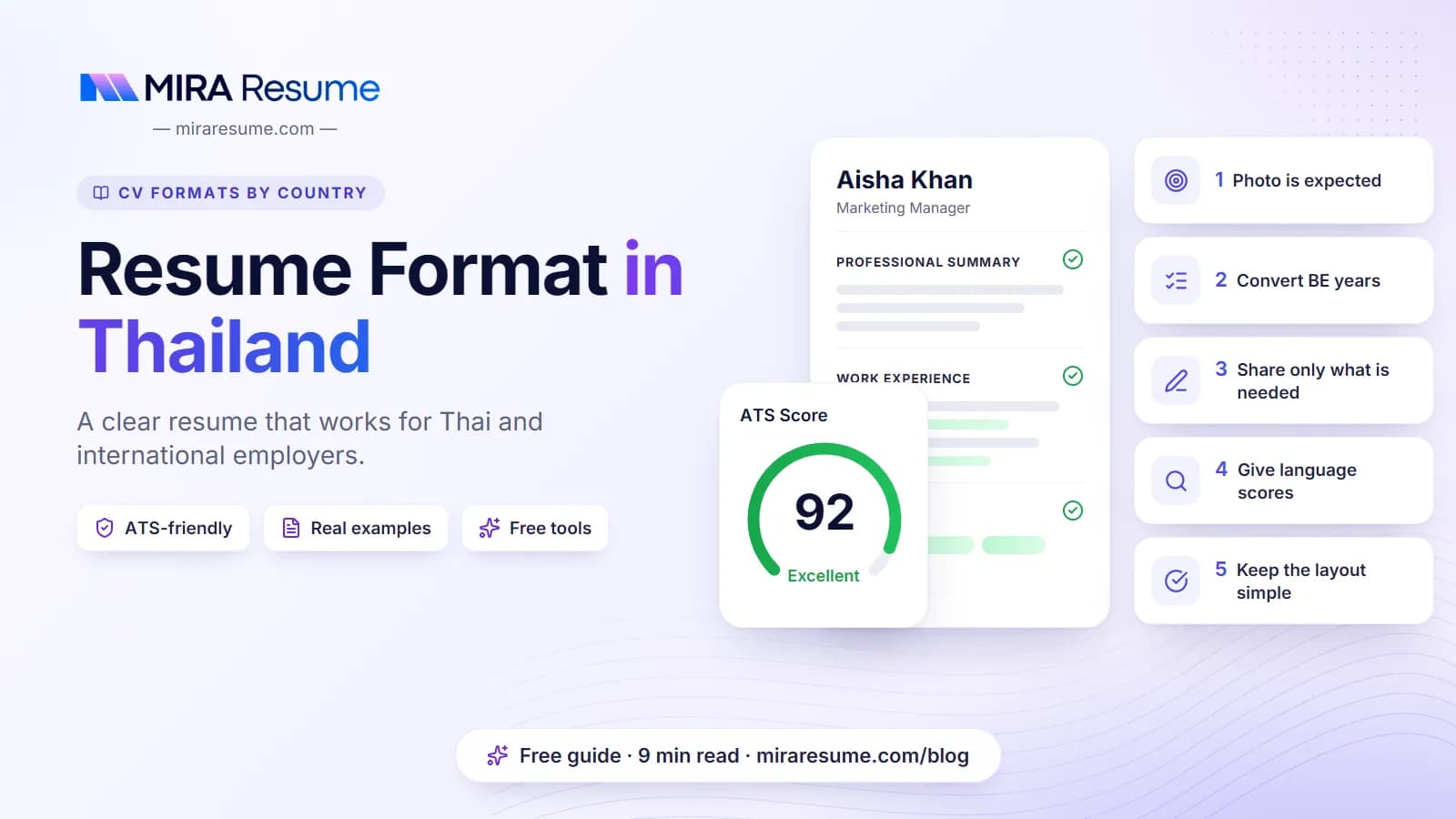
Resume Format in Thailand: cover image for the Mira Resume guide, with an example resume and the 5 main points

If you are looking for the right resume format Thailand employers will recognise, start with one idea: Thai hiring habits mix local tradition with international practice. A Thai family business, a Japanese manufacturer in the Eastern Seaboard, a five-star hotel in Phuket and a multinational office in Bangkok may each expect something slightly different from your document.

This guide explains what is common in Thailand today: resume length, the photo, which personal details to include and which to leave out, the usual section order, and how Thai and English resumes differ. It also covers foreigners applying for teaching, hospitality and corporate roles, with a short fictional example you can adapt.

Practice varies by employer and sector, so use this as a guide, not a rulebook. When a job ad gives instructions, follow the ad.

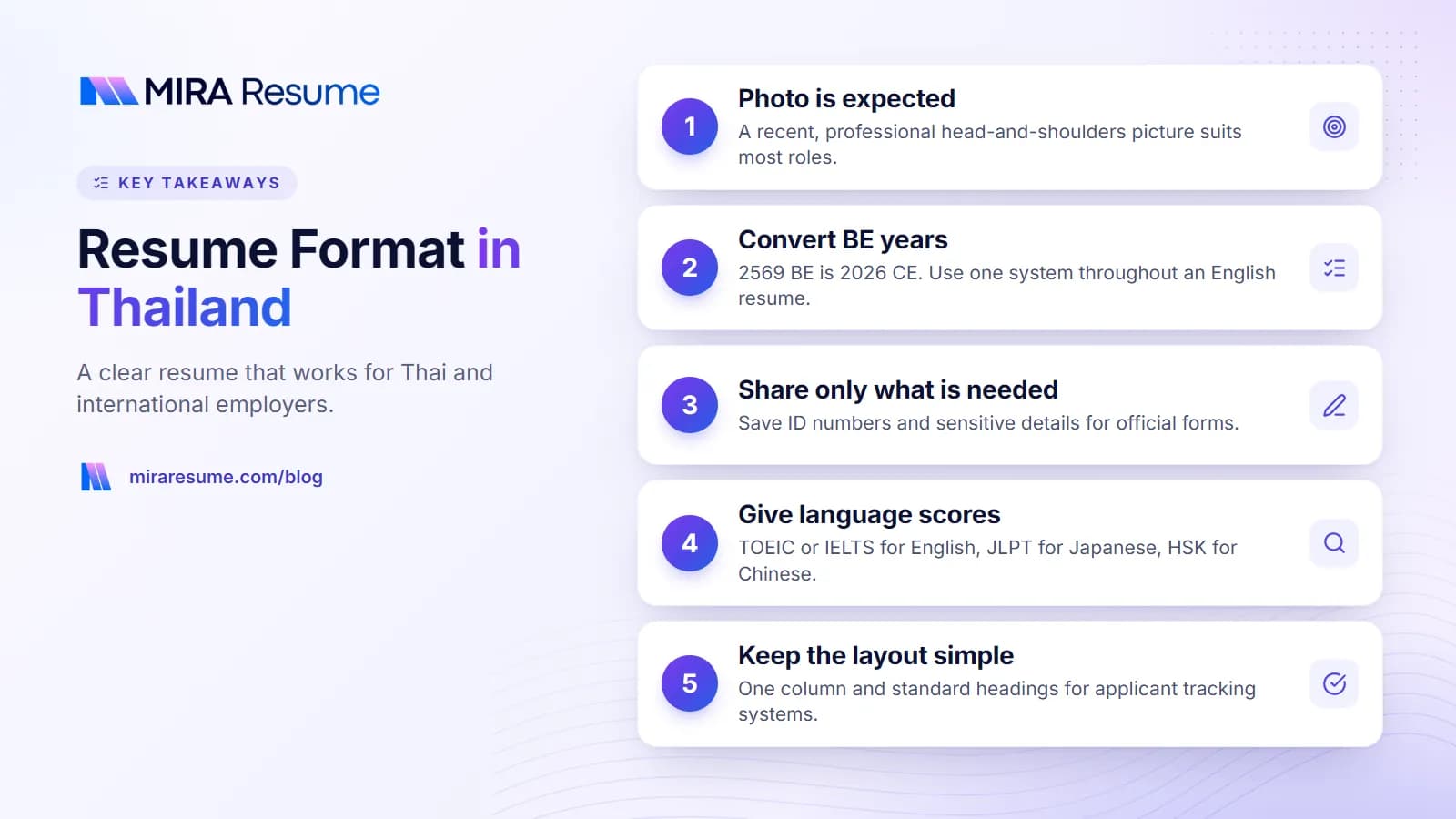
Key takeaways: 1. Photo is expected; 2. Convert BE years; 3. Share only what is needed; 4. Give language scores; 5. Keep the layout simple
Key takeaways from this guide.

Resume or CV in Thailand: the basics

In Thailand, the words resume and CV are both used, and most employers treat them as the same thing: a short summary of your work and education. Thai job sites and recruiters often use the English loanword resume. Many employers also ask you to fill in their own job application form at the interview stage, which may ask for more personal detail than your resume.

Quick facts on the CV format Thailand employers commonly use

ItemCommon practice in Thailand
Name for the documentResume or CV, used interchangeably
Length1 page for graduates, 2 pages for most experienced candidates
Paper sizeA4
LanguageThai for many local firms; English for multinationals, international schools and many hotels
Year formatThai documents often use Buddhist Era (BE) years; English resumes use Western (CE) years
PhotoCommonly included
File typeText-based PDF is common; .docx if the employer asks

The Buddhist Era year is 543 years ahead of the Western year, so 2569 BE is 2026 CE. If your degree certificate or transcript shows BE years, convert them carefully on an English resume and keep one system throughout.

Not sure what to call your document? Our guide to the difference between a CV and a resume explains how the terms vary around the world.

Personal details Thai employers commonly ask for

Traditional Thai resumes and application forms often include personal details that would be unusual in the UK or US, such as date of birth, age, nationality, religion, marital status, and sometimes height and weight. Some forms ask male Thai applicants about military service status. You will still see these fields on many Thai resume templates, but practice is changing, especially at international companies.

The photo

A photo is commonly included on resumes in Thailand. Use a recent, professional head-and-shoulders picture with plain clothing and a neutral background. A formal or business-casual look suits most office and hotel roles.

Data protection

Thailand's Personal Data Protection Act B.E. 2562 (2019), often called the PDPA, came fully into force on 1 June 2022. In general terms, it expects organisations to collect personal data for a clear purpose and keep it secure, and it gives extra protection to sensitive data such as religious beliefs, health information and criminal records. For applicants, the practical habit is to share what an employer needs to assess you, and save sensitive details for official forms that ask for them.

DetailInclude?Notes
Full name (and nickname if you use one at work)YesSpell your English name exactly as on your passport or ID card
Phone with +66 and emailYesUse a professional email address
District and province, or cityYesA full street address is rarely needed
PhotoCommonly includedRecent and professional
Date of birth or age, nationalityOften includedNationality is useful for foreigners because of work permit rules
Marital status, height, weightOptionalLeave off unless the ad asks and it is relevant
Religion, health detailsUsually leave outSensitive data; give it only if an official form requires it
Thai national ID or passport numberLeave outProvide it on the employer's application form or at onboarding

This order suits most private-sector roles in Thailand. Graduates can put education before experience.

OrderSectionWhat to put there
1HeaderName, nickname (optional), job title, phone, email, location, photo
2Profile or career objective2 to 4 lines on your experience and the job you want
3Work experienceMost recent first, with short results-focused bullets
4EducationDegree, university, years, GPA or honours if strong
5SkillsSoftware, tools, job-specific skills
6LanguagesThai, English and others, with test scores where you have them
7Certificates, training, activitiesCourses, licences, volunteering, student projects
8Personal details or referencesOnly what the ad asks for; references can be "available on request"

Fictional example (English resume)

Kanokwan Srisuk (Ploy)
Digital Marketing Executive | Bangkok
+66 80 000 0000 | [email protected] | linkedin.com/in/example

Profile
Digital marketing executive with three years of experience running social media and search campaigns for a consumer brand. Works in Thai and English (TOEIC 845). Looking for a regional marketing role at an international company in Bangkok.

Digital Marketing Executive, Lotus Lane Foods Co., Ltd., Bangkok | 05/2023 to present

  • Plan and run monthly social media campaigns in Thai and English across three product lines.
  • Rebuilt the brand's search ads structure with the agency, which lowered cost per lead over six months.
  • Prepare a weekly performance report for the marketing manager and sales team.

Each bullet starts with an action and ends with an outcome. That works equally well in a Thai resume. For more ideas on the opening lines, see our resume summary examples.

Thai resume or English resume?

The simplest rule is to use the language of the job ad. A Thai ad usually means a Thai resume is welcome. An English ad usually means the team works in English, so send an English resume. Some employers ask for both; if so, keep the facts identical in each.

Who usually wants which

  • Multinationals and regional offices in Bangkok commonly expect English.
  • Japanese companies, of which there are many in Thailand, often value Japanese language skills, and some roles ask for a JLPT level.
  • International schools and many hotels generally work in English.
  • Thai companies and government bodies often prefer Thai and may use their own application forms.

Tips for a strong Thai resume or English version

  • Translate job titles accurately and do not upgrade them in translation.
  • Check machine translations carefully, or ask a fluent friend to read the final version.
  • Use BE years on a Thai resume if you prefer, but use CE years on an English one.
  • Spell your name and employers' names the same way on your resume, LinkedIn profile and certificates.

Choosing a resume template in Thailand

Search for a free resume template Thailand job seekers commonly use and you will find photo boxes, sidebars and skill bars. They can look attractive, but complex two-column designs can be harder for applicant tracking systems to read. For large employers, a clean one-column layout with the photo in the header is a safer choice. Our ATS friendly CV template guide shows how.

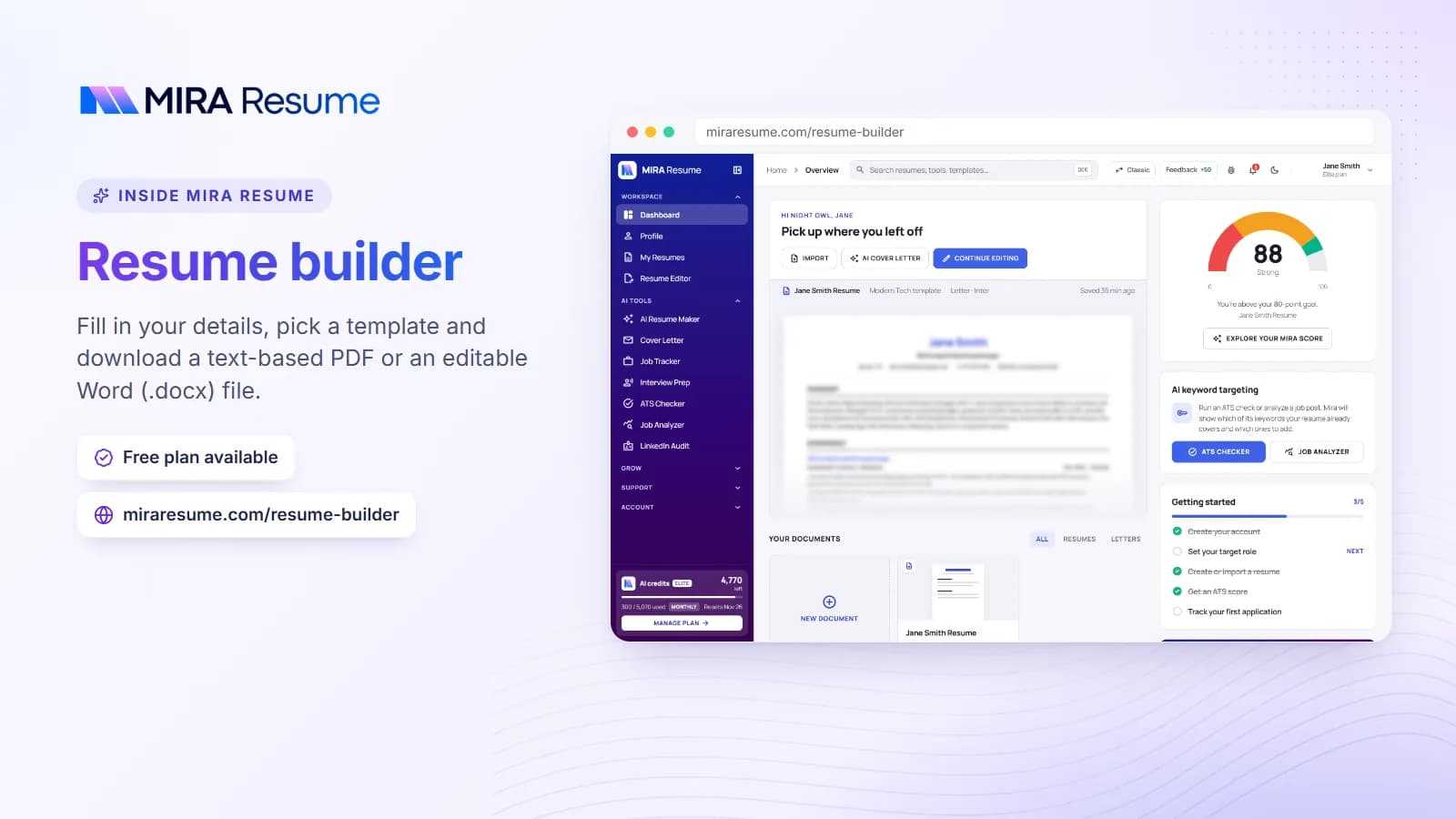
Screenshot of the Mira Resume resume builder (Fill in your details, pick a template and download a text-based PDF or an editable Word (.docx) file.)
Screenshot: Resume builder: Fill in your details, pick a template and download a text-based PDF or an editable Word (.docx) file.Try it

CV for jobs in Thailand as a foreigner

Thailand hires foreigners for teaching, hospitality, management and specialist roles. Your resume should show that you fit the job and that hiring you is practical: your nationality, current location, availability and any relevant licences.

Teaching jobs

Schools and language centres usually look for a degree, a TEFL, TESOL or CELTA certificate, and experience with the age group they teach. Many formal schools also need foreign teachers to hold a teaching licence from the Teachers Council of Thailand or temporary permission to teach without one, and requirements can differ for language schools. Put your degree, certificate and teaching experience near the top. Our teacher resume sample shows a clear layout.

Hospitality and tourism

Hotels and resorts in Bangkok, Phuket, Chiang Mai, Koh Samui and other destinations often hire international staff for guest-facing, sales and management roles. Show the scale of the properties you worked in, the systems you used (such as a property management system), guest feedback you improved and the languages you speak. Languages spoken by the property's guests can be a real advantage. Our server resume guide has useful bullet ideas for food and beverage roles.

Multinational and regional roles

Lead with scope and results: countries covered, team size, budgets, revenue or cost improvements. If you are applying from abroad, add a short line such as "Relocating to Bangkok in January 2027" or "Will require work permit sponsorship".

Work permits in general terms

Foreigners generally need a work permit to work in Thailand, usually alongside an appropriate non-immigrant visa, and the employer normally plays a central role in the application. Thai law also reserves some occupations for Thai nationals. Rules and document lists change, so check with your employer and official Thai government sources such as the Ministry of Labour's Department of Employment. This guide is not legal or immigration advice.

Education, languages and skills

Education is read closely, especially for graduates. List your degree, faculty or major, university and years. Thai universities commonly use a 4.00 GPA scale, and transcripts may show a cumulative GPA, sometimes written GPAX. Include it if it is strong. If you graduated with first-class or second-class honours, add it after the degree.

Languages

Give evidence, not just a label:

  • English: TOEIC or IELTS score and year (many Thai employers ask for TOEIC)
  • Japanese: JLPT level, for example N3
  • Chinese: HSK level
  • Thai (for foreigners): describe what you can do, such as "conversational, can handle basic guest requests"

Skills and certificates

List software and job-specific skills you can use well, and add training courses or licences relevant to the role. Our guide to skills to put on a resume helps you choose the right ones, and the resume length guide helps you decide what to cut.

ATS and online applications in Thailand

Many jobs in Thailand are posted on JobsDB, JobThai and LinkedIn, and on company career pages. Teaching jobs also appear on specialist teaching job sites. Larger employers often use an applicant tracking system (ATS) to sort applications, so make your file easy to read:

  • One column, standard headings (Work Experience, Education, Skills, Languages).
  • A text-based PDF or .docx, never a scanned image.
  • Photo in the header, but no text inside images or icons.
  • Keywords from the job ad, used only where they are true.
  • A clear file name, for example Kanokwan-Srisuk-Resume.pdf.

Before you apply, run your file through our free ATS checker. A short, tailored cover letter helps too, especially for English-speaking employers; our AI cover letter generator can give you a first draft to edit.

Do's and don'ts for a resume in Thailand

DoDon't
Use the language of the job adSend a Thai resume to an English-only international team
Add a recent, professional photoUse a holiday photo or a heavily filtered selfie
Keep it to one or two A4 pagesCopy every duty from your job descriptions
Convert BE years to CE on an English resumeMix BE and CE years in the same document
Give language test scoresClaim "native" or "fluent" levels you cannot back up
Save ID numbers and sensitive details for official formsUpload a resume with your ID number to job sites
Show results you can explain in an interviewInflate titles, numbers or qualifications

Final checklist before you apply

  • The resume is in the same language as the job ad.
  • It fits on one or two A4 pages.
  • Your English name matches your passport or ID spelling.
  • The phone number includes +66 (or your own country code if abroad).
  • The photo is recent and professional.
  • Years use one system: CE on English resumes.
  • Each job has two to five bullets with outcomes.
  • Language levels have scores or clear descriptions.
  • No ID numbers, religion or health details unless a form requires them.
  • Foreign applicants have stated nationality, location and availability.

Comparing the region? See our guides to the Vietnam CV format, Cambodia and Laos CV format and Malaysia resume format, or browse all CV formats by country. When you are ready, build a clean, ATS-friendly resume in our resume builder.

Frequently asked questions

Should I put a photo on my resume in Thailand?

Yes, a photo is commonly included on resumes in Thailand, and many employers expect one. Use a recent, professional head-and-shoulders picture with plain clothing and a neutral background. Some international companies treat the photo as optional, so if a job ad or careers page says not to include one, follow that instruction.

How long should a resume be in Thailand?

One A4 page is usually enough for new graduates and junior roles. Most experienced candidates use two pages. Focus on recent, relevant experience and results, and cut older or unrelated detail. Senior, academic or technical roles can justify more, but check the job ad and keep every line useful.

Should I write my resume in Thai or English?

Use the language of the job ad. Multinationals, international schools and many hotels work in English, while many Thai companies and government bodies prefer Thai. If an employer asks for both, prepare two versions with identical facts. Use Western years on an English resume and check any translation carefully.

What personal details should I put on a Thai resume?

Include your name, phone with country code, email, location and a photo. Date of birth and nationality are often included. Marital status, height and weight are optional, and religion or health details are usually best left out. Keep your ID or passport number for the employer's official application form.

Do foreign teachers need a licence to teach in Thailand?

Many formal schools need foreign teachers to hold a teaching licence from the Teachers Council of Thailand, or temporary permission to teach without one, in addition to a work permit. Requirements can differ for language schools and change over time, so check with your school and official sources before you accept a job.

Do foreigners need a work permit in Thailand?

Foreigners generally need a work permit to work in Thailand, usually alongside a suitable non-immigrant visa, and the employer normally plays a central role in the application. Some occupations are reserved for Thai nationals. Check current rules with your employer and official Thai government sources, as this is not legal advice.

Found this useful? Share it

Send it to a friend who is job hunting, or save it for later.

Read this guide with AI

Get a plain-language summary and help applying it to your own resume. Pick an assistant; it opens with this article and a ready prompt.

Back to CV Formats by Country hub

All articles