Coming soon
AI Resume Tools

Mira Scout vs JobHire.AI: Which One Fits Your Job Search?

Mira Scout vs JobHire.AI compared: JobHire.AI is an autonomous apply agent, while Mira Scout adds rules, limits and a pause switch you control.

Mira Resume Editorial Team · Career content team Published Updated 7 min read
Mira Scout vs JobHire.AI: cover image for the Mira Resume guide, with an example resume and the 0 main points

Mira Scout vs JobHire.AI is a question about what you want software to do for you. JobHire.AI is generally described as an autonomous agent that finds jobs and applies in the background. Mira Scout, coming soon to Mira Resume Pro and Elite, also works in the background but is built around rules you set, such as a minimum match, a daily limit and a pause switch.

Autonomous agents promise a hands-off search. How hands-off you actually want to be is the real decision. This guide compares them side by side, explains where each fits, and covers the trade-offs honestly. Mira Resume is not affiliated with JobHire.AI. The Mira Scout screens shown below are illustrations with sample data, because the feature has not launched yet. Mira Scout was previously called AI Career Ops; only the name has changed, and the plans and rules described here are the same.
The short answer

Both products promise to take the grind out of applying, and both can work while you are away. The question is how much autonomy you want to give software and how much transparency you get back. Mira Scout is designed as an agent on a leash: it works in the background, but inside rules you set and report back each morning.

If you want to set the rules and walk away entirely, an autonomous service may feel appealing. If you want guardrails and a clear log, Mira Scout is designed with that in mind.

What JobHire.AI is

JobHire.AI is generally described as an AI service that finds job listings matching your preferences and submits applications for you, usually with a tailored resume and cover letter. Reviews say its web app can submit automatically or wait for your approval, and that a separate browser extension leaves the submitting to you. Reported application volumes vary by plan.

Pricing and refund terms are described differently across sources, and some reviews report billing complaints, so read the vendor's own terms carefully and understand what recurs automatically before subscribing.

What JobHire.AI does well

An autonomous service is attractive when time is your scarcest resource. Tools in this category are good at:

  • Hands-off operation. Set preferences and let the service run in the background.
  • Tailored documents. Resume and cover letter adjustments for each application.
  • Dashboards. A record of what was submitted and where.
  • Options on approval. Some let you choose between auto-submit and approve-first modes.

The trade-off is trust. The more autonomous the agent, the more it matters that you can see exactly what it sent and stop it quickly.

Where Mira Scout is different

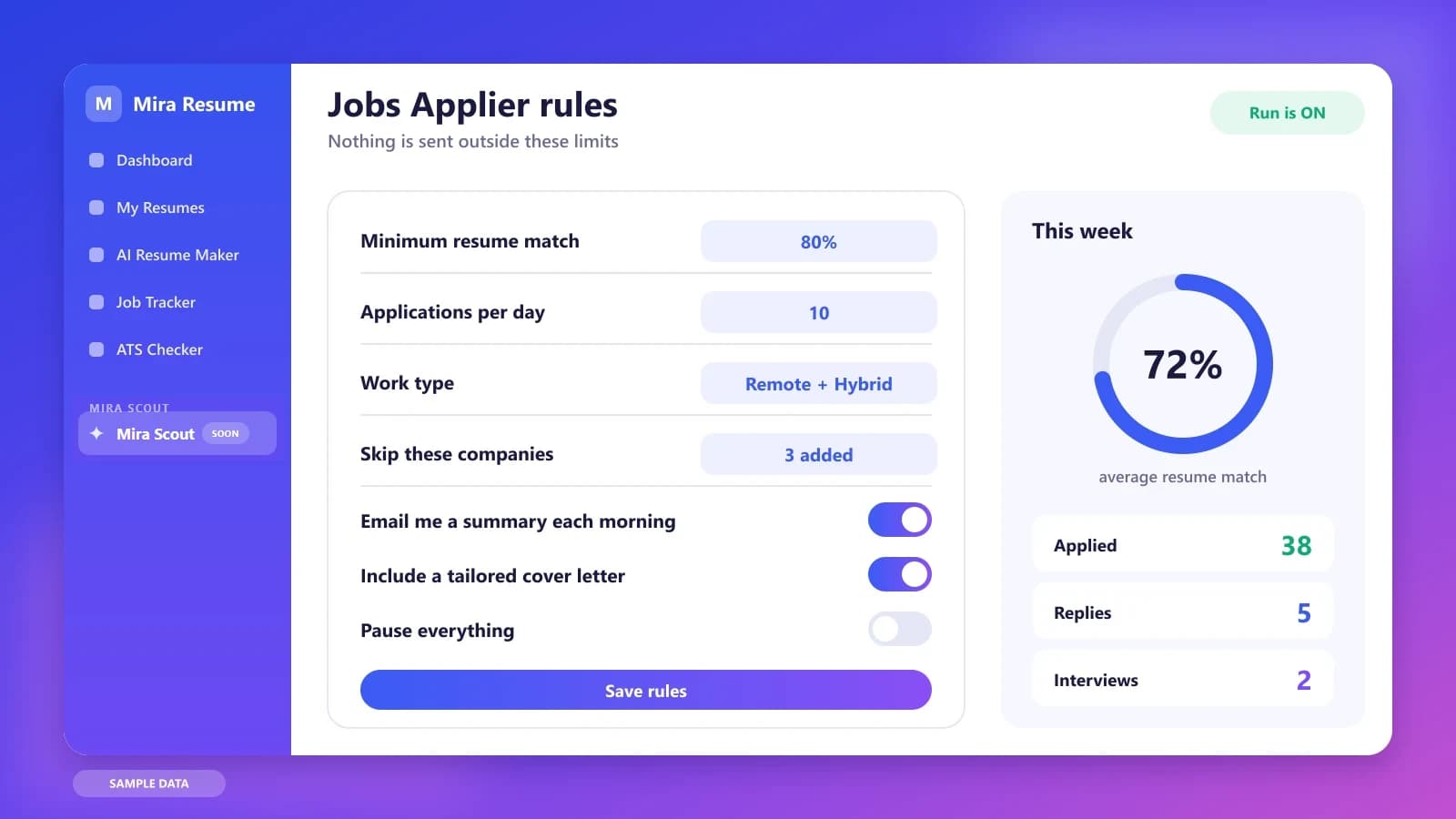
Mira Scout is designed around visible, adjustable rules. The minimum resume match keeps weak fits out. The daily limit caps volume. A skip list removes companies you do not want. A pause switch stops everything immediately. Each application uses a tailored resume and cover letter and is logged in your Job Tracker, and a morning summary shows what was sent and what was skipped.

It also lives inside Mira Resume, so the resume it works from is the one you edit and check for ATS issues yourself. You are not handing a CV to a separate service and hoping the versions match.

Illustration of the Jobs Applier rules screen: minimum match, daily limit, work type, pause switch and weekly stats
Illustration with sample data: the rules that decide what the applier is allowed to do.

Mira Scout vs JobHire.AI: side-by-side comparison

This table describes what each tool is designed for. JobHire.AI details come from its own published pages and third-party reviews, and may have changed, so check its website directly. Mira Scout details describe our plan and may change before launch.

QuestionJobHire.AIMira Scout (coming soon)
PostureAutonomous agent in the backgroundBackground agent bound by your rules
ControlMode and plan settingsMin match, daily limit, skip list, pause switch
TransparencyDashboard of submissionsMorning summary and Job Tracker log
Resume sourceA resume uploaded to the serviceYour master resume in Mira Resume
TailoringPer application, by the servicePer application, editable in the Mira editor
Billing clarityCheck terms and renewal carefullyPart of Pro and Elite plans
AvailabilityAvailable nowPro and Elite members, launching soon

How much autonomy is the right amount?

There is no single right answer, but there is a sensible way to find yours. Start with the least autonomy you can tolerate and increase it only when the results earn your trust.

  1. Week one: a low daily limit and a high minimum match. Read every application the agent sent.
  2. Week two: if the applications were accurate and well targeted, raise the limit a little.
  3. Ongoing: review the summary regularly, tighten the rules when quality slips and pause when you are not able to respond to replies.

Remember that replies are the real finish line. An automated application only becomes an interview if you answer quickly. Keep your tracker current, and read how to follow up in our guide to following up on a job application.

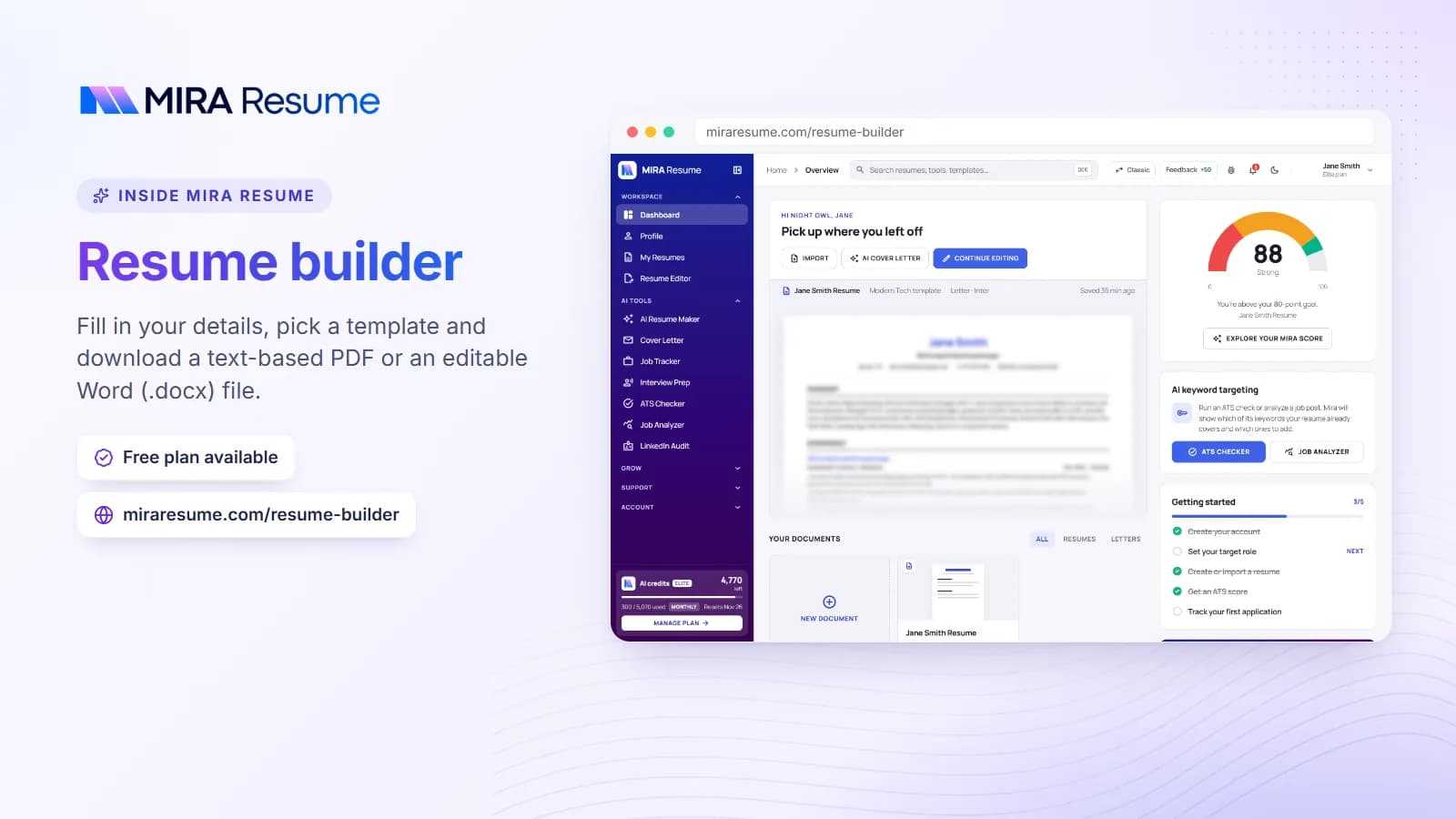
Screenshot of the Mira Resume resume builder (Fill in your details, pick a template and download a text-based PDF or an editable Word (.docx) file.)
Screenshot: Resume builder: Fill in your details, pick a template and download a text-based PDF or an editable Word (.docx) file.Try it
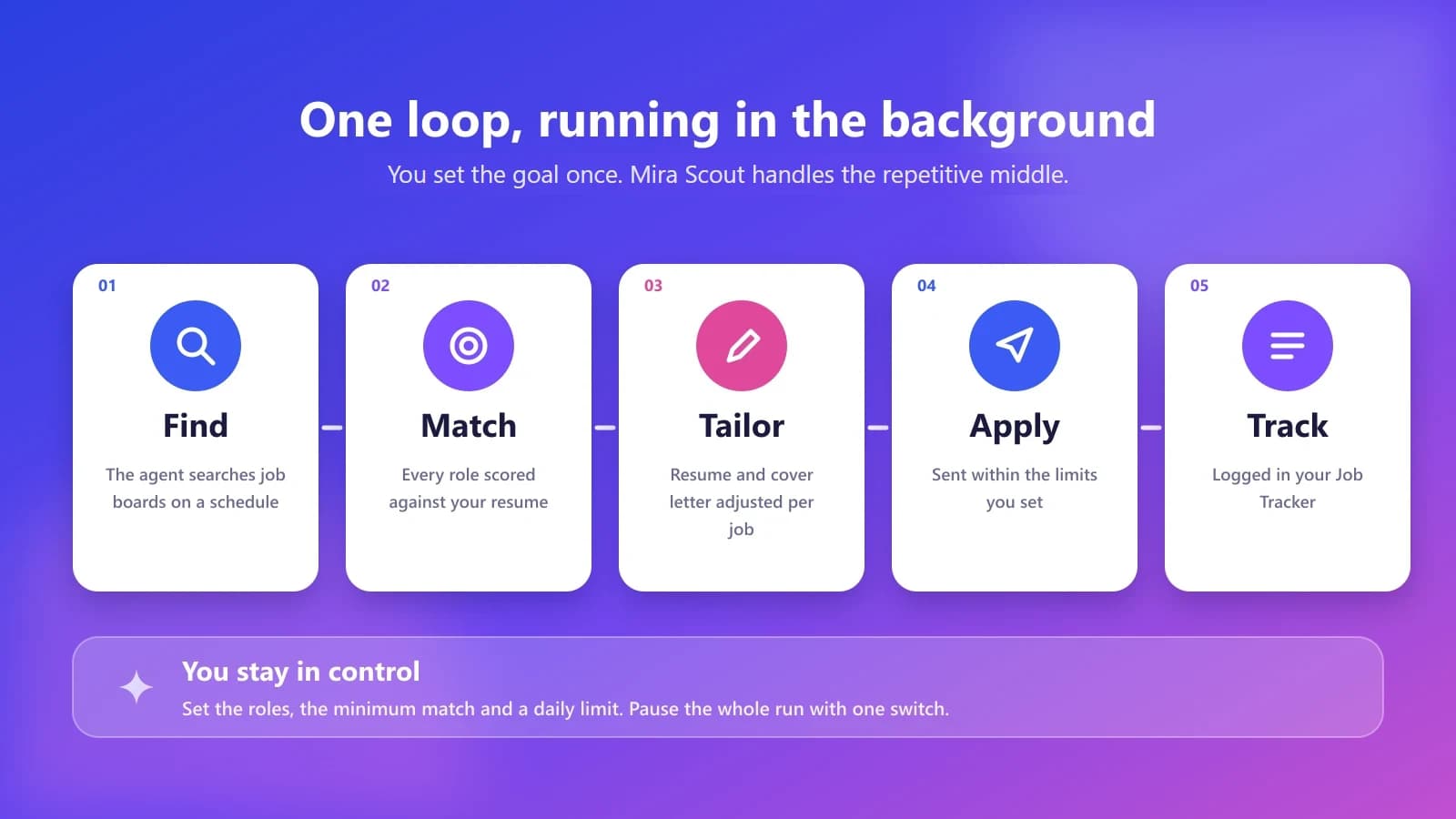
The Mira Scout loop in five steps: find, match, tailor, apply and track
Illustration: the Mira Scout loop. You set the goal once, and the repetitive middle runs in the background.

Giving an agent more autonomy, one week at a time

A careful way to adopt any autonomous agent is to widen its freedom in steps. In the first week, run it with a low daily limit and read every application it sent. If the targeting is good and the answers are accurate, raise the limit slightly in the second week.

Mira Scout is designed for exactly this ramp. Because the limit, the minimum match and the skip list are yours, you can tighten or loosen them as the results come in, and the pause switch is there if a bad week arrives. The key is that the agent earns trust gradually, rather than receiving it all on day one.

Three job seekers, three different comfort levels

Zara, a consultant on a tight schedule, is attracted by a fully hands-off agent but wants clear pricing and an easy way to stop. She reads the renewal and refund terms before anything else.

Ben, a product manager, wants guardrails. He prefers an agent that obeys a minimum match, a daily limit and a skip list, with a summary every morning so he never wonders what was sent.

Mei, a careful planner, starts with approval-first mode wherever it exists, checks the first twenty applications by hand and only then gives the agent more freedom.

Questions to ask before trusting an autonomous agent

  • What exactly can it do without my approval?
  • Are the pricing, renewal and refund terms clear before I pay?
  • Can I see every application it sent, with the resume version used?
  • How quickly can I stop it, and what happens to my data afterwards?

Limits to keep in mind about autonomous agents

An autonomous agent is only as good as the instructions and resume you give it, and it cannot judge nuance the way you can. Reviews describe mixed experiences and some billing complaints, so read the vendor's terms carefully, confirm what renews automatically and check JobHire.AI's own site for current plans before subscribing.

Which should you use?

  • An autonomous service may suit you if you want a very hands-off search and have read the billing and refund terms closely.
  • Mira Scout (after launch) may suit you if you want automation with guardrails, one master resume and a tracker you already use.
  • In both cases, a strong resume and sensible limits matter more than the logo on the tool.

The bottom line

The headline difference is posture. An autonomous agent asks for trust up front and shows results afterwards. A rules-based agent asks for your rules up front, shows results every morning and stops the moment you flip a switch. Neither is automatically better; it depends on how much supervision you want to give. If you are cautious, choose the model with the clearest controls and the clearest terms, start with tiny limits, and read the first batch of applications line by line. Trust should be earned by results, not granted by marketing.

Whichever way you lean on JobHire.AI, the groundwork is the same:

  1. Finish one master resume. Every matcher, agent and tracker works better from a clean, honest document.
  2. Run an ATS check. Use the free ATS checker to catch formatting and keyword gaps.
  3. Write down your rules. Roles, locations, salary floor, companies to avoid and a daily number you are comfortable with.
  4. Check your plan. Mira Scout is for Pro and Elite members, so compare options on the pricing page. The Mira Scout section is already visible in the V2 dashboard, with a launch countdown.

One last tip: whichever tools you choose, review the results weekly. Count applications sent, replies received and interviews booked, then adjust your resume, your rules or your targets based on what the numbers show. Small, regular adjustments usually beat one big change made in a panic.

Keep reading in the Mira Scout series. Start with Mira Scout: the complete guide, then compare it with other kinds of tools:

Frequently asked questions

How is Mira Scout different from JobHire.AI?

Both can work in the background. Mira Scout is designed around rules you control, including a minimum resume match, a daily limit, a skip list and a pause switch, and it runs inside Mira Resume using your master resume and Job Tracker.

Does JobHire.AI submit applications without approval?

Reviews describe a web app that can auto-submit or wait for approval, and a browser extension where you submit. Features change, so confirm on JobHire.AI's own site. Mira Scout is designed with rules and review, and details may change before launch.

What should I check before subscribing to any auto-apply service?

Read the pricing, renewal and refund terms, check which job boards it uses and whether they allow automation, and confirm how to pause or cancel. Test with a low volume first and review the results before scaling.

Are autonomous job agents worth it?

They can save time if your resume is strong and your rules are tight. They are less useful with a weak resume or vague targeting. No agent can guarantee interviews, so judge any tool by the quality of what it sends.

Can I keep editing my resume while an agent runs?

In Mira Resume you edit one master resume, and Mira Scout is designed to work from it. Check the ATS checker after any major edit so the agent always works from a clean, accurate document.

Found this useful? Share it

Send it to a friend who is job hunting, or save it for later.

Read this guide with AI

Get a plain-language summary and help applying it to your own resume. Pick an assistant; it opens with this article and a ready prompt.

Back to AI Resume Tools hub

All articles