
When people search for the best resume services, they usually want to know one thing: should I pay a person, use an AI tool, or write it myself? Each path can work. A professional writer offers human judgment and a conversation. An AI tool is fast and often cheaper. Doing it yourself costs the least and gives you full control. This guide compares all three fairly, so you can choose based on your situation and not on a sales pitch. We make an AI tool, so we say clearly where a human writer may serve you better.
The three main ways to get a resume written
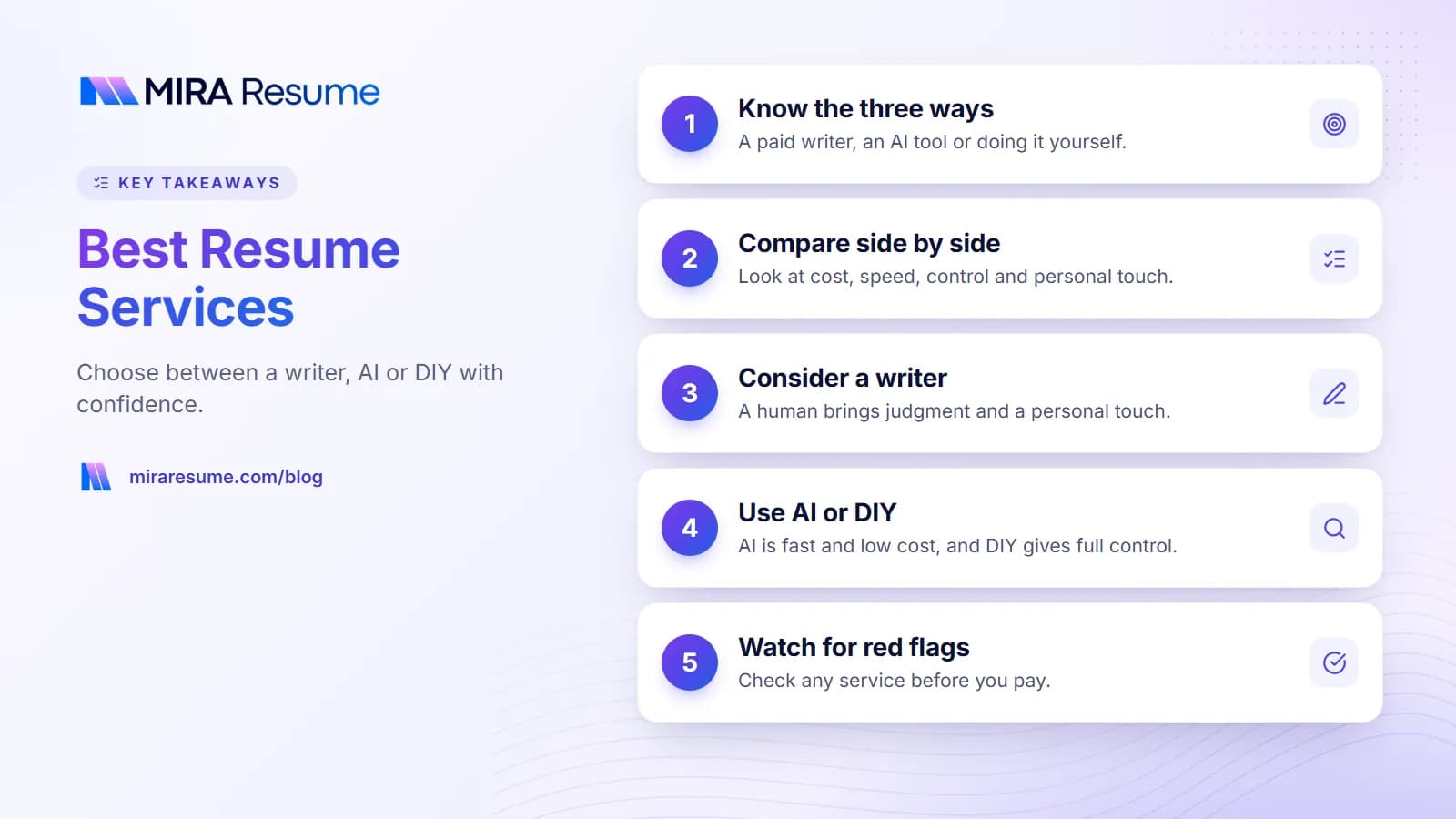
Almost every option falls into one of these groups.
1. A professional resume writer
A person works with you, often by interview or questionnaire, and writes or rewrites your resume. Some also write cover letters and LinkedIn profiles. Services range from solo freelancers to large companies. Quality, process, and style vary a lot.
2. An AI resume tool
Software drafts or rewrites your resume from the facts you give it. It is quick, available at any hour, and usually costs much less than a person. It can also invent details or give bland wording, so you must review it.
3. Doing it yourself (DIY)
You write it using guides, examples, and a template, maybe with feedback from a friend or a resume review. It takes the most of your time, and it gives you the most control.
Many people mix these. For example, you might draft with AI, then pay for a human review, or write it yourself and run it through a checker. Nothing says you must pick only one.
Side-by-side comparison
This table shows the typical trade-offs. Exact details vary by provider, so treat it as a general guide.
| Factor | Professional writer | AI tool | DIY |
|---|---|---|---|
| Cost | Varies widely by writer and package | Often free to start; paid plans vary | Free, apart from your time |
| Speed | Often days, depending on the service | Minutes to draft | Hours, depending on your pace |
| Personal advice | Strong, if the writer asks good questions | Limited; follows your inputs | Only what you or friends add |
| Accuracy of facts | Depends on what you tell the writer | Can add made-up details; you must check | You know the facts |
| Your voice | Writer may or may not capture it | Can sound generic until you edit | Fully yours |
| ATS-readable layout | Varies; ask to see the file format | Often built in, but test it | Depends on the template you choose |
| Revisions | Set by the service terms | Edit as often as you like | Unlimited |
| Best for | Career changes, senior roles, tricky stories | Fast drafts, tailoring to many jobs | Simple histories, tight budgets |
For cost, we are not listing numbers. Prices for writers and tools change often and differ across countries, so always check current pricing and what is included, such as revisions, formats, and a cover letter.
When a professional resume writer is worth considering
A human writer can be a good fit when your story is hard to tell. A few examples:
- A big career change. A person can help you pick which past work to show and how to word it for a new field.
- Senior or executive roles. Leadership resumes depend on how well you frame scope and results.
- Gaps, short jobs, or unusual paths. A skilled writer can help you present these clearly and honestly. Our guide on resume gaps shows what that can look like.
- You freeze when writing about yourself. Talking it through with someone can unlock the details.
- You have the budget and want a done-for-you option.
How to vet a writer
- Ask for a sample, with personal details removed.
- Ask what file formats you will get, and whether the file can be copied as text.
- Ask how many revisions are included and how long they take.
- Read the refund and privacy terms.
- Be wary of any promise of a guaranteed interview or job. No honest provider can promise that.
- Check that the writer will use only facts you confirm.
When an AI resume tool is enough
AI tools shine on speed and volume. They are a good match when:
- Your work history is fairly straightforward.
- You are applying to many roles and need to tailor each one.
- You want a first draft in minutes and are happy to edit it.
- You need a clean, ATS-readable layout without learning design.
- Budget matters.
An AI resume builder can draft a summary and bullets from your inputs, and a checker can then review the file. AI works best when you feed it real facts: tools, tasks, team size, and results you are sure of.
What AI does less well
- It cannot interview you the way a good human writer does.
- It may add details you never gave it, so you must read every line.
- Its wording can sound alike from person to person until you add your own voice.
- It cannot judge your whole career story the way an experienced person can.
If you are comparing tools, our guide to the best AI resume builder criteria gives you a checklist, and the ChatGPT resume prompts article shows safe ways to use a general chat assistant.
When DIY is the smart choice
Writing your own resume costs only time, and it teaches you your own story, which helps in interviews. DIY works well if:
- You have a clear work history and a few years of experience.
- You are willing to follow a template and a checklist.
- You can get feedback from a friend, a mentor, or a free checker.
A simple DIY plan
- List every job, with dates, tools, and results you are proud of.
- Pick a one-column layout. Browse resume templates if you want a start.
- Write a short summary using resume summary examples as a guide.
- Write bullets with strong verbs from action verbs for resume.
- Check the file with the resume checker and the ATS checker.
- Ask one person to read it and tell you what they think you do.
That last step is a quick and honest test: if a friend cannot tell what job you want, your resume is not clear yet.
How to choose: a short decision guide
Answer these questions to narrow your choice.
| Question | If yes, lean toward |
|---|---|
| Is my career story complicated or changing direction? | A professional writer, or a human review of an AI draft |
| Do I need a draft today and want to edit it myself? | An AI tool |
| Is my budget very small? | DIY or an AI tool with a free tier |
| Am I applying to many different roles? | An AI tool or DIY with a reusable master copy |
| Do I want advice on strategy, not just wording? | A writer or career coach |
| Do I worry about my personal data? | Check privacy terms for any option, or write DIY |
A hybrid approach
Many job seekers do best with a mix. Draft quickly with AI, rewrite parts in your own voice, run a checker, and pay for a human review only if you are stuck or the stakes are high. This keeps cost down and still gives you a second pair of eyes.
Whichever route you choose, the result should pass a basic test. Read what is an ATS resume for the layout rules that apply no matter who writes the document.
Red flags with any resume service
- Guaranteed interviews or jobs. No one controls employer decisions.
- Vague pricing. You should know what you pay and what you get, including revisions.
- No sample or process description. A good service explains how it works.
- Pressure to buy now. Fake countdown timers and big "limited-time" claims are a bad sign.
- Image-only or locked files. You need a file that can be read by software and edited later.
- Invented achievements. A service that adds numbers you did not provide puts you at risk.
- Unclear privacy terms. Your resume holds personal details, so you should know how they are stored.
Be careful with "free resume review" offers, too. Some are genuine, and some exist mainly to pitch a paid package. A free review is fine if you are comfortable saying no to the upsell.
Common mistakes when picking a resume service
- Paying for polish when the content is the problem. If your bullets list duties and not results, fix that first. See the STAR method for resumes.
- Not reading what you receive. You are responsible for every claim on the page, whoever wrote it.
- Skipping the format check. Ask for a text-based file and test it by copying and pasting.
- Using one version for every job. Even a great resume needs light tailoring.
- Expecting the resume to do everything. A resume opens doors, but networking, a good cover letter, and interview skill matter too.
If your resume is fine and your cover letter is the weak spot, read what is a cover letter before you spend money.
A fair way to compare quotes and offers
Once you know which route suits you, compare the actual offers on the same terms. Prices and packages can look similar and still include very different things. Write down the answers for each option so you are not relying on memory.
| Ask this | Why it matters |
|---|---|
| What exactly is included? | Some packages cover only the resume, while others add a cover letter or a LinkedIn profile. |
| How many revisions do I get, and for how long? | You will almost always want at least one round of changes. |
| What file do I receive? | You need a file with selectable text that you can edit later. |
| Who actually writes or reviews it? | A named person, a team, or software are very different things. |
| What are the refund and privacy terms? | You are sharing personal details, so you should know how they are handled. |
| How long will it take? | If you have a deadline, timing may matter more than price. |
Do not pay for what you can fix in an afternoon
Before you buy anything, run a quick self-check. A lot of resumes only need a cleaner layout, a clearer summary, and bullets that show results. Our fix my resume checklist takes about an hour and can show you whether the problem is big or small. If you still feel stuck after that, you will be a better-informed buyer, because you will know what you want help with.