
A strong nurse practitioner resume opens with your credentials, your specialty, and the kind of patients you treat. Hiring managers for NP roles check licenses and board certification first. Then they look for proof of how you work: your patient panel, your procedures, and how you handle complex cases.
This guide gives you a plain layout, a table of keywords, and bullet rewrites you can reshape with your own facts. It also covers new graduate NPs, experienced NPs, and the question of whether to use a CV instead.
If you are a registered nurse looking at the RN version instead, see our registered nurse resume page.
What hiring managers want to see on an NP resume
NP hiring is different from RN hiring. An NP diagnoses, orders tests, prescribes (within state rules), and often manages a panel of patients. Your resume should show those parts of the job clearly.
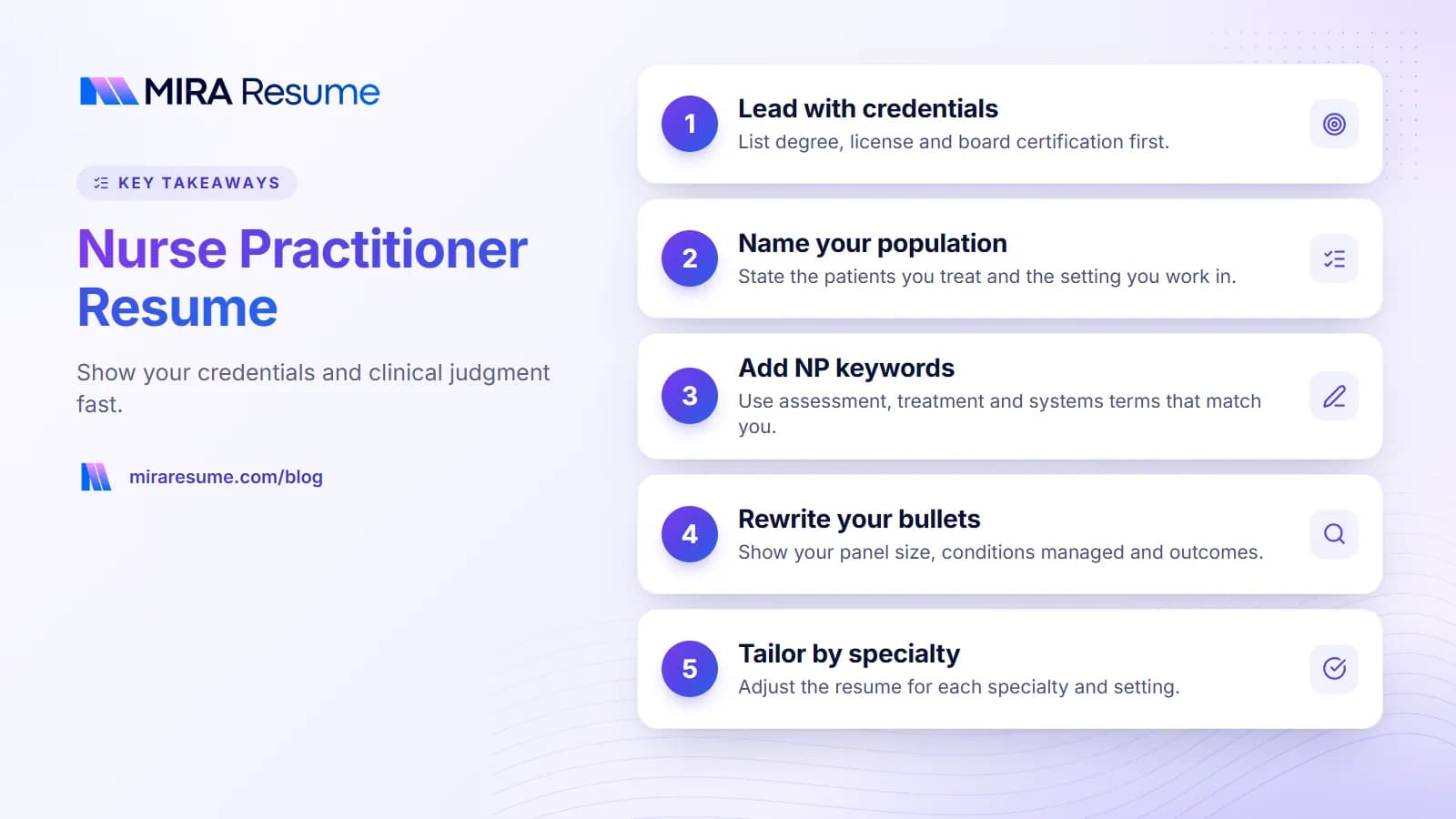
- Credentials up front. Degree (MSN or DNP), state license, national board certification, and prescriptive authority where your state requires a separate listing.
- Population focus. Family, adult-gerontology, pediatrics, women's health, psychiatric-mental health, acute care, or another focus.
- Setting. Primary care clinic, urgent care, hospital, specialty practice, telehealth, or long-term care.
- Clinical scope. Visit volume, conditions managed, procedures, and how you work with physicians or run your own panel.
- Outcomes and quality work. Screening rates, follow-up systems, or patient education programs, only where you can state them truthfully.
Scope of practice for NPs differs by state, so describe tasks you were actually authorized to do, and check your state's rules for how to list authority.
Nurse practitioner resume skills and keywords
Choose only those that match your training and the posting. Posting words matter because many employers use applicant tracking systems that search for them. Our resume keywords guide explains how to find them.
| Area | Keywords to consider | Where to place them |
|---|---|---|
| Credentials | FNP-BC, AGPCNP-BC, PMHNP-BC, ACNP-BC, APRN, DEA registration, state license | Header line and Licenses section |
| Assessment | Comprehensive health assessment, differential diagnosis, physical exams, risk screening, history taking | Skills and bullets |
| Treatment | Prescribing, treatment plans, chronic disease management, medication reconciliation, care coordination | Bullets |
| Procedures | Suturing, joint injections, skin biopsy, IUD insertion, point-of-care testing (list only those you do) | Skills list |
| Systems | EHR names such as Epic or Cerner, e-prescribing, telehealth platforms, patient portals | Skills list |
| Quality and teaching | Evidence-based practice, patient education, preceptor, quality improvement, HIPAA | Bullets and summary |
Some certification letters differ by organization and population. Write yours exactly as it appears on your certificate.
Nurse practitioner resume example: section by section
The person below is invented. Copy the structure, not the facts.
1. Header
Taylor Brooks, DNP, FNP-BC
City, State | 555-555-0100 | [email protected]
2. Summary (2 to 3 lines)
Board-certified family nurse practitioner with [number] years in outpatient primary care. Manages adult and pediatric patients with chronic and acute conditions. Strong in preventive care and patient education.
3. Licenses and certifications
APRN, State Board of Nursing, license number and expiry as required
FNP-BC, certifying organization, year
DEA registration (where applicable), BLS
4. Experience
Family Nurse Practitioner, Example Community Health Center, City, State, 2021 - Present
- Managed a panel of about [number] patients, from newborns to older adults
- Diagnosed and treated common acute and chronic conditions, including [conditions]
- Performed [procedures you do] in clinic
- Helped build a reminder system to improve follow-up on abnormal results
5. Education
Doctor of Nursing Practice, Example University, 2021
Bachelor of Science in Nursing, Example College, 2015
6. Clinical training (for new NPs)
List rotation sites, population types, and hours if you know them. Keep everything on one or two pages. Our guide on how many pages a resume should be explains when a second page is fair.
Nurse practitioner resume bullets: before and after
Good bullets name the action, the patient group, and the result. Replace the [placeholders] with your own facts. If you do not know a number, leave it out.
| Weak bullet | Stronger bullet |
|---|---|
| Saw patients | Evaluated and treated about [number] patients per week in a primary care clinic, developing treatment plans for acute and chronic conditions |
| Managed diabetes patients | Managed diabetes care for a panel of [number] adults, adjusting medicines and coaching on diet, which supported steadier follow-up visits |
| Prescribed medications | Prescribed and monitored medications within state authority, reviewing interactions and counseling patients on safe use |
| Worked with doctors | Collaborated with [number] physicians and a medical assistant team to refer complex cases and coordinate specialist care |
| Did patient education | Taught patients and families about asthma action plans and medicine use, using teach-back to confirm understanding |
| Precepted students | Precepted [number] nurse practitioner students per year, reviewing their notes and giving weekly feedback |
Need other verbs? See action verbs for resume bullets.
What to measure
- Panel size, patients per day or week
- Types of conditions and ages treated
- Procedures performed
- Quality project results, only if you tracked them
New graduate NP vs. experienced NP
| Part of resume | New graduate NP | Experienced NP |
|---|---|---|
| Order | Credentials, then clinical training, then prior RN work | Credentials, then NP experience, then RN history in brief |
| Summary focus | Population, certification, training sites | Years, setting, panel size, strengths |
| Bullets | Rotation tasks, cases handled, supervised procedures | Independent practice, outcomes, mentoring |
| RN experience | Keep it detailed. It shows real patient time | Compress to one or two lines |
| Length | One page | One to two pages |
New graduates: use your RN years
Your time as an RN matters. A new NP who worked in cardiac care, for example, can show a strong base for a cardiology role. Describe it with detail. Our new grad nurse resume guide has ideas for showing clinical training.
Experienced NPs: show trust
Show growth such as leading a clinic team, becoming a preceptor, or taking on a quality project. For help showing growth within one employer, see how to show a promotion on a resume.
Nurse practitioner CV example: resume or CV?
Many NPs wonder which to use. In the United States, most clinical job applications use a resume. A CV is longer and includes research, publications, teaching, presentations, and committee work. It is more common in academic and some hospital roles.
| Choose a resume when | Choose a CV when |
|---|---|
| Applying to clinics, urgent care, or private practice | Applying to a university or teaching role |
| The posting asks for a resume | The posting asks for a CV |
| Your experience is mostly clinical | You have papers, posters, or grants |
| You want one or two pages | A longer record helps your case |
If a CV is required, add sections for Publications, Presentations, Teaching, and Professional Memberships. Our guide on CV vs resume explains the differences. When unsure, follow the posting.
Licenses, certifications, and education on an NP resume
Requirements differ by state and employer, so check your state board and the posting before you list anything. In many states an NP needs an RN license, an APRN license or recognition, and national board certification. Prescriptive authority and DEA registration may be handled separately.
How to list them
- Write the full credential name first, then the issuing body, then the year or expiry.
- List the state where you hold each license. If you hold a multistate license, say so if it is accurate.
- Show your highest degree first: DNP or MSN, then BSN.
- Add BLS, ACLS, or PALS only if you hold them and they are current.
If a certification is pending, write "Exam scheduled for month, year" and be accurate. Never list a credential you do not hold. Our guide to listing certifications on a resume shows layouts.
Tailor your NP resume by specialty and setting
An NP resume for a pediatric clinic should not read like one for a psychiatric practice. Use the posting to decide what comes first.
| Specialty or setting | What to emphasize |
|---|---|
| Family or primary care | Wide age range, preventive care, chronic disease follow-up, panel size, continuity of care |
| Adult-gerontology | Complex medicine lists, falls and cognition screening, care for older adults, working with families |
| Pediatrics | Well-child visits, growth and development checks, vaccine counseling, talking with parents |
| Psychiatric-mental health | Assessments, therapy and medicine management, safety planning, telehealth sessions |
| Acute care or hospital | Rounding, procedures, admissions and discharges, working with specialists |
| Urgent care | Fast assessment, minor procedures, triage decisions, volume per shift |
| Telehealth | Virtual visits, platforms you used, how you handled exams remotely, follow-up systems |
Say how you work with others
Some states let NPs practice on their own, and others require agreements with a physician. Describe your actual arrangement in plain terms, such as "collaborated with two physicians on complex cases" or "ran an independent panel." Do not claim more or less than the facts.
Show leadership without a manager title
NPs often lead without being managers. Mention precepting, teaching, committee work, or quality projects. A short line such as "Led a project to improve follow-up on abnormal lab results" tells a manager you think beyond your own schedule, as long as it is true.
Keep a master version
Save one full version with every setting, procedure, and project. For each application, copy it and cut what does not help. The resume summary examples guide helps you rewrite your opening each time.
Common nurse practitioner resume mistakes
- Burying credentials. Put them in the header and a licenses section.
- Writing like an RN. NP bullets should show diagnosis, prescribing, and treatment planning, not only care tasks.
- Listing duties only. "Responsible for patient care" says little. Add population, volume, and results.
- Sharing patient details. Never include names or identifiable information.
- Going beyond your scope. List only what you were trained and authorized to do.
- Using a complex template. Columns, icons, and text boxes can scramble in applicant tracking systems. See how ATS works.
- Skipping the posting. If it asks for a specific EHR or telehealth platform and you have used it, say so.
Check and finish your NP resume
- Highlight the credentials, population, and systems named in the job post.
- Update your header, summary, and skills to match what is true for you.
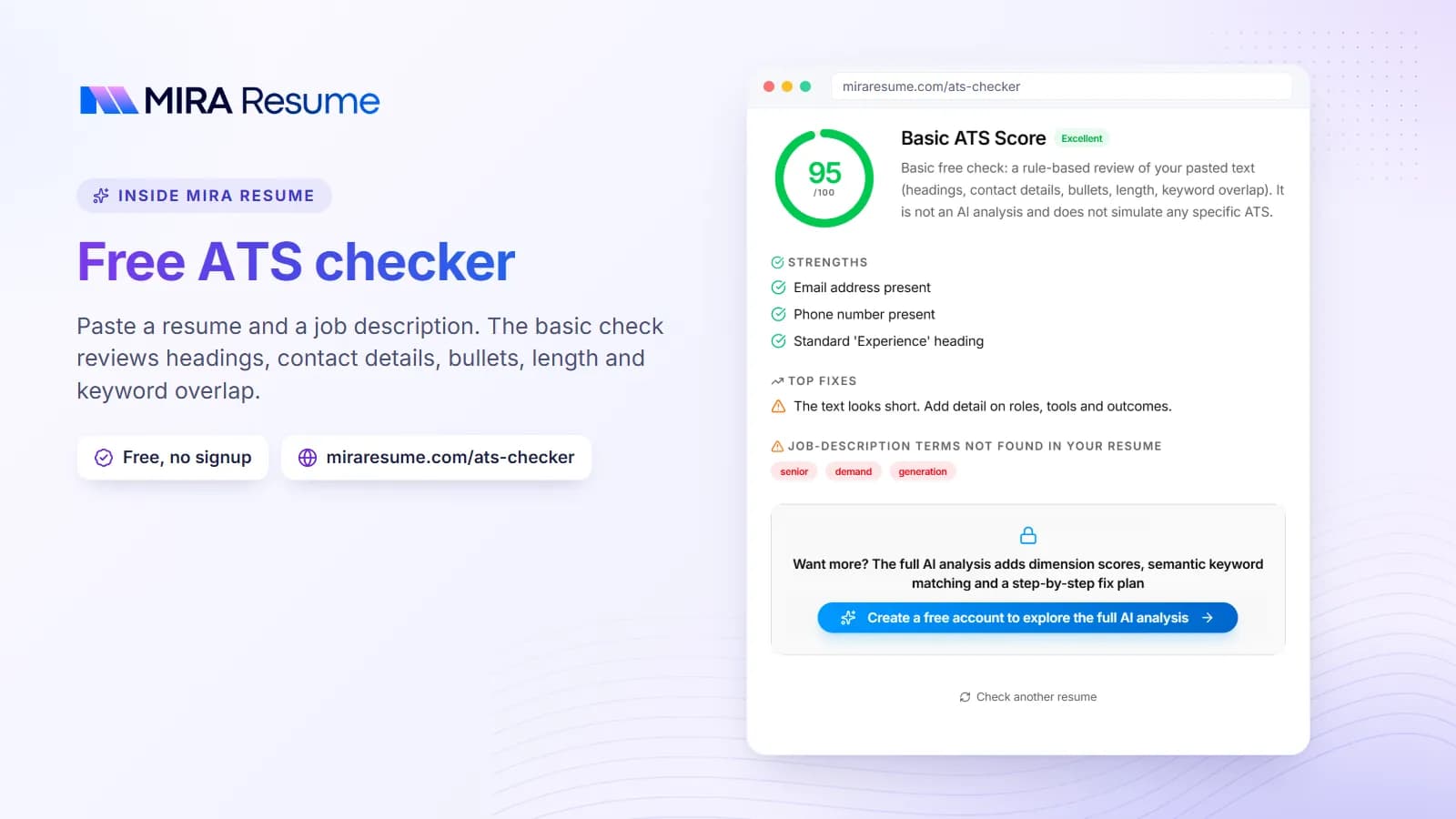
- Run your file through the ATS checker with the posting pasted in to see missing keywords and layout problems.
- Fix what fits your real experience and save the file as a PDF with a clear name.
If you want a clean starting layout, the AI resume builder can set up sections while you add your own details. Also see our nurse resume template guide for formatting ideas.