
An engineer resume has one job: show a hiring manager, fast, what you built, how you built it and what changed because of it. Engineers often write long lists of tools and duties. Readers want projects, numbers and clear scope instead.
This guide works for civil, mechanical, electrical, chemical and general engineering roles. You will get a simple layout, a skills table, bullet rewrites you can copy, and notes for students and experienced engineers. Software roles have their own guide, so see our software developer resume page for that.
What an engineering resume should look like
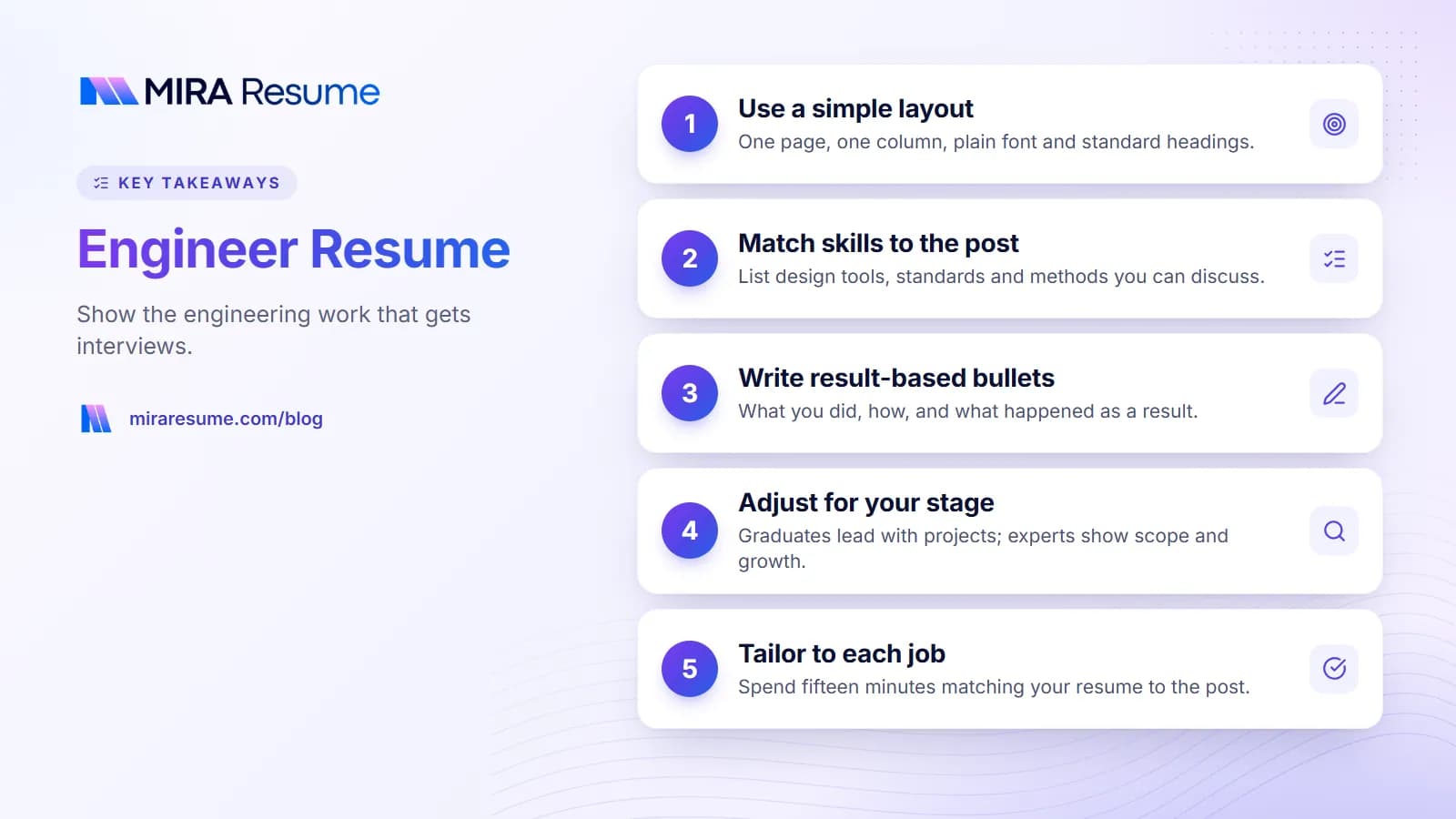
Keep it to one page if you have under ten years of experience. Use one column, a plain font and standard headings. Applicant tracking systems (ATS) read plain text best, so skip text boxes, icons and skill bars. You can check how your file reads with our ATS checker.
Engineers are hired for judgment, not decoration. Put your best project or role near the top and cut anything that does not help the job you want.
The section order that works
- Name, city, phone, email, LinkedIn link
- Short summary (two or three lines)
- Technical skills
- Experience or projects
- Education, licenses and certifications
Students and new graduates can put education above experience. Everyone else should lead with work. If you are not sure about margins and fonts, read how to format a resume.
Sample layout
[Your Name]
[City, State] | [Phone] | [Email] | [LinkedIn URL]
Summary
[Discipline] engineer with [X] years in [industry]. Strong in [two core skills]. Delivered [type of project] for [type of client or team].
Technical Skills
[Software], [Standards or codes], [Methods], [Lab or field tools]
Experience
[Job Title], [Company], [Dates]
- [Action verb] [what you did] to [result with a number]
Key skills and keywords for an engineer resume
Read the job post first. Match its exact words where they are true for you. The table below shows common groups. Pick only the ones you can discuss in an interview.
| Type | Examples | Where to show it |
|---|---|---|
| Design software | AutoCAD, SolidWorks, Revit, MATLAB | Skills list and project bullets |
| Analysis methods | Finite element analysis, load calculations, root cause analysis | Experience bullets |
| Standards and codes | ASME, IEEE, ISO, local building codes | Skills list (name the ones you used) |
| Project work | Scheduling, cost control, vendor coordination, site visits | Experience bullets |
| Quality and safety | Testing, inspections, documentation, safety reviews | Experience bullets |
| People skills | Client updates, team lead, technical writing | Summary and bullets |
For help balancing tools and soft skills, see good skills to put on a resume and our guide to hard skills examples.
Civil, mechanical and electrical differences
- Civil: mention codes, site work, drawings, permits and project size. A civil engineer resume often shows budget scope and inspection work.
- Mechanical: mention CAD, tolerances, testing, manufacturing and design reviews.
- Electrical: mention circuits, controls, schematics, testing equipment and safety standards.
Use the words your branch uses. A reader in your field spots filler right away.
How to write engineer resume bullets
Each bullet should hold three parts: what you did, how you did it, and what happened. A number helps, but only use real numbers. If you do not have one, describe the scope instead, such as the size of the team, the number of drawings or the type of site.
Start with a strong verb. Our list of action verbs for a resume has plenty of options. For a repeatable method, the STAR method for resumes is a good fit for engineering stories.
Before and after examples
| Weak bullet | Stronger bullet (replace the brackets) |
|---|---|
| Responsible for design work | Designed [component or system] using [software], cutting [cost, weight or build time] by [number] on [project] |
| Worked on testing | Ran [type of test] on [number] units, found [issue], and changed [part or process] to fix it |
| Helped manage projects | Coordinated [number] contractors on a [budget size] [project type], finishing [on time or X days early] |
| Did site inspections | Inspected [number] sites per [month or quarter] and logged findings in [system], reducing rework on [project] |
| Wrote reports | Wrote [type of report] for [client or team] that led to [decision or approval] |
These are templates, not facts. Fill them only with work you actually did.
Entry-level engineer resume vs experienced engineer resume
New graduates have less work history, so projects carry more weight. Experienced engineers need to show growth and scope. The table compares the two.
| Part | Entry-level | Experienced |
|---|---|---|
| Length | One page | One page, two if you have 10+ years of strong projects |
| Top section | Education, then projects | Summary, then work history |
| Main proof | Capstone, labs, internships, competitions | Delivered projects, budgets, team size |
| Summary | Optional, one or two lines | Two or three lines with scope and specialty |
| Skills | Software and lab skills from school | Tools plus standards and leadership |
Entry-level example bullets
- Led a [number]-person capstone team to design [product] that met [requirement]
- Built a [model or prototype] in [software] and tested it against [standard or target]
- Completed a [length] internship at [company], supporting [type of work]
Experienced example bullets
- Managed design of [project type] valued at [amount you can share], coordinating [number] teams
- Mentored [number] junior engineers and reviewed their [drawings, calculations or code]
- Introduced [process change] that saved [hours or cost] per [period]
If you are just starting out, our entry-level resume examples and internship resume guide help you present school work well.
Education, licenses and certifications
List your degree, school and graduation year. Add honors if they are real and relevant. Then list licenses and certifications that matter to the job.
- Fundamentals of Engineering (FE) exam passed, or Engineer in Training status, if you hold it
- Professional Engineer (PE) license, with state and license number if the employer asks
- Project management, safety or software certificates tied to your work
Licensing rules differ by state, country and employer. Check your state board and the job post to see what is required for the role you want. Do not list a license you do not hold, and write "in progress" with a date if you are still working toward one. For formatting help, see how to list certifications on a resume.
A short summary you can copy
A summary is optional but useful when you want to point the reader at your specialty. Keep it to three lines and avoid empty words such as "hard-working".
[Discipline] engineer with [X] years of experience in [industry]. Skilled in [software or method] and [second skill]. Delivered [type of project] on [budget or timeline] for [client type].
Recent [degree] graduate with [internship or capstone experience]. Comfortable with [software] and [method]. Looking for an entry-level [discipline] engineering role in [industry].
More options are in our resume summary examples.
A full engineer resume example you can adapt
Here is a complete sample written for a mechanical engineer. It is illustrative: the names, tools and numbers are placeholders. Swap in your own facts and delete any line that is not true for you.
[Your Name]
[City, State] | [Phone] | [Email]
Summary
Mechanical engineer with [X] years in product design and testing. Works in [CAD software] and [analysis tool]. Known for turning customer feedback into clear design changes.
Technical Skills
[CAD software], [analysis tool], GD&T, test planning, root cause analysis, technical writing
Experience
[Job Title], [Company] | [City] | [Month Year] to Present
- Designed [part or assembly] in [CAD software] for [product line], reducing [cost, weight or part count] by [number]
- Planned and ran [number] design tests, then wrote results for the [team or client]
- Worked with [number] suppliers to fix [issue], cutting delays on [project]
Education
B.S. Mechanical Engineering, [University], [Year]
Certifications
[Certification name], [Year] (check your state or employer for any license rules)
Notice what the sample does. Each bullet names a task, a tool and a result. The skills line is short. Nothing in it needs a second page.
How to tailor your resume to one engineering job post
A generic resume gets a generic response. Tailoring takes about fifteen minutes and is worth it for jobs you really want. Follow these steps.
- Copy the job post into a document and highlight the tools, methods and results it names.
- Check which of those you have used. Be honest. If you have used a close match, name the real tool you used.
- Move the best match to the top of your skills line and your first bullet under each job.
- Reuse the post's own wording for skills, such as "finite element analysis" or "site inspections", so an ATS finds the match.
- Cut one or two bullets that have nothing to do with this role.
- Read the page out loud. If a line sounds like a task list, add the result.
Our AI resume builder can help you reword bullets, and you stay in control of every line. Always read AI suggestions and remove anything that is not true. For a deeper look at how job posts and scanners connect, read how ATS works.
What to do about career gaps or a job change
If you left the field for a while or you are moving from one branch of engineering to another, say so plainly in your summary and show the skills that carry over, like design reviews, site safety or technical writing. See resume with gaps in employment for wording ideas.
Common engineer resume mistakes
- Listing duties, not results. "Responsible for CAD drawings" says little. Show what the drawings led to.
- Tool dumps. A list of forty programs hides the three that matter. Keep what the job post asks for.
- Vague scope. Add size: budget range, units, team size, site count, or system type.
- Too much design. Columns, graphics and photos can break ATS reading. Plain wins.
- Old software first. Put current tools at the front of your skills line.
- Typos in technical terms. Proofread standards, tool names and units twice.
- One resume for every job. Change the top third for each role. See resume keywords for how to match a post.
If your draft feels messy, try our resume checker for a quick review before you apply.
How to build and save your resume
Start with a clean template, fill in the sections above, and trim until it fits one page. Save as a PDF so your layout stays fixed. Name the file clearly, such as [FirstName]-[LastName]-Engineer-Resume.pdf.
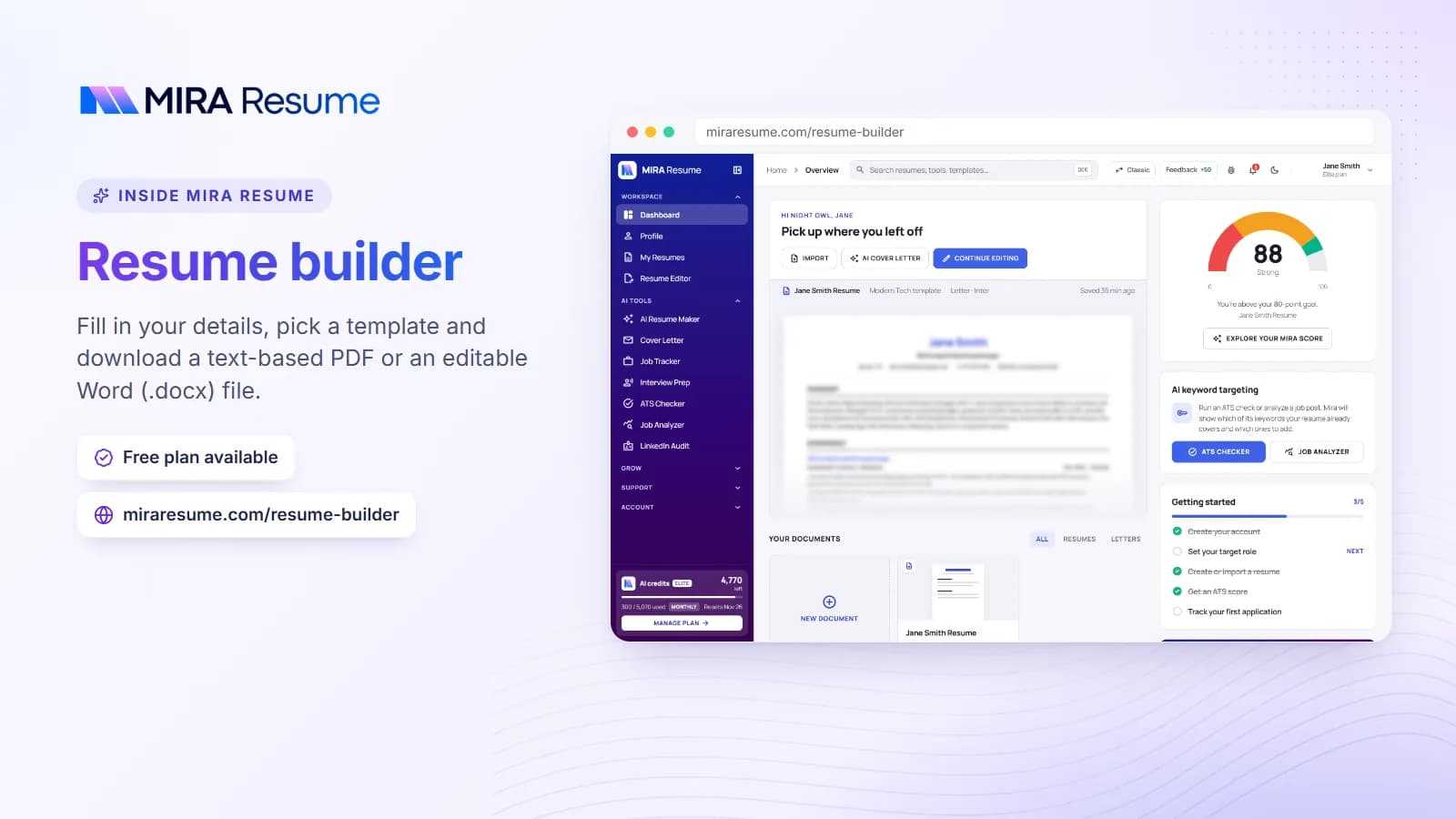
Our resume builder gives you ATS-friendly templates you can edit and download as a PDF. Browse the resume templates or see resume examples for other fields. If you are managing builds and teams, our project manager resume guide may also help.