
A strong construction project manager resume is built around your projects. Owners and general contractors want to know what you built, how big it was, who you managed, and whether you kept it on budget, on schedule, and safe. A list of duties will not tell them that.
This guide gives you a layout, a project table you can adapt, a skills list, and bullet rewrites. It is different from a general project manager resume because construction hiring focuses on field work, subcontractors, drawings, and safety.
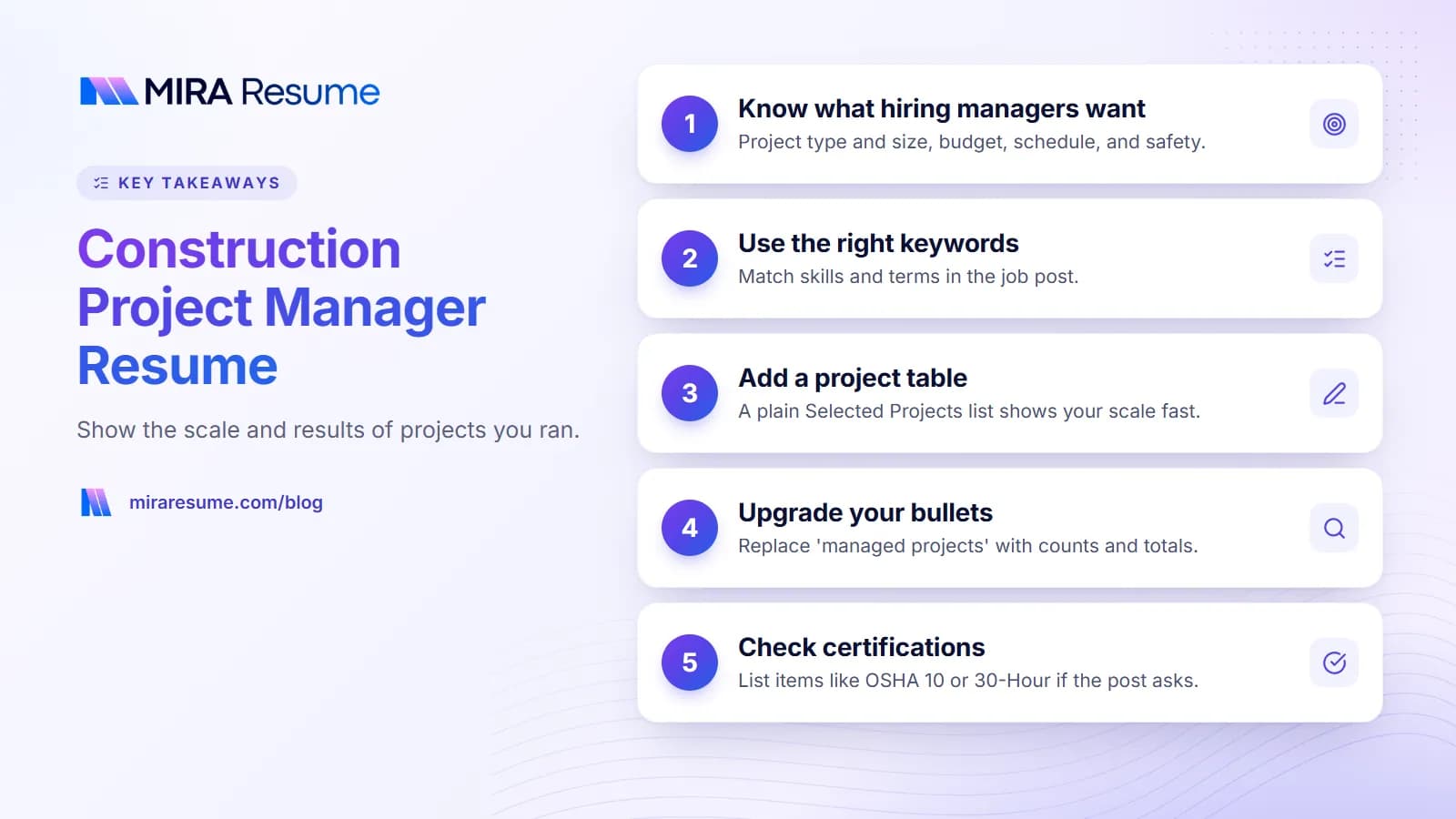
What construction hiring managers look for
Construction hiring is project-based, so your resume should read like a list of finished work.
- Project type. Commercial, residential, industrial, healthcare, civil, or renovation.
- Project size. Contract value, square footage, floors, or length of the schedule.
- Your role. Assistant PM, project engineer, PM, or senior PM, and how many projects you ran at once.
- Control of money and time. Budgets, change orders, cost tracking, and schedules.
- People. Subcontractors, superintendents, owners, architects, and inspectors.
- Safety and quality. Safety record, site audits, and punch list close-out.
Figures should come from real records. If a project value is confidential, use a range or describe the size by area or scope.
Construction project manager skills and keywords
Choose the ones that match your experience and the job post. Many large contractors use applicant tracking systems, so job post words matter. See resume keywords.
| Area | Keywords to consider | Placement |
|---|---|---|
| Cost control | Budgeting, cost tracking, change orders, bid review, estimating, cash flow, billing, lien waivers | Bullets |
| Scheduling | Critical path, look-ahead schedules, Primavera P6, MS Project, milestone tracking, delay recovery | Skills and bullets |
| Contracts and documents | Subcontracts, RFIs, submittals, drawings, specifications, close-out documents, permits | Bullets |
| Field coordination | Subcontractor management, site meetings, inspections, punch lists, quality control | Bullets |
| Safety | OSHA 30, site safety plans, toolbox talks, incident reporting, safety audits | Certifications and bullets |
| Software | Procore, Bluebeam, AutoCAD (viewing), Excel, Autodesk Construction Cloud, BIM coordination (only if used) | Skills list |
| People | Owner communication, conflict resolution, team leadership, mentoring | Summary and bullets |
Construction project manager resume example
This construction project manager resume sample uses an invented person. Swap in your own details, and use placeholders for anything you do not know.
Chris Walker
City, State | 555-555-0100 | [email protected]Summary
Project manager with [number] years in commercial construction. Delivers mid-size projects from preconstruction through close-out, with a focus on cost control, subcontractor coordination, and site safety.Skills
Procore | Primavera P6 | Budget tracking | Change orders | Subcontractor management | RFIs and submittals | OSHA 30Experience
Project Manager, Example Builders, City, State, 2021 - Present
- Managed [number] commercial projects at a time, ranging from [dollar range] each
- Tracked costs and change orders in Procore and reported to owners monthly
- Led weekly meetings with [number] subcontractors and updated look-ahead schedules
- Closed out projects with complete punch lists and turnover documentsAssistant Project Manager, Example Construction Co., City, State, 2018 - 2021
- Processed RFIs and submittals, kept drawing sets current, and tracked pay applicationsCertifications and Education
OSHA 30-Hour Construction, year
Bachelor of Science in Construction Management, Example University, 2018
See more formats in our resume examples.
A project table to show your scale
Construction managers often add a "Selected Projects" section. It lets readers see scope fast. Use a simple table or a short list. Keep it plain, since applicant tracking systems handle simple text best.
| Project (illustrative) | Type | Size | Your role and result |
|---|---|---|---|
| Example Medical Office Building | Healthcare, new build | [square feet], [contract value] | PM: ran budget, schedule, and owner reports through close-out |
| Example Retail Fit-Out | Tenant improvement | [square feet], [number] weeks | PM: coordinated [number] trades, finished by the opening date |
| Example School Renovation | Renovation, occupied site | [number] phases | Assistant PM: managed submittals, RFIs, and safety logs |
Rules for this section
- Only list projects you worked on, and describe your actual role.
- Do not share client names if your contract bars it. Use a general description.
- Keep it to three to six projects. Place it after your experience.
Construction project manager bullets: before and after
Replace [placeholders] with your real facts or drop numbers you cannot support.
| Weak bullet | Stronger bullet |
|---|---|
| Managed projects | Managed [number] commercial projects totaling [dollar amount], from preconstruction through turnover |
| Controlled budgets | Tracked job costs weekly and flagged overruns early, keeping [number] of [number] projects within budget |
| Handled schedules | Updated look-ahead schedules with subcontractors each week and re-sequenced trades to recover [number] days after a delay |
| Worked with subs | Coordinated [number] subcontractors on site, resolving conflicts between trades and keeping inspections on schedule |
| Safety | Ran weekly toolbox talks and site walks, closing safety findings within [timeframe] and supporting a record of [number] lost-time incidents |
| Owner communication | Sent monthly progress reports to owners and led change-order talks, explaining cost and schedule effects in plain language |
For more starter words, see action verbs for resume bullets. Only include safety numbers if your records show them.
Assistant PM vs. experienced construction PM
| Part of resume | Assistant PM or project engineer | Experienced PM |
|---|---|---|
| Summary | Education, internships, tools, and eagerness to run a site | Project types, size range, and results |
| Bullets | RFIs, submittals, document control, field support | Budget ownership, owner relations, subcontractor decisions |
| Safety | OSHA 10 or 30, site logs | OSHA 30, safety leadership |
| Software | Procore, Bluebeam, Excel | Add scheduling, estimating, and cost tools |
| Length | One page | One to two pages |
Coming from the field
If you were a carpenter, foreman, or superintendent, your site knowledge is a real advantage. Show that you can read drawings, manage crews, and track costs. Add any office skills, such as Procore or Excel, and ask what training you will need. See skills-based resume for how to lead with skills when your title changes.
Coming from another kind of project management
Show the overlap: budgets, schedules, and stakeholder communication, but be honest about what you do not know yet. Our project manager resume page covers the general approach.
Certifications, licenses, and education to check
What employers expect depends on your region, project type, and the employer. Check each job post and your local rules.
- OSHA 10 or 30-Hour: common for site roles. List the card type and year.
- PMP or CAPM: Project Management Institute credentials, helpful at some companies. List only if you hold them.
- Construction management credentials: programs from industry groups, listed by their official names.
- Contractor or PE licenses: where required, list type, state, and number as needed.
- LEED or other green credentials: if you hold them and the job values them.
- Degree: construction management, engineering, or related. If you came up through the trades, say so with pride and list training courses.
Never list a license or credential you do not hold. For layout help, see how to list certifications on a resume.
Tailor your resume to the type of construction work
A general contractor, a homebuilder, and an industrial firm all hire project managers, but they care about different proof. Read the post and adjust what comes first.
| Sector | What they care about | What to emphasize |
|---|---|---|
| Commercial | Large budgets, many trades, owner reporting | Contract values, subcontractor coordination, close-out |
| Residential or homebuilding | Volume, schedules, buyer expectations | Number of homes, schedule control, quality checks |
| Industrial | Safety, shutdown windows, technical detail | Safety systems, permits, tight outage schedules |
| Civil and infrastructure | Public contracts, compliance, long schedules | Regulatory knowledge, quantities, inspections |
| Renovation and tenant work | Fast turns, occupied spaces | Phasing, communication with building users |
| Owner's representative | Oversight and budget protection | Reviewing bids, pay apps, and contractor performance |
Preconstruction and estimating
If you reviewed bids, built estimates, or ran bid leveling, say so, because it shows you understand the cost side. Describe it with the size of the work, such as the number of bid packages, and say who relied on it.
Use words from the post
If the job names "ground-up," "tenant improvement," or "design-build," and you did those jobs, use the same words. Applicant tracking systems and recruiters both look for these terms. Never claim project types you have not worked on.
Show you handle problems
Construction rarely goes to plan. A bullet that shows how you handled a delay, a design change, or a weather loss tells a hiring manager more than "excellent problem solver." Keep it factual: what happened, what you did, what the outcome was.
Common construction project manager resume mistakes
- No project numbers. Contract values, square feet, or schedule length give readers scale.
- Taking credit for the team. Say what you personally managed and what the team did.
- Skipping safety. Employers in construction look for it.
- Too many software names. List what you actually use.
- Long project descriptions. Keep each bullet to one or two lines.
- Revealing private client data. Respect contracts and use general descriptions.
- Complicated formatting. Columns, icons, and photos can break in applicant tracking systems. See how ATS works.
Final check before you apply
- Read the job post for project type, size, tools, and certifications.
- Move your most similar projects to the top of your experience.
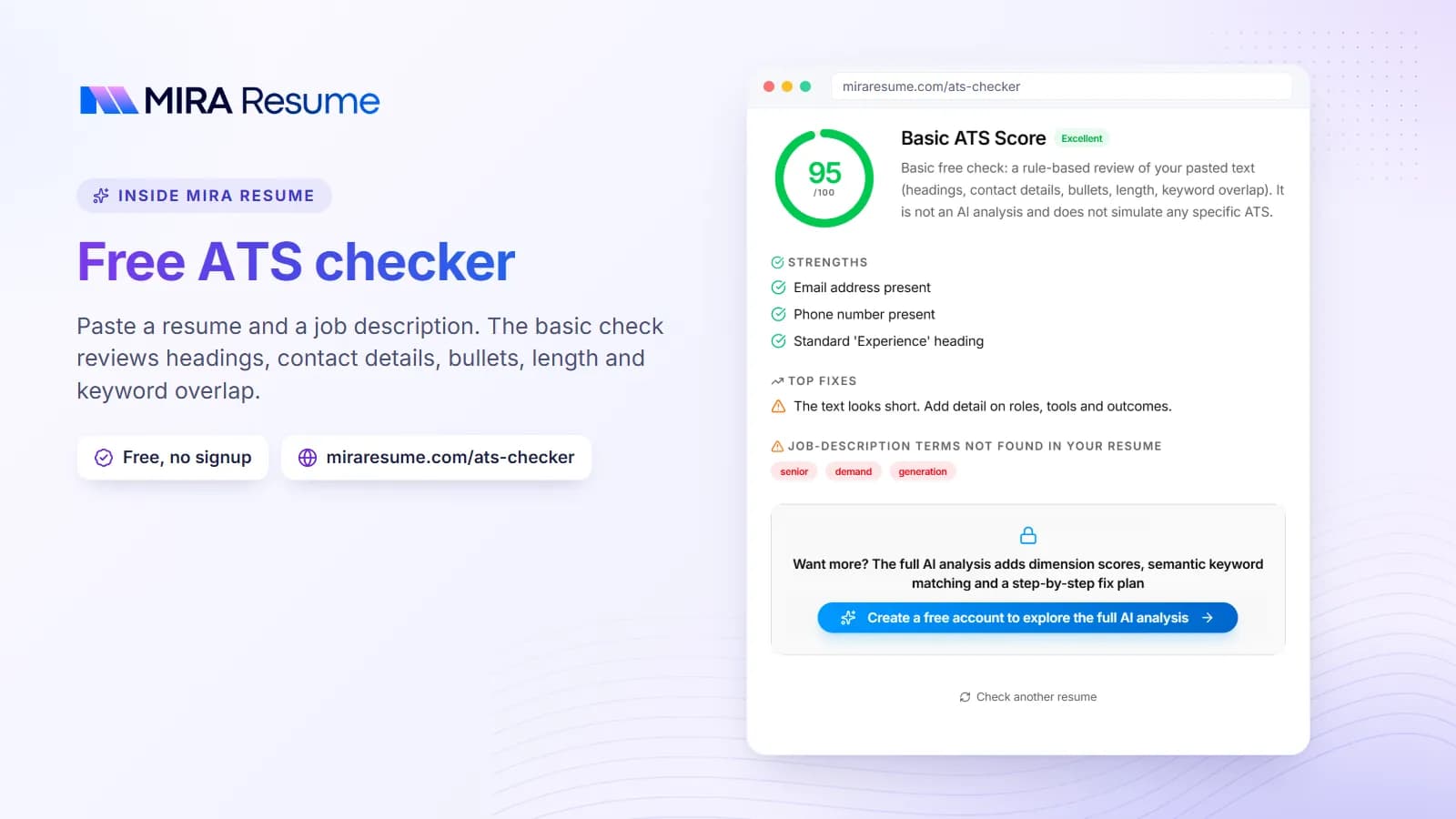
- Upload your resume to the ATS checker with the post pasted in to see missing keywords and layout issues.
- Save a PDF and read it for accuracy, especially numbers, dates, and project names.
The AI resume builder can help you set up a clean format, and you add your own projects and results.
Keep your numbers consistent
Your resume, your online profile, and your interview answers should tell the same story. If the resume says you managed projects worth a certain amount, your profile should not say something different. Round numbers fairly, state the period they cover, and use the same project names each time. Small mismatches make readers doubt the rest. If you are unsure of an exact figure, check your old reports or ask a former colleague, and use a safe range instead of a guess.
Be ready for the interview stage
Expect questions about your projects, so be ready to explain every number on the page. Think of one project that went well, one that went wrong, and what you learned from each. Have a short list of references from owners, superintendents, or senior managers who saw your work firsthand. Ask them first, and tell them which job you are applying for. A resume opens the door, and clear, honest answers about real projects finish the job. Update your master copy after every project closes, while the details are fresh, so you never have to rebuild numbers from memory years later.