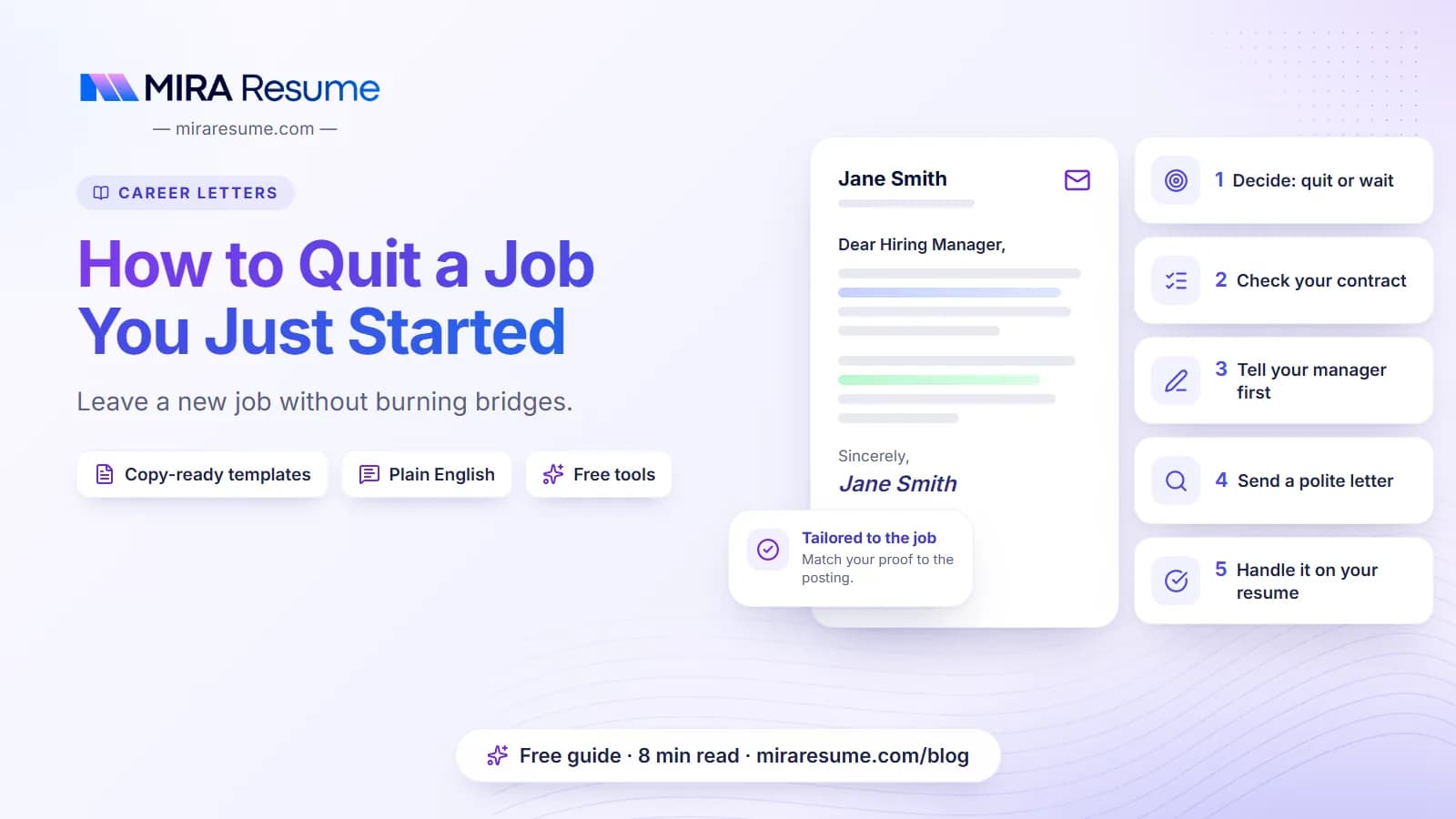

Knowing how to quit a job you just started matters because the first days feel different from the rest. You may have found the role is not what was described. The hours may not fit. The team may feel wrong. Or something outside work may have changed. Whatever the reason, you are not the first, and it is fixable.
Leaving fast is not a crime, but how you do it still counts. A calm, kind exit keeps your reputation safe. This guide covers how to decide, how to talk to your manager, what to write, how much notice to give, and how to handle the short job on your resume.
For the standard process, read how to resign from a job. For wording, see the resignation letter samples.
This is general guidance, not legal advice. Check your contract and local labor rules, including any trial period terms.
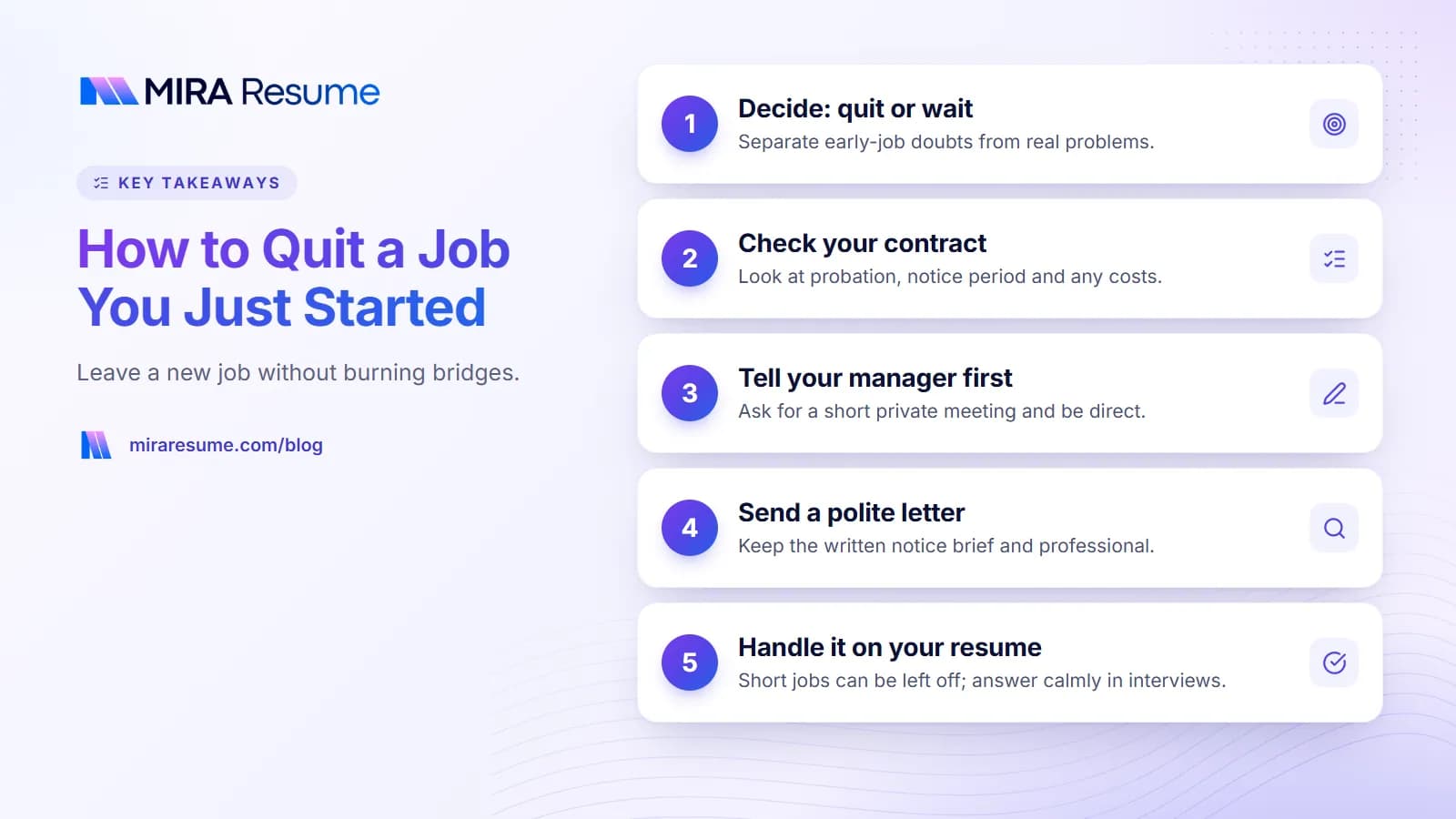
First, decide: quit now or give it time?
New jobs are hard at first. Everything is unfamiliar, so doubts are normal. Before you quit, take a short, honest look.
Reasons that may be worth waiting out
- You feel lost because you are still learning the tools and names.
- Your manager is busy but not unkind.
- You feel nervous but the actual work seems fine.
- The commute or schedule is hard but may improve once you settle in.
Reasons that are serious
- The job is very different from what you were told.
- The pay or hours are different from your offer.
- You face unsafe, unfair or disrespectful treatment.
- The work harms your health.
- A better, serious opportunity has come up and you are sure.
- A family or personal emergency changed your situation.
A simple test
Write down your top three reasons. For each, ask: "Can this be fixed by a conversation?" If yes, talk to your manager first. If no, and it is serious, you have your answer.
| Situation | Try first | Consider quitting if |
|---|---|---|
| Role not as described | Ask your manager to clarify tasks | It stays very different after a conversation |
| Hours or pay differ from the offer | Raise it with HR in writing | They refuse to correct it |
| Poor fit with the team | Give it a few weeks | It affects your health or safety |
| Overwhelmed by learning | Ask for training | No support is offered at all |
| Better offer arrived | Think about long-term fit | You are sure and can act fairly |
Check your contract and trial period first
Before you say a word, read your paperwork. Quitting early can have different rules from quitting after years.
What to look for
- Probation or trial period: some jobs allow shorter notice during this time. Others may have no difference.
- Notice period: the days or weeks you must give. It may be shorter at the start, or the same as for any employee.
- Sign-on bonus or relocation pay: you may need to repay it if you leave early.
- Training costs: some employers ask you to repay paid training if you leave soon.
- Equipment and access: how and when to return items.
Where to find answers
Look at your offer letter, contract, and employee handbook. If something is unclear, you can ask HR for the rule. Ask calmly, such as, "Can you confirm the notice period that applies to me?" If you are worried about legal risk, a local labor office or a legal professional can advise. Rules differ greatly by country and state.
Money matters
Ask when final pay will arrive and how unused time off, if any, is handled. Keep all emails.
| Item | Question to answer |
|---|---|
| Notice | How many days do I owe? |
| Bonus | Do I have to repay anything? |
| Final pay | When and how will it be sent? |
| Benefits | When does cover start and end? |
| Equipment | What must I return, and when? |
What to say when you quit a new job
Honesty with kindness works best. You do not need to share every reason.
Talk to your manager first
Ask for a short private meeting. Say it in the first minute so they are not left guessing.
"Thank you for hiring me and for the time you have spent with me. I have realized this role is not the right fit, and I would like to resign. I want to be fair to you, so I am telling you now. I can work through [date] and help hand over anything I have started."
Choose a reason that is true
- "The role is different from what I expected."
- "The schedule does not work with my family needs."
- "I have an opportunity that I feel I must take."
- "The work is not the right match for my skills and goals."
Avoid lies. A made-up reason can fall apart and hurt your reputation. If you prefer privacy, "It is a personal decision" is enough.
Handle their reaction
Your manager may be surprised, disappointed or even annoyed. They invested in hiring and training you. Stay calm. Say thank you and sorry for the inconvenience once, then focus on the handover.
What to avoid saying
- "This job is terrible."
- "My coworkers are..."
- "I only took it because..."
Even when true, these lines can follow you.
A letter you can use for quitting after a few days or weeks
Here are two short letters. Edit them for your situation.
Standard notice letter
Dear [Manager's Name],
Thank you for the opportunity to join [Company Name] as [Job Title]. After careful thought, I have decided that this role is not the right fit for me, and I am resigning. My last day will be [Date].
I am sorry for the inconvenience and I appreciate the time you and the team have given me. I will finish my open tasks and share notes so that the transition is easy.
Sincerely,
[Your Name]
Short letter for immediate departure
Dear [Manager's Name],
I am resigning from my role as [Job Title], effective [Date]. I am sorry that I cannot continue, and I thank you for the opportunity. Please tell me how to return equipment and how final pay will be handled.
Regards,
[Your Name]
For more details on formats, look at the 2 week notice letter guide and the two weeks notice email guide.
How much notice?
If your contract names a period, follow it. If a trial period allows shorter notice, you may use it, but offering a few extra days shows respect. If you can give a full two weeks, it helps the team, but you do not have to stay in a job that is harming you.
How to handle a short job on your resume
A very short job can raise questions, but it does not ruin your career. Many people have one. What matters is how you handle it.
Should you list it?
- A few days or weeks: many people leave it off, since it adds little. This is a personal choice. If a background check or application asks for all jobs, be honest.
- Two to three months or more: list it, with a short, clear description.
- It left a visible gap: think about whether to list it to avoid an unexplained hole. See our guide on resumes with gaps in employment.
Be honest in applications
Never lie about dates or titles. Leaving a short job off a resume is common, but writing false dates is not okay. If a form asks for a full history, include it.
If you list it, keep it short
Use two or three bullets with real tasks or skills you used. Do not write a long explanation in the resume. Prepare a short answer for interviews.
| Length of job | Common approach |
|---|---|
| Days to a few weeks | Often omitted, but never lie on forms |
| One to three months | List briefly, or explain in the cover letter if it matters |
| Over three months | List normally with key results |
You can edit your resume layout in the resume builder and use the resume summary examples to open with a clear statement of your strengths.
What to say in interviews about leaving quickly
Interviewers may ask, "Why did you leave so soon?" A calm, short, true answer is best.
Good answer pattern
- State the fact in a neutral way.
- Give one honest reason that is about fit, not blame.
- Show what you learned.
- Turn to why this new role suits you.
"The role turned out to be mostly [type of work], while I was hired for [what you were told]. I decided it was fair for both sides to make a quick decision. I learned to ask more detailed questions about daily tasks before I accept an offer, and that is why I am excited about this role."
What to avoid
- Blaming the company or the people.
- Long, emotional explanations.
- Pretending the job did not exist if you list it.
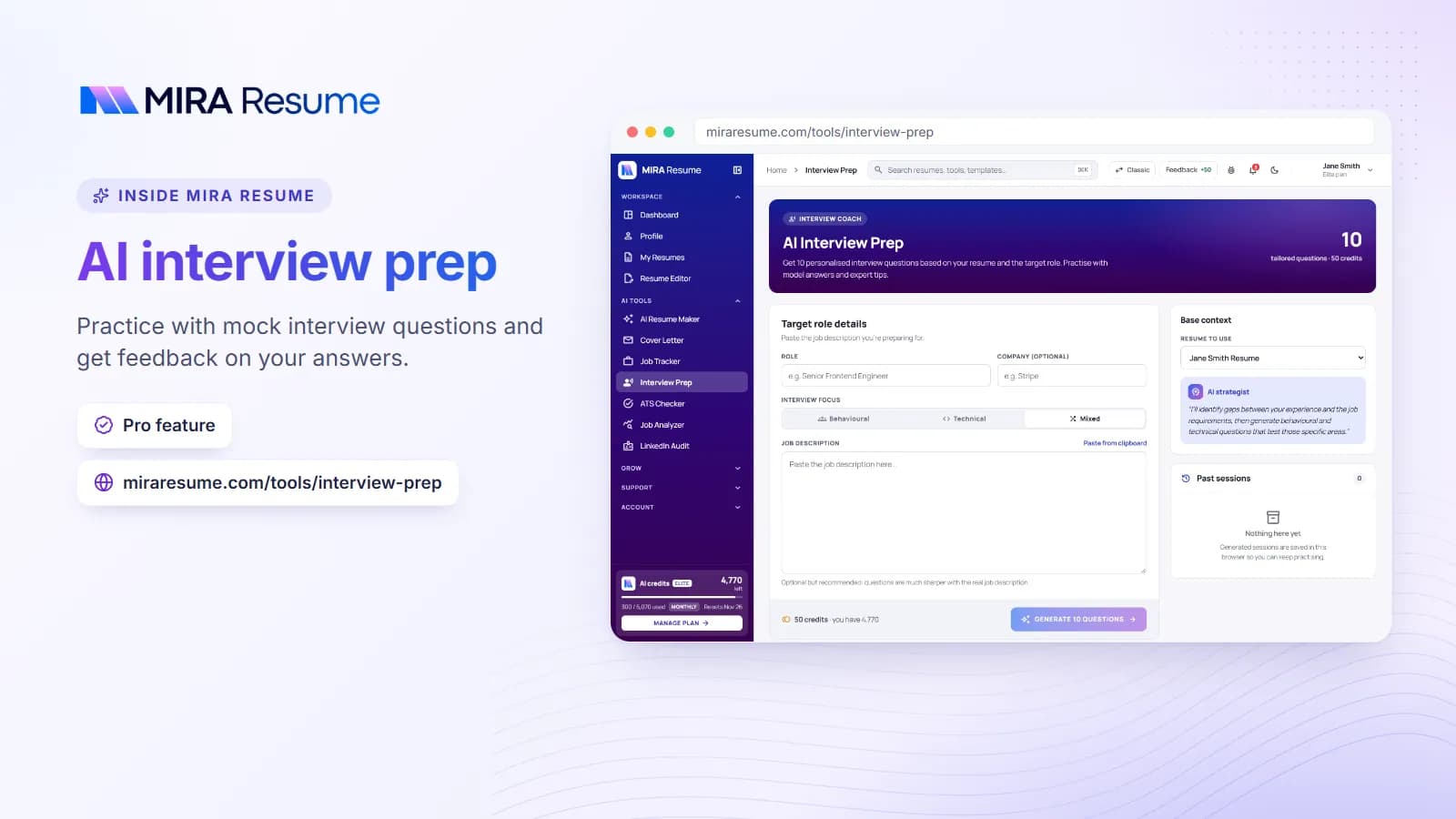
Practice with interview prep until your answer is short and steady. If you need to mention it in writing, our cover letter tool can help you write a brief, positive note.
Learn from it
Write down what you would ask next time: the daily schedule, the main tasks, the success measures and the team structure. Our job tracker keeps notes on each application so you can compare roles side by side.
Common mistakes when quitting a new job
- Ghosting. Not showing up and not saying anything damages your reputation and may break contract terms.
- Quitting by text with no explanation. Even a short, polite email is far better.
- Not checking the contract. You could owe a bonus or training costs.
- Venting online. Posts can be found by future employers.
- Making up a story. Keep to true, short reasons.
- Accepting another offer without thought. Do the same checks you did the first time.
- Taking things that are not yours. Return keys, badges and equipment.
- Not planning money. If you leave without another job, think about your bills and benefits.
Your next steps after you quit
- Confirm final pay and paperwork in writing.
- Update your resume and LinkedIn. The LinkedIn audit helps you check your profile.
- Restart your search with a clear list of what you need.
- Ask earlier employers for references if needed. See references on a resume.
If you already have a better offer in hand
Sometimes a new job is great, but another offer arrives right after you start. This is delicate. Treat it with extra care, because you made a promise to the first employer.
Questions to ask before you switch
- Is the new offer truly better, or just newer and shinier?
- Have you checked the daily work, hours and manager, not only the pay?
- Would you be happy if a new hire left you after two weeks?
- Does your current contract have repayment rules?
How to handle it fairly
- Be honest with your current manager as soon as you decide.
- Offer as much notice as you can without harming the new opportunity.
- Do not use the first employer to bargain with the second unless you truly mean to stay.
- Thank the first employer sincerely. You may meet these people again.
The world of work is smaller than it looks. Being kind and clear on your way out can protect your name for years.